
Introduction: Why a Comprehensive Supply List Matters
Back-to-school shopping feels overwhelming. Parents stare at retail shelves wondering which supplies actually matter. Kids get excited about colorful notebooks they’ll never use. Teachers silently purchase classroom essentials from personal budgets. The result? Wasted money, missing supplies, and preventable stress.
A thoughtful, grade-appropriate supplies list changes everything.
This guide covers every grade level from kindergarten through 12th grade—plus teachers. You’ll find specific, actionable checklists, budget breakdowns, and strategies to shop smart. Whether your student is entering school for the first time or starting a new grade, this resource ensures you buy what actually gets used, when you need it, at the best possible price.
Let’s start building your 2026 back-to-school success.
Understanding Your School’s Requirements
Before you buy a single pencil, check your school’s official supply list.
Most schools publish detailed requirements by grade level, available on their websites or sent home by mail. These lists reflect classroom needs and teacher preferences. A 3rd-grade teacher might request specific pencil types; a 6th-grade science class might need graphing calculators.
Why this matters: Buying unauthorized supplies wastes money and creates classroom disruption. Some teachers ban personal devices; others require them. Understanding these expectations prevents costly mistakes.
Action Step: Contact your school’s main office or check the website for official supply lists before purchasing anything. Note specific brand requirements (like “Ticonderoga #2 pencils” vs. generic pencils).
Common mistake: Assuming all schools want identical supplies. A progressive school emphasizing digital learning needs different tools than a traditional district.
Professional tip: If your school doesn’t publish a detailed list, request one. Most teachers appreciate parent initiative and will provide specific guidance.
Kindergarten & 1st Grade Supply List
Young learners are building foundational skills. Their supplies emphasize durability, safety, and simplicity.
Essential Kindergarten Supplies:
- Backpack (easy zippers, comfortable straps)
- Lunch box with water bottle
- 2–3 changes of clothes (for accidents)
- Crayons (64-count, washable)
- Colored pencils (washable)
- Glue stick (non-toxic)
- Safety scissors (child-safe, rounded blades)
- Drawing paper and coloring books
- Hand sanitizer (sensitive formulas)
- Tissues (2–3 boxes)
- Disinfecting wipes
- Pencil case
1st Grade Additions:
- #2 pencils (12-pack, pre-sharpened)
- Pencil sharpener (manual, plastic)
- Erasers (traditional pencil-top style)
- Notebooks (wide-ruled, large print)
- Folders (bright colors for organization)
- Ruler (12-inch, simple plastic)
- Lunch containers (BPA-free)
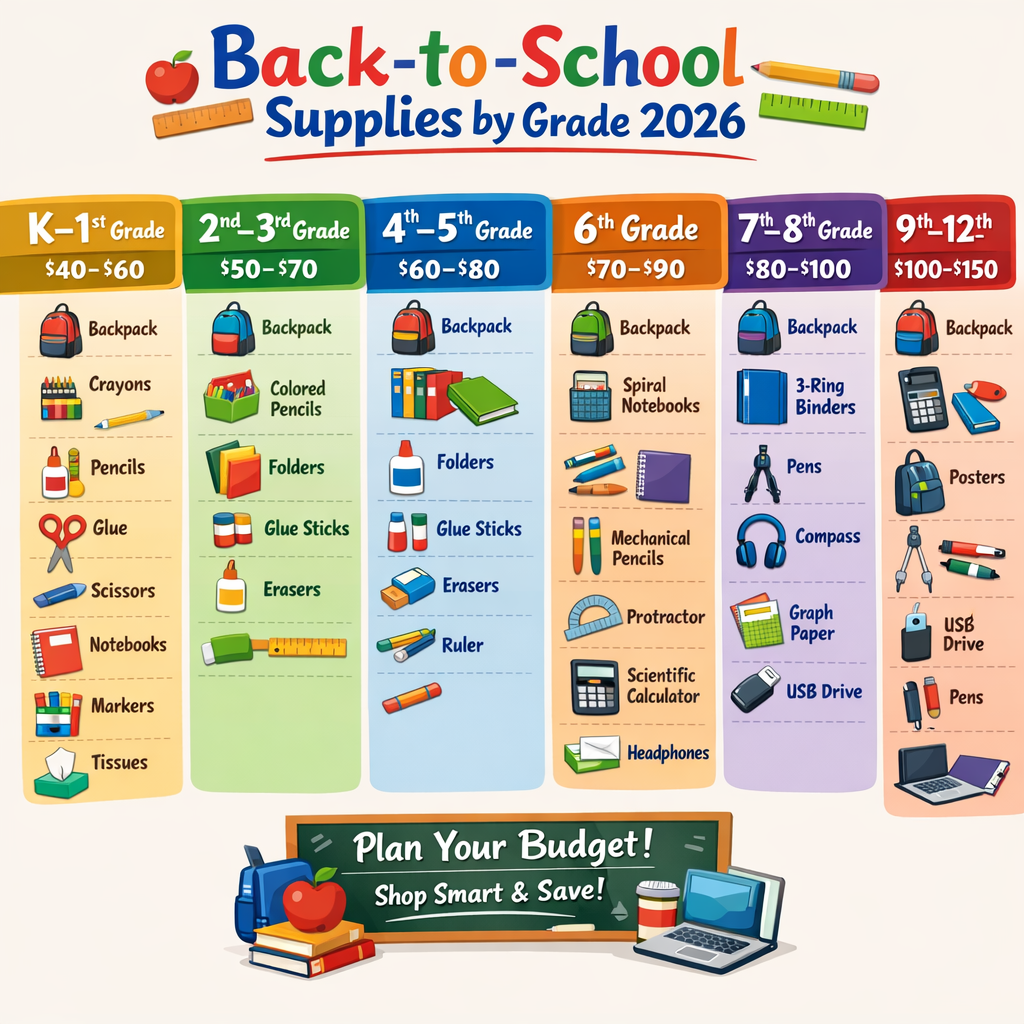
Budget estimate: $40–$65 per student
Quality consideration: Buy mid-range brands. Cheap supplies break easily; premium brands offer unnecessary extras. Crayola crayons and basic Elmer’s glue offer excellent value.
Common mistake: Buying expensive character-themed backpacks. Kids outgrow favorites quickly; simple, durable packs last longer.
Professional tip: Label everything. Kindergarteners and 1st graders lose supplies constantly. Permanent markers on backpacks, lunch boxes, and pencil cases prevent loss.
2nd & 3rd Grade Supply List
Students develop reading fluency and mathematical reasoning. Supplies become more sophisticated but remain fundamentally similar to 1st grade.
Core 2nd–3rd Grade Supplies:
- Backpack (slightly larger, with compartments)
- #2 pencils (24-pack)
- Pencil grips (triangular, ergonomic options for struggling writers)
- Erasers (pencil toppers and larger standalone erasers)
- Colored pencils (24-count)
- Washable markers (12–24 count)
- Glue sticks (6-pack)
- Scissors (still safety-focused)
- Notebooks (primary-ruled, then transitioning to college-ruled)
- Folders (8–10 for organization)
- Sticky notes (3×3 inch)
- Ruler (12-inch)
- Lunch containers
- Hand sanitizer
- Tissues
Math-Specific Additions (3rd grade):
- Whiteboard and dry-erase markers (for practicing)
- Fraction manipulatives (optional, teacher-provided often)
- Ruler with fractions marked
Budget estimate: $50–$80 per student
Why quality matters: 2nd and 3rd graders develop independent writing skills. High-quality pencils with good erasers reduce frustration. Ergonomic pencil grips prevent hand strain.
Common mistake: Buying mechanical pencils. Many schools prohibit them in early grades because they teach bad habits. Stick with traditional #2 wooden pencils.
Professional tip: Invest in a quality pencil sharpener at home. A broken sharpener creates morning stress. [Internal Link: Best Home Pencil Sharpeners]
4th & 5th Grade Supply List
Upper elementary students transition toward independent learning. Organizational tools become increasingly important.
Comprehensive 4th–5th Grade Supplies:
- Backpack (durable, water-resistant preferred)
- #2 pencils (2 dozen)
- Mechanical pencils (0.7mm, if permitted)
- Pencil case (organizer with multiple compartments)
- Erasers (various sizes and types)
- Colored pencils (24–48 count)
- Markers (washable and permanent)
- Highlighters (4–6 colors)
- Glue stick (6-pack) and liquid glue
- Scissors (standard child-safe)
- Composition notebooks (for journals/notes)
- Wide-ruled notebooks (multiple for different subjects)
- Folders (8–10, color-coded by subject)
- Dividers with tabs
- Sticky notes (multiple colors)
- Index cards (3×5 inch, for flashcards)
- Ruler (12-inch, with metric)
- Protractor (for geometry)
- Compass (for drawing circles)
- Scientific calculator (basic model for introduction)
- Lunch containers
- Water bottle
- Hand sanitizer
- Tissues and disinfecting wipes
Organizational Tools (New Category):
- Planner or assignment notebook
- Binder with pockets
- 3-hole punch (small, portable)
- Tape (clear and masking)
- Stapler (small, portable)
Budget estimate: $75–$120 per student
Quality decisions: By 4th grade, buy better-quality colored pencils and markers. Kids use them seriously now; cheap brands dry out or produce faint colors.
Common mistake: Buying too many supplies upfront. Teachers often request specific quantities. Excess supplies create desk clutter and distraction.
Professional tip: Establish a color-coding system with your student. Red = math, blue = reading, green = science, etc. This supports organization and independence.
6th Grade & Middle School Supplies
Middle school marks a major transition. Students move between classrooms and teachers, managing multiple subjects independently.
6th Grade Comprehensive List:
- Backpack (laptop-compatible, weather-resistant)
- #2 pencils (2–3 dozen)
- Mechanical pencils (0.7mm, premium brands like Pentel)
- Erasers (pencil toppers, mechanical eraser refills, kneaded erasers)
- Pens (ballpoint and gel, multiple colors)
- Colored pencils (quality 48+ set)
- Markers and highlighters
- Notebooks (separate for each subject, 70–100 pages)
- Composition books (for journals)
- Binder with dividers (subject-specific)
- Folders (color-coded)
- Sticky notes and index cards
- Ruler (12-inch, metric included)
- Protractor and compass
- Scientific calculator (TI-30X or equivalent)
- Planner or digital calendar
- Tape, stapler, staples
- Correction fluid or correction tape
- Lunch container and water bottle
- Hand sanitizer and tissues
Subject-Specific Additions:
- Science: Lab notebook, safety glasses (often provided)
- Art: Sketchbook, specialty markers, colored pencils
- PE: Athletic shoes, socks, gym clothes, lock
Technology Considerations:
Many 6th-grade programs introduce laptops or tablets. Check if your school supplies these or requires student purchase. Some include keyboard cases or styluses.
Budget estimate: $100–$180 per student
Quality shift: By 6th grade, invest in premium brands. Students need reliable tools they’ll use daily across multiple classes. Cheap pens leak; quality pens last.
Organization becomes critical: A disorganized middle schooler misplaces assignments and struggles academically. Premium planners and color-coding systems pay dividends. [Internal Link: Best Planners for Middle School Students]
Common mistake: Not planning for locker organization. Students need a lock, personal whiteboard, and small organizer for their locker.
Professional tip: Involve your student in selection. Middle graders care about appearance and brand. A planner they find attractive gets used; a generic one collects dust.
7th & 8th Grade Supply List {#7th-8th}
By 7th and 8th grade, students refine their organizational systems and begin serious academic preparation.
7th–8th Grade Detailed Supplies:
- Premium backpack (reinforced, laptop compartment)
- #2 pencils (quality brand, 2 dozen)
- Mechanical pencils (premium 0.7mm, with quality erasers)
- Ballpoint pens (multiple colors, reliable brands like Pilot G2)
- Gel pens (for color-coding notes)
- Highlighters (4–6 colors)
- Erasers (mechanical refills, white vinyl erasers)
- Colored pencils (48+ professional-quality set)
- Markers (permanent and washable)
- Notebooks (100-page, one per subject minimum)
- Spiral-bound notebooks (for classes emphasizing board notes)
- Composition books (for organized journaling)
- Binder with expanding dividers (two per student, organized by subject)
- Folders (sturdy stock, color-coded)
- Sticky notes (multiple sizes, various colors)
- Index cards (3×5 and 4×6 for study materials)
- Ruler, protractor, compass (quality metals, not plastic)
- Scientific or graphing calculator (TI-83 or equivalent)
- Digital planner or premium paper planner
- Tape, stapler, staples, staple remover
- Correction fluid and correction tape
- Post-it flags (for marking important passages)
- Binder clips and fasteners
- Lunch containers and water bottle
- Hand sanitizer and disinfecting wipes
Emerging Technology Needs:
- Laptop or tablet (if required by school)
- Stylus (for note-taking on tablets)
- Headphones (for educational videos)
- USB drive (for backing up assignments)
Subject-Specific Supplies:
- English: Literature anthology, novel notebook, reading journal
- Science: Lab notebook, calculator, safety equipment
- Math: Graphing calculator, geometry set, graph paper pad
- Social Studies: World map, highlighters for textbooks
Budget estimate: $120–$220 per student (excluding devices)
Quality matters significantly: 7th and 8th graders use supplies extensively. Premium pens don’t skip; quality erasers actually erase; sturdy folders survive backpack pressure.
Organization systems: Many students still struggle with organization. A color-coding system with clear labels prevents lost assignments. Consider a portable file organizer for locker use.
Common mistake: Assuming students will automatically stay organized. They won’t. Premium planners, labeled folders, and parent reminders remain necessary.
Professional tip: Introduce digital organization tools. Google Drive folders, OneNote notebooks, and calendar apps supplement physical supplies and teach lifelong skills.
High School Supplies (9th–12th Grade)
High school demands sophisticated organizational systems, serious writing tools, and sometimes technology.
Essential High School Supplies:
- Premium backpack or messenger bag (professional style)
- #2 pencils (quality brand, as backup)
- Mechanical pencils (premium, 0.7mm and 0.5mm)
- Ballpoint pens (multiple colors, quality brands)
- Gel pens (color-coding system)
- Highlighters (multiple colors)
- Erasers (mechanical refills, vinyl erasers, kneaded erasers)
- Colored pencils (professional-grade 48+ set)
- Markers (permanent markers for projects)
- Notebooks (120-page, one per class)
- Spiral-bound notebooks (if preferred for note-taking)
- Binders with expanding dividers (one per class minimum)
- Folders or file boxes (class-organized system)
- Sticky notes and flags
- Index cards (for flashcards, research)
- Ruler, protractor, compass, triangle ruler
- Scientific and graphing calculator (TI-84 Plus or equivalent)
- Premium planner (paper or digital)
- Tape, stapler, staples, clip organizers
- Correction fluid and tape
- USB drives (multiple for backup)
- Headphones (quality, wired preferred for school)
- Laptop or tablet (if required; many high schools provide these)
AP & Honors-Specific Additions:
- Specialized calculators for calculus or statistics
- Subject-specific notebooks and organizers
- Highlighters and color-coding system for dense textbooks
Elective-Specific Needs:
- Art/Design: Sketchbook, specialty markers, colored pencils
- Science Lab: Safety equipment, lab notebook, calculator
- Business/CTE: Professional notebook, presentation supplies
- PE: Athletic shoes, performance wear, personal lock
College Prep Supplies:
- Calendar or planner (tracking test dates, college deadlines)
- File organizer for college correspondence
- Quality writing pens for essay preparation
Budget estimate: $150–$300+ per student (excluding devices)
Quality standards: High school students need professional-grade tools. Cheap supplies undermine academic performance. Invest in quality pens, durable folders, and reliable calculators.
Organization systems become personal: By high school, students develop individual organizational preferences. Respect these while ensuring basic structure exists.
Technology integration: Most high school students use laptops. Digital note-taking, organized cloud folders, and calendar apps become essential alongside physical supplies.
Common mistake: Assuming high schoolers don’t need planners. They absolutely do. Academic success depends on tracking assignments, test dates, and project deadlines.
Professional tip: Help your student establish a filing system from day one. Digital folders for each class, backed up on cloud storage, prevent catastrophic loss of assignments.
Teacher Supplies Checklist
Teachers often purchase classroom supplies from personal budgets. A comprehensive teacher supply list ensures classrooms run smoothly.
Classroom Organization Supplies:
- Sticky notes (multiple colors, various sizes)
- Index cards (3×5 and 4×6)
- Binder clips, paper clips, fasteners (bulk quantities)
- Stapler, staples, staple remover
- Tape (clear, masking, painter’s)
- 3-hole punch
- Paper shredder (if not provided)
- File organizer or filing cabinet
- Shelving or storage units
- Labeled storage containers
- Desk organizer
- Cork board or whiteboard for classroom
- Bulletin board supplies
Writing & Marking Supplies:
- Pens (ballpoint, gel, in multiple colors)
- Permanent markers (various colors)
- Dry-erase markers (multiple colors)
- Highlighters (multiple colors)
- Pencils (#2, for backup)
- Colored pencils
- Erasers and correction supplies
- Whiteboard eraser and cleaner
Paper & Printing Supplies:
- Printer paper (bulk, multiple reams)
- Colored paper (for activities, displays)
- Cardstock (for posters, labels)
- Index cards (bulk)
- Post-it notes (bulk, various sizes)
- Envelopes (various sizes)
- Labels and label maker
- Notebooks or journals
Instructional Supplies (Subject-Dependent):
- Elementary: Stickers, stamps, ink pads, rewards
- Math: Manipulatives, graph paper, laminating supplies
- Science: Safety equipment, lab materials (varies by curriculum)
- Language Arts: Books, reading guides, grammar posters
- Social Studies: Maps, timelines, reference materials
Classroom Comfort Supplies:
- Hand sanitizer (bulk)
- Tissues (multiple boxes)
- Disinfecting wipes
- Trash cans and liners
- Cleaning supplies
- Pencil sharpener (electric, if not provided)
- Lamp or lighting (if needed)
Student Reward & Motivation Supplies:
- Stickers or stamps
- Certificates or awards
- Treats or snacks (per school policy)
- Prize box items
- Class pet supplies (if applicable)
Technology Supplies:
- USB drives (for backup)
- Cables and adapters
- Batteries (various sizes)
- Whiteboard or smart board supplies
Budget estimate: $300–$800+ annually (varies dramatically by school support level)
Professional tip: Many schools and communities offer teacher supply grants. Check with administration, nonprofits, and local businesses. Teachers should never fund basic classroom needs alone.
Common mistake: Teachers purchasing supplies without checking inventory. Coordinate with department colleagues to avoid duplication and share bulk purchases.
Budget-Friendly Shopping Strategies
Back-to-school shopping doesn’t require overspending. Smart strategies reduce costs significantly.
Timing Matters:
July–August Peak Sales: Most retailers discount supplies 30–50% during peak back-to-school season. Early shoppers (mid-July) find full selection; late shoppers (mid-August) find deeper discounts.
Post-Season Sales: September through October sometimes offer clearance pricing as stores make shelf space for fall merchandise.
January Sales: Many retailers run secondary back-to-school promotions for spring semester.
Where to Shop:
| Retailer Type | Best For | Cost Savings |
|---|---|---|
| Warehouse Clubs (Costco, Sam’s Club) | Bulk quantities, premium brands | 15–20% vs. retail |
| Dollar Stores (Dollar General, Family Dollar) | Basic supplies, notebooks, folders | 30–50% savings on everyday items |
| Big Box Retailers (Walmart, Target) | Comprehensive selection, sales, coupons | 20–40% with sales + coupons |
| Office Supply Stores (Staples, Office Depot) | Quality brands, rewards programs | 10–25% with sales |
| Online Retailers (Amazon, school suppliers) | Bulk items, convenience, free shipping | Varies; compare carefully |
| Local/Independent Stores | Personalized service, community support | Generally higher prices |
Professional tip: Use the Staples and Office Depot rewards programs. Accumulated points reduce subsequent purchases by 10–15%.
Cost-Cutting Strategies:
- Buy generics: Store-brand supplies match name-brand quality at 30–50% lower cost. Crayola crayons cost 2–3x more than generic brands with identical performance.
- Bulk purchasing: Buying 2-dozen pencils costs less per unit than 1-dozen. Share bulk purchases with other families to reduce excess inventory.
- Donate last year’s supplies: Check that previous year’s folders, notebooks, and organizers are still usable. Extend their lifespan.
- Use coupons strategically: Combine manufacturer coupons with retailer sales for maximum savings. Typical: 40% off clearance + 20% coupon = 60% total savings.
- Skip character-themed items: Licensed character supplies (Disney, superhero themed) cost 50–100% more than basic equivalents with identical functionality.
- Buy one quality item per category: Invest in one premium backpack or planner; buy generic basics for expendables like pencils and paper.
- Shop sales cycles: Track sales at favorite retailers. Most run promotions every 2 weeks.
Monthly Budget Breakdown (Sample Family):
| Grade Level | Budget | Timeline |
|---|---|---|
| K–1st grade | $45 | July sale |
| 2nd–3rd grade | $65 | July sale |
| 4th–5th grade | $95 | July sale |
| 6th grade | $150 | July sale |
| 7th–8th grade | $170 | July/August sales + coupons |
| 9th–12th grade | $220 | July/August sales + coupons + rewards |
| Teacher | $400–600 | July sale + grants |
Action step: Create a spreadsheet tracking prices at different retailers. Compare total costs before committing to a single store.
Special Needs & Accessibility Supplies
Students with ADHD, dyslexia, autism spectrum disorder, fine motor delays, or other needs require specialized supplies.
ADHD-Specific Supplies:
- Fidget tools (stress balls, spinners, pop-its for focus)
- Noise-canceling headphones (for distraction-free work)
- Weighted lap pad (for sensory input)
- Visual timer (for time management)
- Color-coded organizational system (stronger cues)
- Premium planner with frequent check-in points
- Highlighters (for main idea extraction)
- Sticky notes (for reminders, organization)
- Organizational labels (large, colorful text)
Dyslexia-Specific Supplies:
- Graph paper or lined paper with wider spacing
- Colored overlays (for reducing visual stress)
- Text-to-speech software access
- Specialized writing tools (ergonomic grips, wider barrels)
- Highlighters (for identifying key concepts)
- Digital organizers (reducing handwriting demands)
- Audiobook access (if permitted by school)
Fine Motor Delays:
- Ergonomic pencil grips (triangular, cushioned)
- Weighted pencils (providing sensory feedback)
- Pencil grips with finger guides
- Wider writing instruments (easier to grasp)
- Pre-pencil tools (crayons, markers first)
- Adaptive scissors (one-handed or spring-loaded)
- Sloped writing boards (improving hand positioning)
Autism Spectrum Disorder:
- Sensory-friendly supplies (unscented markers, smooth paper)
- Noise-canceling headphones
- Visual schedules (for organizational support)
- Fidget tools (for self-regulation)
- Calm-down corner supplies (soft items, preferred textures)
- Social story cards (for transitions, expectations)
- Preferred-color notebooks and folders (supporting comfort)
Visual Impairment:
- Large-print materials
- High-contrast supplies (dark markers, light paper)
- Tactile markers (slightly raised for texture)
- Large-grip writing instruments
- Magnification tools
- Braille labels (if applicable)
- Audiobook-compatible devices
Hearing Impairment:
- Visual supports (color-coding, written instructions)
- Captioning-compatible devices
- Sign language resources
- Sound-frequency devices (if recommended by audiologist)
Professional tip: Request a 504 plan meeting or IEP review to identify necessary accommodations. Many specialized supplies require prescriptive documentation for school reimbursement.
Common mistake: Parents purchasing specialized supplies without teacher/specialist consultation. Discuss needs with special education staff to ensure purchases align with the student’s specific support plan.
Eco-Friendly & Sustainable Options
Environmental consciousness matters increasingly to families and schools. Sustainable supplies exist across most categories.
Eco-Friendly Paper Products:
- Recycled paper notebooks: FSC-certified (Forest Stewardship Council), reducing virgin forest cutting
- Tree-free paper: Bamboo, hemp, or agricultural waste-based alternatives
- Recycled folders and dividers: Pre-consumer or post-consumer recycled content
- Plantable paper: Seed-embedded paper products that grow plants when discarded
Sustainable Writing Tools:
- Wooden pencils: Natural, biodegradable alternatives to plastic mechanical pencils
- Bamboo pens: Renewable resource requiring minimal processing
- Refillable pens: Reduce plastic waste; replace ink cartridges only
- Natural rubber erasers: Sustainable alternatives to synthetic rubbers
- Plant-based markers: Non-toxic, water-based inks, compostable barrels
Reusable & Durable Supplies:
- Quality backpacks: Durable construction extends lifespan, reducing replacement frequency
- Refillable water bottles: Metal or high-quality plastic, reducing single-use bottle waste
- Cloth lunch containers: Replacing disposable plastic bags
- Durable folder sets: Made from recycled plastic, reusable across years
- Solid wood or bamboo organizers: Sustainable alternatives to plastic storage
Sustainable Organizational Supplies:
- Organic cotton binders: Sustainable fabric, comfortable handling
- Cork or cardboard organizers: Renewable materials, biodegradable
- Natural rubber dividers: Sustainable alternatives to plastic
- Reusable sticky notes: Silicone-based, washable alternatives
Brands Pioneering Eco-Friendly Supplies:
- Sprout Pencils: Seed-embedded wooden pencils
- EarthHero: Certified sustainable school supplies
- Preserve: Recycled plastic, sustainable goods
- Decomposition Books: Tree-free, FSC-certified notebooks
- Better World Club: Sustainable accessories
Cost Consideration: Eco-friendly supplies typically cost 10–30% more than conventional options. Budget accordingly, but recognize longevity often offsets higher initial cost.
Professional tip: Start small. Replace one supply category (pens, notebooks) with sustainable options. Expand as comfort and budget allow.
Common mistake: Assuming all “green” claims are legitimate. Check certifications (FSC, B-Corp, cradle-to-cradle) rather than relying on vague “eco-friendly” marketing.
Technology & Digital Tools for 2026
Modern education increasingly integrates technology. Understanding digital tool requirements ensures readiness.
Essential Digital Tools:
- Laptop or tablet: Windows, Mac, iPad, or Chromebook (check school requirements)
- Stylus: For note-taking on tablets, particularly useful for math and art classes
- Noise-canceling headphones: Minimizing distraction during virtual learning or instructional videos
- USB drives: Backing up assignments, transferring files (2–3 recommended)
- Webcam: For video conferencing during remote learning situations
- Microphone: Quality audio for presentations and online participation
Productivity & Organization Apps:
- Google Drive: Cloud-based document storage, collaborative projects
- Microsoft OneNote: Digital note-taking, organization by subject
- Notion: Advanced organization and study planning
- Todoist: Task management and assignment tracking
- Calendar apps: Google Calendar, Outlook for deadline management
Learning & Study Apps:
- Khan Academy: Free educational videos across all subjects
- Quizlet: Flashcard creation and study tools
- Duolingo: Language learning
- Photomath: Math problem solving and explanation
- Grammarly: Writing assistance and grammar checking
Subject-Specific Tools:
- GeoGebra: Math visualization and graphing
- Desmos: Advanced graphing calculator
- Wolfram Alpha: Computational knowledge engine
- Audible/Libby: Audiobook access for different learners
- Adobe Creative Suite: For art and design classes (often provided by schools)
Time Management & Productivity:
- Forest: Gamified focus timer
- Pomodoro Timer: Time-blocking technique support
- RescueTime: Productivity tracking
- Be Focused: Focus and break management
Important note: Check your school’s technology policy before purchasing or installing software. Some schools restrict certain apps; others provide free licenses for approved tools. [External Link: Common School Technology Policies and Requirements]
Budget consideration: Most essential apps are free or included in school-provided accounts. Paid subscriptions typically add $5–15/month but aren’t necessary for academic success.
Professional tip: Students don’t need every app. Identify 3–4 core tools that fit your student’s workflow. Mastery of fewer tools outperforms shallow familiarity with many.
Shopping Timeline & Best Deals
Timing your back-to-school shopping optimizes selection and saves money.
Recommended Timeline:
May–June (Early Planning):
- Request official school supply lists
- Identify special needs or preferences
- Check school technology requirements
- Review last year’s supplies for reuse
Late June–Early July (Early Shopping):
- Begin monitoring sales at preferred retailers
- Purchase high-ticket items (backpack, tablet, calculator)
- Buy items with limited selection (specific brands, sizes)
- Take advantage of early sales (15–25% typical)
Mid-July through August 10 (Peak Shopping):
- Maximum sales and selection
- Combine manufacturer coupons with store discounts
- Use loyalty programs and rewards
- Purchase bulk quantities
- Shop online for convenience
August 10–20 (Final Push):
- Clearance pricing increases to 40–60% off
- Stock up on basics (pencils, paper, erasers)
- Risk: Reduced selection on popular items
- Opportunity: Lowest prices overall
After August 20 (Clearance):
- Extreme markdowns (50–70% off)
- Very limited selection
- Good for restocking basics mid-year
- Risky for finding specific requirements
Sale Windows to Monitor:
| Retailer | Typical Sale Window | Discount |
|---|---|---|
| Walmart | Mid-July through August 15 | 25–40% |
| Target | Early July through August 20 | 20–35% |
| Staples | Late June through August 10 | 15–30% + rewards |
| Office Depot | Late June through August 15 | 15–30% + rewards |
| Dollar Stores | July through August | 20–35% |
| Amazon | July 15 through August 20 | Varies; often best bulk prices |
Professional tip: Sign up for email alerts from favorite retailers. Sales announcements come before general promotion, allowing strategic shopping.
Action step: Create a calendar with school start dates, known sale windows, and personal shopping deadlines. Plan shopping trips for peak discount periods.
Common Mistakes to Avoid
Learning from common pitfalls saves money and frustration.
1. Buying Without a School List
Mistake: Assuming you know what’s needed; purchasing at random.
Solution: Always request the official supply list from school before buying anything.
2. Overbuying
Mistake: Purchasing excessive quantities based on bulk pricing.
Solution: Buy modest quantities for use during the year. Teachers often request specific amounts for classroom management.
3. Buying Forbidden Items
Mistake: Purchasing supplies schools explicitly prohibit (certain types of pens, personal devices, specific brands).
Solution: Check the complete list for any restricted items. Ask teachers about policy.
4. Skipping Organization Tools
Mistake: Assuming kids will organize supplies independently.
Solution: Invest in color-coded folders, labels, and a quality planner. Organization directly supports academic performance.
5. Prioritizing Aesthetics Over Function
Mistake: Buying supplies because they look trendy, ignoring durability or practicality.
Solution: Function first. Appearance matters for motivation, but a beautiful pen that skips is worse than a functional generic pen.
6. Ignoring Special Needs
Mistake: Using generic supplies for students with ADHD, dyslexia, or other differences.
Solution: Consult teachers and specialists about accommodations. Appropriate tools dramatically improve academic success.
7. Forgetting Teacher Supplies
Mistake: Purchasing only student supplies; overlooking classroom essentials.
Solution: Include classroom supplies in the budget or coordinate classroom supply contributions with other parents. [Internal Link: How to Support Teachers with Classroom Supplies]
8. Buying Too Early (Months Ahead)
Mistake: Purchasing supplies in May or June at full price; supplies get lost or damaged before school starts.
Solution: Buy within 4 weeks of school start. Supplies stay fresh and organized.
9. Not Tracking Purchases
Mistake: Losing receipts; unable to return or exchange items.
Solution: Keep all receipts in one folder through August 31. Save email confirmations for online purchases.
10. Ignoring Quality for Specific Items
Mistake: Buying cheapest pencils, erasers, or calculators despite heavy use.
Solution: Invest in quality for frequently-used items. Cheap erasers don’t erase; cheap pencils break; cheap calculators malfunction mid-problem.
Frequently Asked Questions
Q1: What’s the average cost of back-to-school supplies in 2026?
Back-to-school spending varies significantly by grade level. Kindergarten through 2nd grade typically costs $40–$75. Elementary grades 3–5 range $75–$120. Middle school (6–8) runs $120–$220. High school costs $150–$300+, depending on whether technology is included. Teachers often spend $300–$800 annually from personal funds, though this shouldn’t be necessary. National averages suggest families spend $500–$1,000 total when shopping for multiple children. Smart shopping—using sales, coupons, and warehouse clubs—can reduce these costs by 30–40%.
Q2: Should I buy name-brand or generic school supplies?
Generic supplies work fine for most items. Store-brand crayons, folders, and notebooks perform identically to premium brands while costing 30–50% less. However, invest in quality for frequently-used items: pens, pencils, and erasers (frequent user = degradation from cheap products), backpacks (durability matters for daily use), and calculators (cheap calculators malfunction). The sweet spot: generic basics, quality for high-use items.
Q3: When is the best time to buy back-to-school supplies?
Mid-July through August 10 offers the best combination of sales (30–50% off) and selection. Early July shopping (mid-month) captures early sales and full stock. August 10–20 offers the deepest discounts (40–60% off) but reduced selection—good for stocking basics, risky for specific requirements. Avoid shopping in late June (full prices) or after August 20 (limited selection). Plan according to your school’s start date, aiming for 2–3 weeks before classes begin.
Q4: How can I organize supplies so my student actually uses them?
Color-code supplies by subject: red = math, blue = reading, green = science, yellow = social studies. Use labeled folders, dividers, and sticky tabs. Create a supply checklist your student keeps in their binder, checking off items as supplies run low. Establish a “supply station” at home with extra pencils, erasers, and paper for quick restocking. Use a daily planner for assignment tracking. For younger students, picture labels on supplies help with organization. Involve your student in the organizational system—they’re more likely to maintain systems they helped design.
Q5: What supplies do teachers actually want or need?
Teachers need sticky notes (various sizes), index cards, printer paper, tissues, hand sanitizer, disinfecting wipes, markers, and tape. Many teachers appreciate donations of tissues, hand sanitizer, and paper for classroom use. Supplies for student rewards (stickers, certificates) support motivation. Avoid bringing expensive or specialized items without asking the teacher first. Most teachers publish a “class supply list” separate from student requirements. Best approach: Ask the teacher directly, “Is there anything the class needs? What would be most helpful?” Teachers appreciate the question.
Q6: Are eco-friendly school supplies worth the extra cost?
Eco-friendly supplies cost 10–30% more than conventional options. If environmental impact matters to your family, they’re worth considering. Start with one category (notebooks, pens) rather than replacing everything. Many eco-friendly supplies last longer, offsetting higher upfront costs. However, conventional supplies aren’t “bad”—budget is often the bigger constraint. If cost is tight, focus on mainstream affordable supplies. If budget allows, gradually incorporate sustainable options.
Q7: What technology do students actually need for school in 2026?
Check your specific school’s requirements before assuming. Many schools provide Chromebooks or iPads; asking students to buy duplicates wastes money. If your school requires personal devices, determine the specific type (Windows, Mac, iPad, Chromebook), brand recommendations, and specs needed. Tablets, styluses, and headphones are increasingly common but should be purchased only if confirmed necessary. Most schools don’t require personal devices; those that do clearly communicate requirements at enrollment.
Q8: How do I handle special needs when buying supplies?
Request a formal assessment meeting (504 plan, IEP meeting, or accommodations meeting) where special education staff identifies necessary accommodations. Many specialized supplies are covered by school budgets if documented in formal plans. Examples: ergonomic grips, colored overlays, fidget tools. Rather than guessing, ask: “My student benefits from [specific accommodation]. Can the school provide this, or should I purchase it?” This conversation prevents wasted spending and ensures the school commits to supporting your student’s needs.
Q9: Where should I shop for the best deals on school supplies?
Compare these options: warehouse clubs (Costco, Sam’s Club) for bulk items, big-box retailers (Walmart, Target) for variety and coupons, dollar stores for basics, and online retailers for convenience. Many middle-class families find a combination approach works best: bulk staples from warehouse clubs, specific items from retail sales, and dollar store basics. Use sales apps like Ibotta and Checkout 51 for digital coupons. Sign up for retailer rewards programs. Check Honey or Rakuten for online cashback. Average savings: 20–40% with strategic shopping.
Q10: What should I do with leftover supplies from last year?
Reuse any supplies in good condition: folders, binders, notebooks, pencil cases, and organizers easily transfer to new school year. Pens, pencils, erasers, and markers that still work should be saved. Worn-out supplies (bent folders, dried pens, damaged notebooks) should be discarded. Label items clearly to prevent mix-ups between grade levels or siblings. Consider donating gently-used supplies to teachers, schools serving low-income families, or community organizations. Creative reuse: empty folders become file organizers; dried markers become art supplies; old notebooks become journals.



Leave a Reply