

Philippines Higher Education
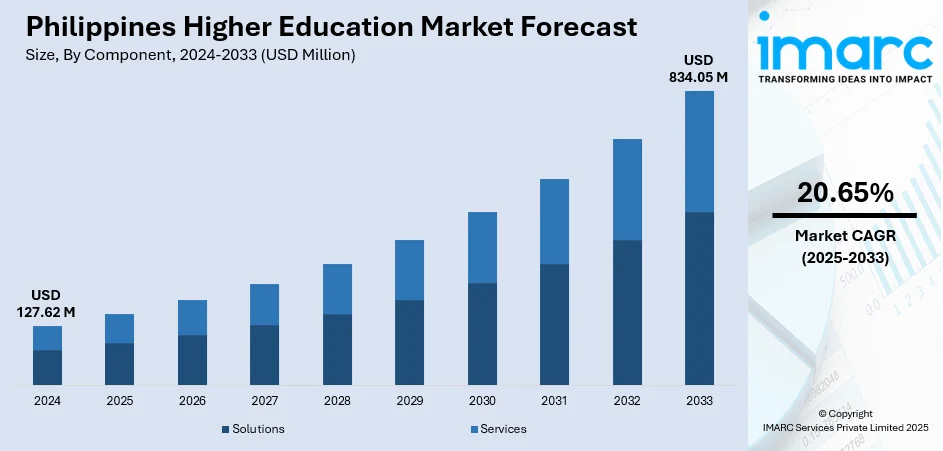
The latest report by IMARC Group, “Philippines Higher Education Market Size, Share, Trends and Forecast by Component, Deployment Mode, Course Type, Learning Type, End User, and Region, 2025-2033,” provides an in-depth analysis of the Philippines higher education market. The report also includes competitor and regional analysis, along with a breakdown of segments within the industry. The Philippines higher education market size reached USD 127.62 Million in 2024 and is projected to grow to USD 834.05 Million by 2033, exhibiting a CAGR of 20.65% during the forecast period.
Report Attributes and Key Statistics:
| Attribute | Details |
| Base Year | 2024 |
| Historical Years | 2019-2024 |
| Forecast Years | 2025-2033 |
| Market Size in 2024 | USD 127.62 Million |
| Market Forecast in 2033 | USD 834.05 Million |
| Market Growth Rate | 20.65% CAGR (2025-2033) |
Philippines Higher Education Market Overview:
The Philippines higher education market is currently growing strongly, driven by a growing youth population, rising demand for skilled professionals, and expanding private sector participation. Increasing adoption of digital technologies and international collaborations are transforming traditional learning models. Government initiatives aimed at improving quality and access are also accelerating development in this sector. The market comprises a blend of public and private institutions offering diverse programs, reflecting evolving competitive dynamics.
Request For Sample Report: https://www.imarcgroup.com/philippines-higher-education-market/requestsample
Philippines Higher Education Market Trends and Drivers:
International partnerships and cross-border collaborations are becoming prominent, with universities offering dual-degree programs and student exchange agreements with countries such as Australia, the US, Japan, and South Korea. Digital infrastructure improvements are facilitating joint research, faculty training, and virtual exchange programs. There is also a rising focus on STEM education, with institutions expanding STEM offerings and partnering with technology companies for industry-relevant training. These trends are helping higher education institutions align with global standards and enhance competitiveness.
Growth is propelled by the large youth demographic entering higher education, increasing private sector involvement, and supportive government policies. The adoption of digital learning tools and online platforms is expanding opportunities for flexible and remote education. International collaborations improve academic quality and global exposure. Investments in STEM education and tech-enabled learning environments are driving demand and preparing graduates for current workforce needs.
Market Challenges and Opportunities:
Challenges include ensuring equitable access to quality education across the archipelago, bridging the digital divide, and maintaining academic quality standards amid rapid growth. Institutions face pressures to balance traditional methods with digital transformation while managing regulatory compliance and funding limitations. The need to continuously update curricula and teaching methods to match evolving industry demands also poses a challenge.
Significant opportunities exist in expanding digital education solutions and building more international partnerships. Growth potential lies in STEM and tech-focused education, workforce upskilling programs, and online education platforms. Public-private partnerships and government support programs aimed at improving access and quality can further unlock market growth. Enhancing mobility and recognition of foreign credentials also attracts more students and investment.
Philippines Higher Education Market Key Growth Drivers:
- Growing youth population and rising demand for skilled professionals
- Increasing private sector participation and investments
- Expansion of international collaborations and cross-border programs
- Government initiatives to improve quality, access, and digital infrastructure
- Rising focus on STEM education and industry-aligned training
Philippines Higher Education Market Segmentation:
Component:
-
- Solutions (Student Information Management System, Content Collaboration, Data Security and Compliance, Campus Management, Others)
- Services (Managed Services, Professional Services)
Deployment Mode:
Understanding Philippines Higher Education
Understanding Philippines Higher Education
Course Type:
-
- Arts
- Economics
- Engineering
- Law
- Science
- Others
Learning Type:
End User:
-
- State Universities
- Community Colleges
- Private Colleges
Regions:
Competitive Landscape:
The market includes a mix of public and private institutions, with major players adopting digital transformation and internationalization strategies. Competitive analysis covers market structure, key player positioning, winning strategies, and company evaluation quadrants to gauge industry dynamics.
Philippines Higher Education Market News (2025):
- June 2025: The Department of Health (DOH) announced the rollout of free mental health medications across Metro Manila. Covered medications include Paliperidone, Escitalopram, Quetiapine, Risperidone, Lithium carbonate, and Clozapine. These are available at major public hospitals and health centers such as the Philippine General Hospital and Jose R. Reyes Memorial Medical Center. Patients must present a valid prescription and can email it to the Metro Manila Center for Health Development to receive access.
- April 2025: A national study revealed that the Philippines’ Mental Health Quotient (MHQ) dropped from 78.44 in 2023 to 68.76 in 2024, though still above the global average of 62.84. The most impacted group was Filipino youth aged 18–24, who scored an average of 24.9. Primary contributing factors include reduced social connection, high screen time, poor diet, and urban stressors, calling for systemic intervention and improved prevention strategies.
Key Highlights of the Report:
- The Philippines higher education market is forecasted to grow at a CAGR of 20.65% through 2033.
- Market expansion is driven by demographic trends, digital transformation, and international partnerships.
- Government initiatives and private sector growth are critical enablers.
- STEM education and industry-relevant programs are reshaping the sector landscape.
- Challenges include ensuring access equity, quality maintenance, and adapting to digital learning demands.
Note: If you require specific information not currently within the scope of the report, we can provide it as part of the customization.
Ask an analyst for your customized sample: https://www.imarcgroup.com/request?type=report&id=37794&flag=C
About Us:
IMARC Group is a global management consulting firm that helps the world’s most ambitious changemakers to create a lasting impact. The company provides a comprehensive suite of market entry and expansion services including market assessment, feasibility studies, company incorporation assistance, factory setup support, regulatory approvals and licensing navigation, branding, marketing and sales strategies, competitive landscape and benchmarking analyses, pricing and cost research, and procurement research.
Contact Us:
IMARC Group
134 N 4th St. Brooklyn, NY 11249, USA
Email: Sales@imarcgroup.com
Tel. No.: (D) +91 120 433 0800
Americas: +1-201-971-6302



Leave a Reply