

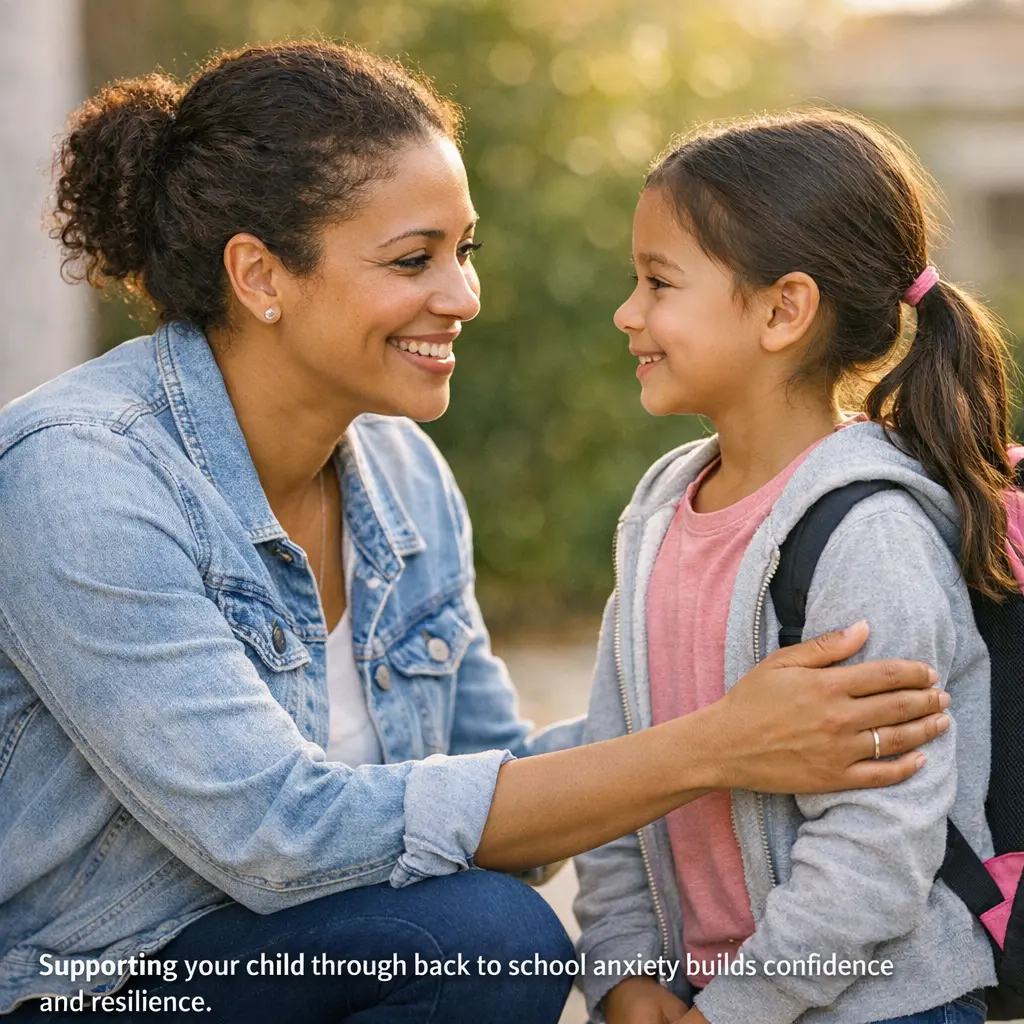
Understanding Back to School Anxiety
Back to school anxiety affects children across all ages and backgrounds. Whether your child is entering kindergarten for the first time or returning to middle school after summer break, the transition from relaxed vacation mode to structured school days triggers worry and nervousness in many kids.
This anxiety is not a character flaw or parenting failure. Research suggests that 10-20% of children experience significant anxiety about school transitions. The stress comes from multiple sources: fear of the unknown, social pressures, academic expectations, separation from parents, and the basic human resistance to change.
For some children, back to school anxiety appears as obvious nervousness and expressed fears. For others, it hides behind physical complaints, behavioral changes, or unexplained irritability. The experience differs by age, temperament, previous school experiences, and current life circumstances.
Understanding that this anxiety is both common and manageable helps parents approach the situation with confidence rather than panic. Your child needs your calm, informed support—not your worry. The strategies outlined in this guide provide a comprehensive framework for helping your child navigate this challenging transition successfully.
Most importantly, normal back to school anxiety differs from clinical anxiety disorders. The adjustment nervousness that resolves within a few weeks requires different intervention than persistent anxiety that interferes with daily functioning. This article helps you distinguish between these situations and respond appropriately.
Signs Your Child Is Experiencing School Anxiety
Back to school anxiety manifests differently across children, but several common patterns emerge. Recognizing these signs early allows for timely intervention before anxiety becomes entrenched.
Physical Symptoms:
- Stomachaches, particularly in the morning before school
- Headaches without medical cause
- Nausea or appetite changes
- Sleep disturbances (difficulty falling asleep, nightmares, early waking)
- Fatigue despite adequate sleep
- Bathroom urgency or frequency
- Muscle tension or general restlessness
Emotional and Behavioral Signs:
- Excessive clinginess or separation difficulty
- Crying or emotional outbursts about school
- Irritability, especially when school is mentioned
- Withdrawal from previously enjoyed activities
- Mood swings or emotional volatility
- Regression to younger behaviors (baby talk, thumb-sucking)
- Excessive reassurance-seeking (“Will you be there when I get home?”)
Cognitive Patterns:
- Repetitive worrying about school scenarios
- Catastrophic thinking (“Everyone will hate me”)
- Difficulty concentrating on non-school tasks
- Perfectionist concerns about academic performance
- Memory of previous negative school experiences
- Excessive focus on “what if” scenarios
Avoidance Behaviors:
- Reluctance to discuss school
- Creating excuses to stay home
- “Forgetting” school-related tasks
- Resistance to school supply shopping or preparation
- Avoiding peers or school-related social situations
- Procrastination on school preparation tasks
Age-Specific Manifestations:
Young children (ages 4-7): Direct verbal expressions of fear, physical clinging, tantrums, regression behaviors, and somatic complaints that are harder to articulate.
Elementary-aged children (ages 8-10): More specific worries about academic performance, social acceptance, or teacher relationships. Physical symptoms often replace direct verbal expression.
Preteens and teens (ages 11-14): Social anxiety dominates, with concerns about peer judgment, appearance, and fitting in. May present as anger or defiance rather than sadness or fear.
Professional Tip: Keep a simple log for 3-5 days noting when symptoms appear, their intensity, and what helps. This pattern recognition aids both your intervention and professional consultation if needed.
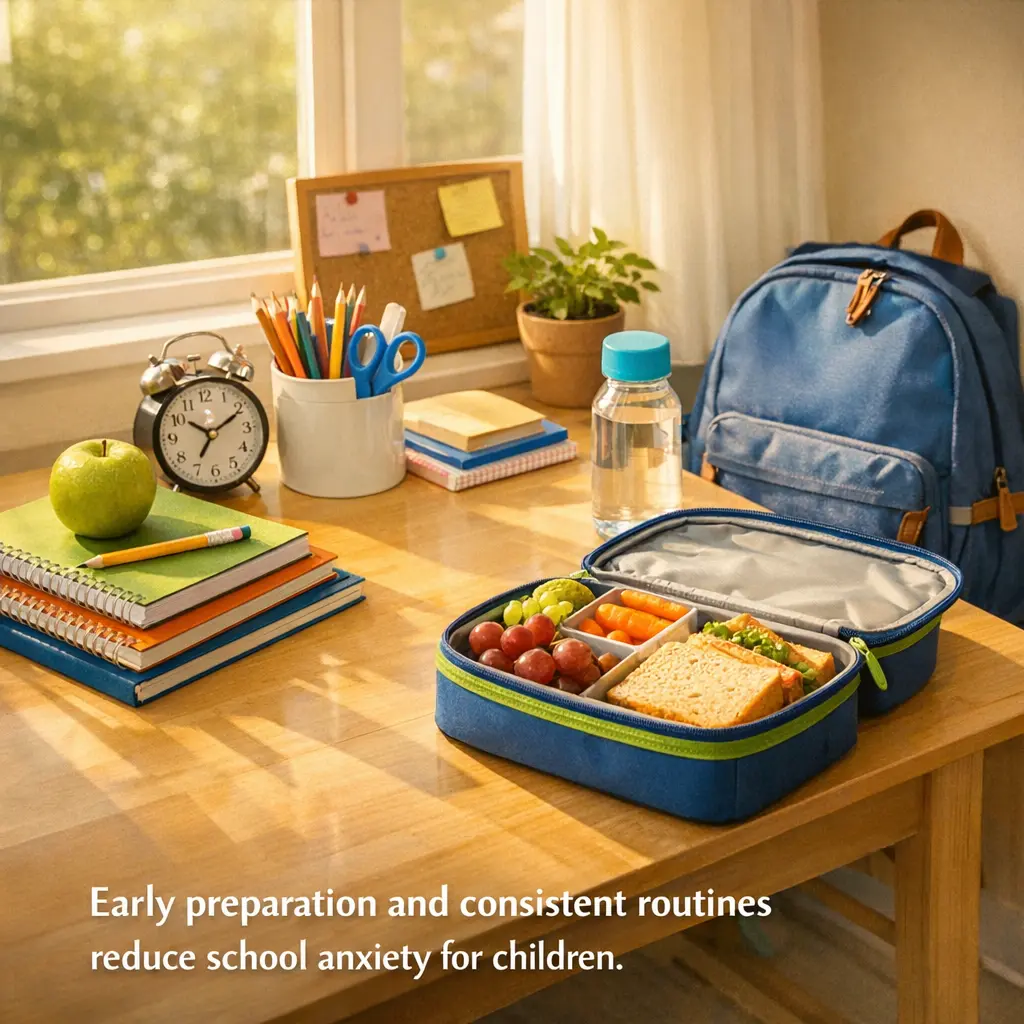
12 Proven Strategies to Help Your Child
Strategy 1: Start Routines Early
Explanation:
The abrupt shift from flexible summer schedules to rigid school routines shocks children’s systems. Gradually reintroducing structure 1-2 weeks before school starts eases this transition and reduces anxiety caused by sudden change.
How to Implement:
Begin adjusting wake times by 15-30 minutes every few days until reaching the school-year schedule. Simultaneously shift bedtimes earlier. Reintroduce morning routines including breakfast timing, getting dressed independently, and organizing materials.
Example:
If school requires a 7:00 AM wake time and your child has been sleeping until 9:00 AM, start the adjustment two weeks prior. Wake at 8:30 AM for days 1-3, then 8:00 AM for days 4-6, continuing until reaching the target time. Practice the full morning routine including teeth brushing, dressing, and eating breakfast—even if there’s nowhere to go.
Benefits:
- Reduces biological stress of sudden schedule changes
- Establishes predictability and control
- Prevents first-week exhaustion that amplifies anxiety
- Creates muscle memory for morning tasks
- Allows troubleshooting of routine problems before stakes are high
Common Mistakes:
- Starting adjustments only 2-3 days before school
- Changing wake times but not bedtimes
- Maintaining weekend schedules during the adjustment period
- Practicing routines without time pressure simulation
Quick Summary: Gradual routine adjustment two weeks before school prevents the shock of sudden change and establishes automatic behaviors that reduce morning stress.
Strategy 2: Validate Their Feelings
Explanation:
Children need acknowledgment that their feelings are real and acceptable before they can move past them. Dismissing or minimizing anxiety (“There’s nothing to worry about!”) teaches children their emotions are wrong, increasing distress and reducing trust in parental support.
How to Implement:
Use reflective listening: “I hear that you’re worried about finding your classroom” or “It sounds like you’re nervous about making new friends.” Normalize the experience: “Many kids feel nervous before school starts. It’s a normal feeling when something new is happening.” Separate validation from problem-solving—first acknowledge, then strategize.
Example:
When your child says “I don’t want to go to school,” resist the urge to immediately counter with reasons school will be fine. Instead: “You’re feeling really worried about going back to school. Can you tell me what part feels most difficult?” After listening fully, then offer: “Those feelings make sense. Let’s think about some things that might help.”
Benefits:
- Builds emotional trust and communication
- Prevents anxiety from intensifying due to suppression
- Teaches emotional literacy and self-awareness
- Reduces shame associated with anxious feelings
- Opens dialogue for practical problem-solving
Limitations:
Validation alone doesn’t solve anxiety—it must pair with boundary-setting and skill-building. Endless validation without moving toward coping strategies can reinforce helplessness.
Common Mistakes:
- Immediately contradicting the child’s feelings
- Comparing to others (“Your sister was never afraid”)
- Minimizing (“That’s silly to worry about”)
- Dwelling on validation without progressing to solutions
Professional Tip: Use the phrase “It’s okay to feel nervous AND you can handle this” to validate while building confidence.
Strategy 3: Practice the School Routine
Explanation:
Rehearsal reduces anxiety by replacing unknown scenarios with familiar ones. Practicing specific school-related tasks builds competence and confidence while identifying potential problems when stakes are low.
How to Implement:
Create dress rehearsals for the entire school morning: setting the alarm, getting dressed, eating breakfast, packing backpack, and simulating the commute. For younger children, practice opening lockers, finding bathrooms, or navigating between locations. Role-play social situations like asking to join a game or requesting teacher help.
Example:
Three days before school starts, conduct a complete run-through. Wake at the actual school time, follow the morning routine with realistic timing pressure, and drive or walk the route to school. For nervous kindergarteners, practice sitting at a table for 15-20 minutes, raising hands, and standing in line. Repeat this practice 2-3 times.
Benefits:
- Transforms abstract worry into concrete, manageable tasks
- Reveals logistical problems (outfit uncomfortable, breakfast takes too long)
- Builds automatic behavioral patterns
- Provides mastery experiences that boost confidence
- Reduces cognitive load on actual first day
Common Mistakes:
- Practicing only once
- Skipping the practice run when child resists
- Making practice feel like punishment
- Not timing the routine realistically
Action Steps:
- List every step of the morning routine
- Identify which steps your child can do independently
- Practice the full sequence 2-3 times before school
- Troubleshoot problems discovered during practice
- Celebrate successful completion of practice runs
Strategy 4: Visit the School Environment
Explanation:
Fear of the unknown drives much school anxiety. Physical familiarity with the building, classroom, and key locations transforms the school from a scary unknown into a mapped, predictable space.
How to Implement:
Contact the school to arrange a visit during open houses, orientation events, or by special appointment. Walk the hallways, locate the classroom, bathroom, cafeteria, and main office. Take photos of key locations. If possible, meet the teacher briefly. For children changing schools, multiple visits before the start date significantly reduce anxiety.
Example:
One week before school, visit during an open house. Let your child explore their classroom, choose their desk if possible, and locate the bathroom independently. Walk the route from classroom to cafeteria, and from classroom to the exit they’ll use for pickup. Take photos of these locations and review them at home. Create a simple map your child can reference.
Benefits:
- Eliminates surprise and disorientation on first day
- Provides mental rehearsal material
- Reduces fear of getting lost
- Familiarizes with sensory environment (sounds, smells, lighting)
- Offers questions to ask before the first day
Limitations:
Not all schools offer pre-visits. Some anxious children may feel overwhelmed even during a quiet visit. Adjust based on your child’s temperament.
Common Mistakes:
- Rushing through the visit
- Visiting only with parent, not letting child explore
- Skipping key locations (bathroom, exit)
- Not following up with photo review at home
Professional Tip: Let your child lead during the visit. Following their pace and interests provides more anxiety reduction than a parent-directed tour.
Strategy 5: Facilitate Peer Connections
Explanation:
Social anxiety represents a major component of back to school stress. Having even one familiar peer reduces the fear of isolation and provides a secure base for navigating the social landscape.
How to Implement:
Arrange playdates or casual meetups with future classmates before school starts. Contact other parents through class lists, school social media groups, or neighborhood connections. For new school situations, attend community events where classmates might gather. Even one 2-3 hour playdate can establish a friendly face.
Example:
Two weeks before school, reach out to parents from last year’s class or new class list: “Hi, I’m Sarah’s mom. We’re excited about starting third grade. Would you be interested in meeting at the park this weekend so the kids can reconnect before school?” Keep the gathering casual and low-pressure. Focus on fun, not talking about school unless kids naturally raise it.
Benefits:
- Provides social security for arrival on first day
- Reduces “I won’t know anyone” fear
- Establishes conversation topics for first interactions
- Helps parents build support network
- Creates positive anticipation rather than only dread
Common Mistakes:
- Forcing shy children into large group events
- Over-scheduling so meetups feel stressful
- Hovering during playtime instead of letting natural interaction occur
- Focusing playdate conversation on school rather than fun
Quick Summary: One or two familiar faces transform the school environment from isolating to navigable for socially anxious children.
Strategy 6: Teach Breathing Techniques
Explanation:
Anxiety triggers physiological stress responses: rapid heartbeat, shallow breathing, and muscle tension. Simple breathing techniques activate the parasympathetic nervous system, physically calming the body and providing children with a portable coping tool they control.
How to Implement:
Teach “belly breathing”: Place hand on stomach, breathe in slowly through nose for 4 counts (belly should expand), hold for 2 counts, exhale through mouth for 6 counts. Practice when calm, not just during anxiety episodes. Other options include “square breathing” (4 counts each: in, hold, out, hold) or “5-finger breathing” (trace up and down each finger while breathing).
Example:
During a calm moment, introduce the technique: “I want to teach you a tool that helps when you feel worried. Put your hand on your belly like this.” Practice together 2-3 times. Then incorporate into daily routine: before bed, after school, during homework. When anxiety appears, cue the skill: “Remember our belly breathing? Let’s try it together.”
Benefits:
- Provides immediate physiological anxiety reduction
- Gives child agency and control
- Portable tool available anywhere
- No equipment or adult assistance required
- Effective within 1-2 minutes
Limitations:
Requires practice before stressful moments—children can’t learn during panic. Works best for mild-moderate anxiety, not severe panic attacks.
Common Mistakes:
- Only suggesting breathing during anxiety episodes
- Making breathing practice feel like punishment
- Complicating the technique with too many steps
- Not practicing together as a family
Professional Tip: Pair breathing with a comfort object or phrase. “Take three belly breaths and hold your worry stone” creates a ritual that signals safety.
Strategy 7: Keep Communication Balanced
Explanation:
Constant questioning about school feelings or excessive enthusiasm about school can increase pressure and anxiety. Children need space to process their own feelings while knowing support is available when needed.
How to Implement:
Ask open-ended questions but accept brief answers. Avoid interrogating about worries. Share your own matter-of-fact preparations: “I’m packing your lunch” rather than “Are you excited about lunch with new friends?” Model calm confidence without forced cheerfulness. Create opportunities for conversation without demanding it.
Example:
Instead of: “Are you excited about tomorrow? What are you most worried about? Don’t you think it will be fun?” Try: “Tomorrow’s the first day. I packed your backpack and set out your clothes. Anything you want to talk about before bed?” Then accept whatever response comes—even “No.”
Benefits:
- Reduces performance pressure to feel a certain way
- Respects child’s processing style
- Models emotional regulation
- Prevents amplification of anxiety through excessive focus
- Maintains parental availability without intrusiveness
Common Mistakes:
- Asking “Are you nervous?” repeatedly
- Over-reassuring to the point of highlighting problems
- Sharing your own childhood school trauma stories
- Projecting your anxiety onto child’s experience
Quick Summary: Calm availability beats enthusiastic interrogation for anxious children.
Strategy 8: Adjust Sleep Schedules Gradually
Explanation:
Sleep deprivation significantly worsens anxiety, emotional regulation, and stress tolerance. Summer’s late bedtimes create a biological mismatch with school schedules, amplifying first-week anxiety and irritability.
How to Implement:
Start bedtime adjustments 10-14 days before school. Shift bedtime 15-20 minutes earlier every 2-3 days. Simultaneously adjust wake times. Maintain consistent sleep routines including wind-down activities, reduced screen time, and consistent sleep environment. Aim for age-appropriate sleep amounts: 9-12 hours for ages 6-12, 8-10 hours for teens.
Example:
If your 8-year-old has been sleeping 10:00 PM to 9:00 AM in summer but needs to wake at 6:30 AM for school, begin adjustments two weeks early. Days 1-3: 9:30 PM bedtime, 8:30 AM wake. Days 4-6: 9:00 PM bedtime, 8:00 AM wake. Continue until reaching 8:00 PM bedtime and 6:30 AM wake time. Maintain weekend consistency during this period.
Benefits:
- Prevents exhaustion-related emotional dysregulation
- Allows biological clock adjustment before school demands begin
- Improves cognitive function and stress tolerance
- Reduces morning rush stress
- Establishes sustainable school-year pattern
Common Mistakes:
- Attempting sudden bedtime shifts
- Adjusting bedtime but not wake time
- Allowing weekend variations during adjustment period
- Neglecting wind-down routines
Action Steps:
- Calculate required wake time and ideal sleep amount
- Count backward to determine target bedtime
- Create 10-14 day adjustment schedule
- Establish consistent bedtime routine
- Dim lights and reduce stimulation 1 hour before bed
Strategy 9: Identify Specific Triggers
Explanation:
“I don’t want to go to school” masks specific, solvable concerns. Vague anxiety feels overwhelming, but identified triggers become manageable problems with concrete solutions.
How to Implement:
Use gentle questioning to narrow broad anxiety to specific scenarios: “What part of the school day feels hardest?” or “If you could change one thing about school, what would it be?” Listen for themes: social concerns, academic pressure, sensory issues, or logistical worries. Sometimes drawing, play, or third-person stories (“Some kids worry about…”) help children articulate concerns.
Example:
Child: “I hate school.” Parent: “School is a lot of different things—classroom work, lunch, recess, bus ride. Which part feels worst?” Child: “Lunch.” Parent: “Tell me about lunch.” Child: “I don’t know where to sit.” Now you have a solvable problem: seating anxiety at lunch. Solutions might include: assigned seats, teacher introduction to peers, bringing a friend, or practicing asking to join a table.
Benefits:
- Transforms overwhelming dread into specific problems
- Allows targeted problem-solving
- Teaches anxiety management skills
- Often reveals simple solutions
- Reduces helplessness through concrete action
Common Mistakes:
- Accepting “I don’t know” without gentle exploration
- Dismissing identified triggers as trivial
- Offering solutions before fully understanding concern
- Asking leading questions that insert your assumptions
Professional Tip: Children often can’t verbalize triggers. Watch for physical tension when discussing specific topics—that’s where the worry lives.
Strategy 10: Create Consistent Goodbye Rituals
Explanation:
Separation anxiety peaks during transitions, particularly morning drop-off. Unpredictable or prolonged goodbyes increase distress, while brief, consistent rituals provide security and predictability that reduce separation panic.
How to Implement:
Develop a specific, repeatable goodbye sequence: hug, specific phrase (“Have a great day, see you at 3:00”), and immediate departure. Keep it under 30 seconds. Practice during low-stress situations before school starts. Never sneak away, but also don’t linger or repeatedly return for “one more hug.”
Example:
Establish: “We’ll do our special handshake, I’ll say ‘Learn something cool today,’ and then I’ll wave from the car until you go inside.” Practice this at home and during school visits. On the first day, execute exactly this ritual, then leave promptly even if tears start. Consistency builds trust that you’ll return as promised.
Benefits:
- Provides predictable structure during stressful transition
- Reduces bargaining and prolonged distress
- Teaches that separation is temporary and survivable
- Builds independence and confidence
- Allows child to shift focus to school rather than prolonged goodbye
Limitations:
Initial crying during goodbye doesn’t mean the ritual failed. Most children calm within minutes of parent departure.
Common Mistakes:
- Changing the ritual based on child’s emotional state
- Returning after initial goodbye
- Lengthy reassurances or negotiations
- Showing your own distress during goodbye
Quick Summary: Brief, consistent goodbyes reduce separation anxiety more effectively than prolonged reassurance.
Strategy 11: Partner with Teachers
Explanation:
Teachers are professional allies in managing school anxiety. Communicating concerns early allows teachers to provide appropriate support, monitor progress, and alert you to issues you can’t observe.
How to Implement:
Email or meet with the teacher before school starts or during the first week. Briefly explain your child’s anxiety, specific triggers if known, and what helps at home. Ask how the teacher prefers to communicate concerns. Establish a check-in system without overburdening the teacher.
Example:
“Hi Ms. Johnson, I wanted to let you know that Emma tends to feel anxious during transitions and new situations. Mornings are particularly hard right now. At home, we’ve found that giving her a specific task helps her focus. She may seem quiet the first few weeks. Would you be comfortable sending a quick weekly email letting me know how she’s adjusting? Please let me know if you see any concerns.”
Benefits:
- Creates consistent support across environments
- Alerts teacher to interpret behaviors correctly
- Enables early intervention if problems develop
- Provides you with information about school-time coping
- Reduces child’s fear that problems will go unnoticed
Common Mistakes:
- Sharing extensive psychological history or diagnoses unless necessary
- Requesting accommodations without formal evaluation
- Daily check-ins that overwhelm teachers
- Not communicating at all, hoping child will manage independently
Professional Tip: Frame communication as partnership, not complaint. Teachers respond better to “How can we work together?” than demands or criticism.
Strategy 12: Monitor and Reassess
Explanation:
Back to school anxiety typically decreases within 2-3 weeks as routines become familiar. Monitoring progress helps distinguish normal adjustment from concerning patterns requiring professional intervention.
How to Implement:
Track anxiety indicators weekly: physical symptoms, emotional distress, sleep quality, school refusal attempts, and social engagement. Note improvements and persistent concerns. Set a 3-week evaluation point to reassess whether current strategies are sufficient or professional help is needed.
Example:
Create a simple tracking chart with daily ratings (1-5 scale) for morning anxiety, school day coping (from teacher), and evening mood. After three weeks, review patterns. Improving or stable ratings suggest normal adjustment. Worsening ratings or no improvement indicate need for professional consultation.
Benefits:
- Provides objective data vs. emotional impressions
- Helps recognize gradual improvement you might otherwise miss
- Identifies when professional help is needed
- Allows strategy adjustment based on results
- Reduces parental anxiety through structured monitoring
Common Mistakes:
- Expecting immediate resolution
- Not distinguishing between bad days and negative trends
- Waiting too long to seek professional help
- Stopping strategies once child seems better
Action Steps:
- Choose 3-4 measurable indicators to track
- Rate daily for three weeks
- Review weekly for patterns
- Adjust strategies based on findings
- Consult professional if no improvement by week 4
Age-Specific Considerations
Preschool and Kindergarten (Ages 4-5):
Separation anxiety dominates this age. Children have limited understanding of time and struggle to trust that parents will return. Concrete reassurances work better than abstract ones: “I’ll pick you up right after snack time” rather than “I’ll be back soon.” Comfort objects from home (photo, small toy) provide tangible connection. Brief goodbyes work better than prolonged reassurance. Physical symptoms are common but hard for children to articulate.
Early Elementary (Ages 6-8):
Social concerns emerge alongside academic performance anxiety. Fear of disappointing teachers or parents may appear. Children this age benefit from specific coping strategies they can name and use independently. Peer relationships become increasingly important. Some children internalize anxiety, appearing compliant at school while melting down at home. Validate both school and home emotions.
Upper Elementary (Ages 9-11):
Academic pressure intensifies, particularly for high-achieving or perfectionistic children. Social hierarchies and exclusion become more sophisticated and painful. Children may resist parental help, wanting to appear independent. Offer support indirectly: “I’m here if you want to talk” rather than interrogation. Physical symptoms often replace verbal expression of anxiety. Increased awareness of performance comparison to peers drives stress.
Middle School (Ages 12-14):
Social anxiety peaks during this developmental period. Peer acceptance, appearance concerns, and social media dynamics create intense pressure. Resistance to parental involvement is normal and healthy, but children still need support. Respect privacy while maintaining connection. Academic anxiety may focus on future implications (high school, college) rather than immediate tasks. Mood swings complicate distinguishing anxiety from normal adolescent emotional shifts.
Professional Tip: Your child’s development doesn’t follow exact age categories. Use temperament and individual maturity level to guide strategy selection.
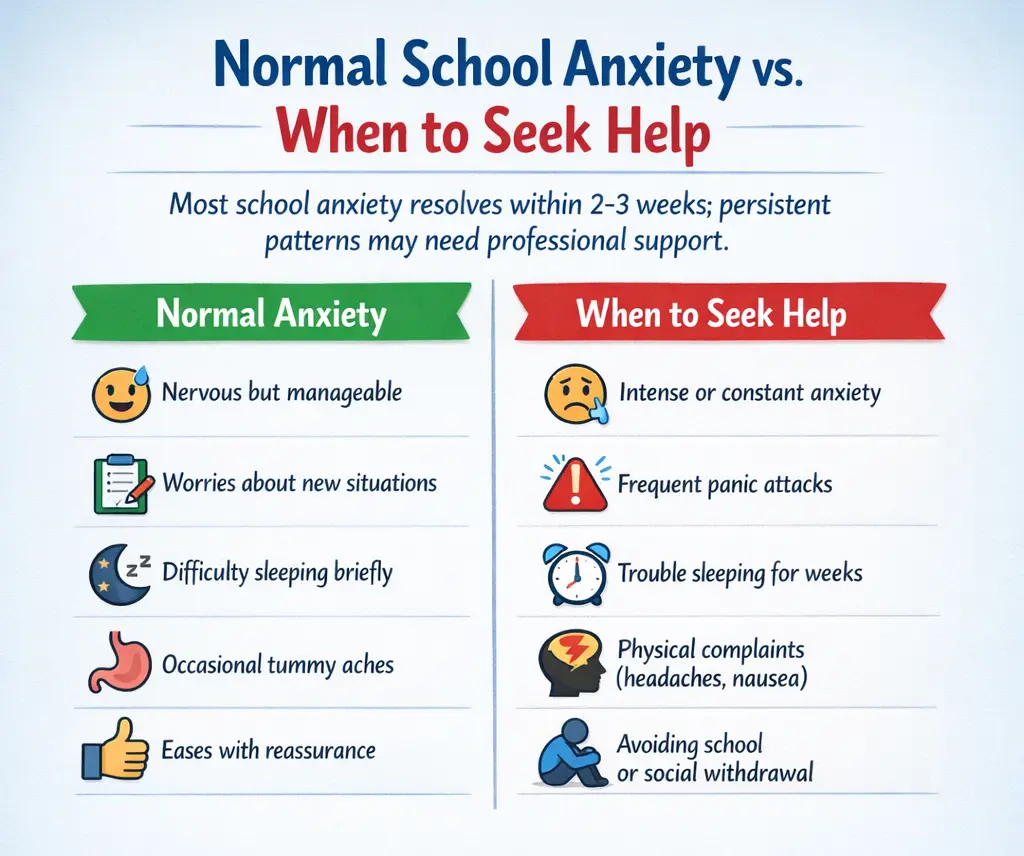
When Anxiety Becomes a Bigger Problem
Most back to school anxiety resolves within 2-3 weeks, but certain patterns indicate professional evaluation is needed.
Seek professional help if:
Severity Indicators:
- School refusal lasting more than 2-3 days
- Panic attacks (sudden intense fear with physical symptoms: racing heart, difficulty breathing, dizziness)
- Physical symptoms severe enough to interfere with functioning
- Significant weight loss or gain
- Self-harm statements or behaviors
- Complete social withdrawal
Duration Indicators:
- Anxiety persisting beyond one month without improvement
- Symptoms worsening rather than stabilizing
- Anxiety spreading to other areas (refusing all activities, not just school)
- Sleep disturbance lasting beyond adjustment period
Functional Impact:
- Academic performance significantly declining
- Complete inability to separate from parent
- Missing school regularly due to anxiety
- Social relationships deteriorating
- Family life significantly disrupted
- Child expressing hopelessness or extreme distress
Underlying Concerns:
- Previous diagnosis of anxiety disorder
- Recent trauma or major life change
- Bullying situations
- Learning difficulties causing academic avoidance
- Suspected sensory processing issues
- Family history of anxiety disorders
Types of Professional Support:
School Counselor: First-line resource for school-specific issues, temporary support, and referral recommendations. Free and accessible.
Pediatrician: Rules out medical causes of physical symptoms, provides anxiety disorder screening, and offers referrals to mental health specialists.
Child Psychologist/Therapist: Provides evidence-based treatment (typically cognitive-behavioral therapy) for clinical anxiety, coping skill development, and family support.
Psychiatrist: Evaluates for anxiety disorders and medication management when therapy alone is insufficient.
Professional Tip: Early intervention prevents anxiety from becoming entrenched. Seeking help isn’t failure—it’s responsive parenting.
What Not to Do
Avoid Forced Exposure:
Throwing children into feared situations without support or preparation (“You’ll be fine, just go!”) can worsen anxiety and damage trust. Gradual, supported exposure works; sudden immersion traumatizes.
Don’t Accommodate Avoidance:
While validating feelings is essential, allowing school avoidance reinforces anxiety. Expect school attendance while providing support for the distress.
Stop Excessive Reassurance:
Constantly reassuring anxious children (“You’ll be fine, don’t worry, nothing bad will happen”) paradoxically increases anxiety by suggesting there’s something to worry about. Limited, confident reassurance works better than repetitive reassurance.
Avoid Comparisons:
“Your brother loved school at your age” or “Other kids don’t act this way” increases shame without reducing anxiety. Each child’s experience is individual.
Don’t Dismiss Physical Symptoms:
Stomachaches and headaches from anxiety are real, not manipulative. Dismissing them teaches children their bodies lie and that you don’t take their distress seriously. Acknowledge the symptom while maintaining boundaries: “I know your stomach hurts. Anxiety can cause that. Let’s try our breathing and see if it helps.”
Stop Information Overload:
Providing extensive details about the school day to reduce uncertainty often backfires, creating more things to worry about. Offer information when requested, not preemptively.
Avoid Sharing Your Own Anxiety:
Your calm confidence (even if performed) helps more than sharing your own school worries or current stress about their anxiety.
Don’t Delay Necessary Help:
Waiting for anxiety to resolve on its own when warning signs appear allows problems to intensify. Professional help is more effective when sought early.
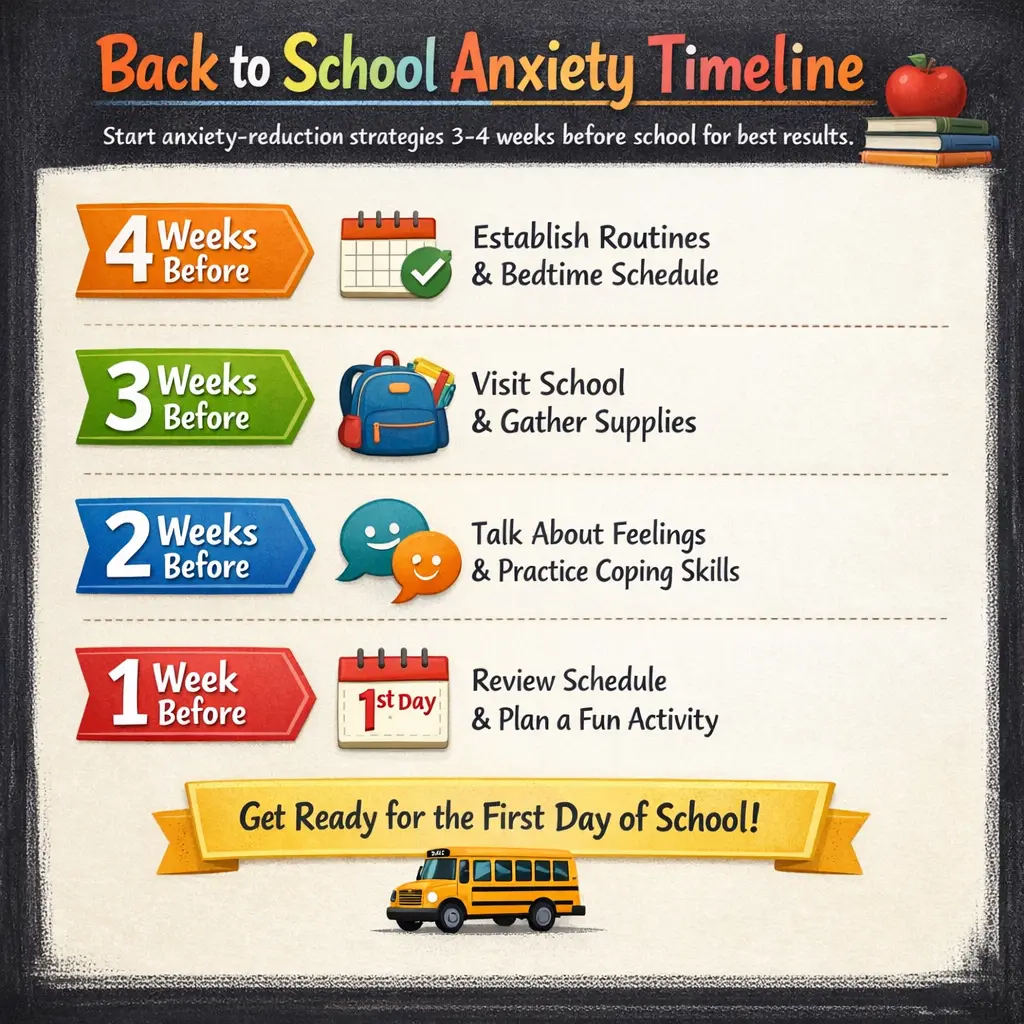
Creating Your Family Action Plan
3-4 Weeks Before School:
- Begin gradual sleep schedule adjustment
- Review school information together
- Contact school about visit opportunities
- Reach out to parents for peer connections
- Start discussing school in neutral, matter-of-fact ways
2-3 Weeks Before School:
- Visit school building if possible
- Practice morning routine 2-3 times
- Complete back-to-school shopping together
- Teach and practice breathing techniques
- Arrange 1-2 peer meetups
1 Week Before School:
- Establish goodbye ritual and practice it
- Complete full dress rehearsal of school morning
- Email teacher with relevant information
- Prepare first-day outfit and materials
- Review photos of school location
- Maintain adjusted sleep schedule strictly
First Week of School:
- Execute consistent goodbye ritual
- Avoid excessive questioning after school
- Maintain routines strictly
- Check in briefly with teacher
- Begin monitoring anxiety indicators
- Celebrate small successes
- Allow downtime for emotional recovery after school
Weeks 2-3:
- Continue monitoring progress
- Adjust strategies based on what’s working
- Maintain teacher communication
- Note improvements to celebrate
- Watch for concerning patterns
Week 4 and Beyond:
- Evaluate progress overall
- Decide if current support is sufficient
- Schedule professional consultation if needed
- Gradually reduce intensive monitoring as child adjusts
- Maintain core routines and coping strategies
Printable Checklist Available:
[Internal Link: Back to School Anxiety Action Plan Printable]
COMPARISON TABLES
Normal Anxiety vs. Clinical Anxiety
| Normal Adjustment Anxiety | Clinical Anxiety Disorder |
|---|---|
| Decreases within 2-3 weeks | Persists beyond one month or worsens |
| Child can be reassured and calmed | Reassurance provides minimal relief |
| Some school resistance but attends | Regular school refusal or severe distress |
| Physical symptoms mild, intermittent | Severe, frequent physical symptoms |
| Functions in most life areas | Impairment across multiple settings |
| Responds to parental coping strategies | Minimal improvement with home strategies |
| Child verbalizes specific concerns | Vague, pervasive worry or panic |
| Age-appropriate fears | Excessive, unrealistic fears |
Strategy Selection by Age
| Age Group | Most Effective Strategies | Less Effective Approaches |
|---|---|---|
| PreK-K (4-5) | Routine establishment, school visits, comfort objects, brief goodbyes, visual schedules | Abstract reassurance, lengthy explanations, expecting emotional articulation |
| Early Elementary (6-8) | Peer connections, teacher partnership, breathing techniques, practice routines, specific problem-solving | Minimizing feelings, forced independence, academic pressure |
| Upper Elementary (9-11) | Identifying specific triggers, breathing techniques, gradual exposure, peer support, skill-building | Excessive parental involvement, dismissing concerns as minor, comparisons to others |
| Middle School (12-14) | Respecting privacy, indirect support availability, social facilitation, teaching self-advocacy, professional help if needed | Hovering, forcing communication, dismissing social concerns, excessive questioning |
Red Flags Requiring Professional Evaluation
| Symptom Category | Concerning Patterns | Timeline for Seeking Help |
|---|---|---|
| School Attendance | Refusal lasting 3+ days, repeated absences, extreme resistance | Immediately if persistent |
| Physical Symptoms | Severe symptoms, significant weight change, repeated ER visits | Within 1 week |
| Emotional Distress | Panic attacks, self-harm statements, hopelessness | Immediately |
| Functional Impairment | Unable to complete daily tasks, complete social withdrawal | Within 2 weeks |
| Duration | No improvement after 3-4 weeks, worsening symptoms | End of week 3 |
| Academic Impact | Significant grade decline, incomplete work, testing refusal | Within 2-3 weeks |
CHECKLISTS
Before School Starts Checklist
4 Weeks Before:
- Calculate required sleep schedule changes
- Begin gradual bedtime adjustment
- Review school calendar and important dates
- Identify child’s specific concerns through gentle conversation
3 Weeks Before:
- Contact school about building visit
- Reach out to parents for peer connections
- Begin practicing morning routine
- Teach breathing techniques during calm moments
2 Weeks Before:
- Visit school building and classroom
- Take photos of key locations
- Complete back-to-school shopping
- Arrange 1-2 peer playdates
- Practice goodbye ritual
1 Week Before:
- Full dress rehearsal of school morning (2-3 times)
- Email teacher with relevant information
- Prepare first-day outfit and supplies
- Review school photos together
- Confirm sleep schedule matches school requirements
Day Before:
- Pack backpack together
- Set out clothes
- Review morning routine
- Early bedtime
- Simple, calm evening
First Week Monitoring Checklist
Daily Observations:
- Morning anxiety level (1-5 scale)
- Physical symptoms present (note type)
- Goodbye difficulty (brief description)
- After-school mood (1-5 scale)
- Sleep quality (hours, ease of falling asleep)
- Appetite and eating patterns
- Positive moments or comments about school
End of Week Review:
- Overall pattern improving, stable, or worsening?
- Which strategies were most helpful?
- Which strategies need adjustment?
- Any new concerns emerged?
- Teacher feedback received?
- Child’s stated feelings?
When to Seek Professional Help Checklist
Seek Help If:
- School refusal lasting 3+ consecutive days
- Panic attacks occurring
- Physical symptoms interfering with daily functioning
- Self-harm statements or behaviors
- No improvement after 3-4 weeks
- Symptoms worsening rather than improving
- Anxiety spreading to other life areas
- Complete social withdrawal
- Significant academic decline
- Family functioning significantly disrupted
- Your parental instinct says something is wrong
DECISION FRAMEWORKS
Is This Normal Anxiety or Something More?
Ask Yourself:
- Duration: Has the anxiety lasted beyond 3-4 weeks without improvement?
- No = Continue current strategies, monitor
- Yes = Consult professional
- Severity: Can my child function in most daily activities despite the anxiety?
- Yes = Normal adjustment anxiety
- No = Seek evaluation
- Responsiveness: Do coping strategies provide at least temporary relief?
- Yes = Continue current approach
- No = Professional consultation recommended
- Interference: Is my child attending school regularly (even if distressed)?
- Yes = Monitor and support
- No = Immediate professional help
- Trajectory: Is anxiety stable or gradually improving?
- Improving = Current strategies working
- Worsening = Seek professional evaluation
Decision: If you answered concerning responses to 2+ questions, professional evaluation is recommended.
Strategy Selection Framework
Step 1: Identify Primary Anxiety Type
- Separation anxiety → Focus on goodbye rituals, gradual exposure, consistency
- Social anxiety → Prioritize peer connections, teacher partnership, social skill practice
- Performance anxiety → Address perfectionism, adjust expectations, build confidence
- General change anxiety → Emphasize routine, familiarity, predictability
Step 2: Consider Child’s Age
- Ages 4-7: Concrete strategies, physical comfort, parental presence
- Ages 8-11: Peer focus, skill-building, problem-solving
- Ages 12-14: Respect autonomy, indirect support, self-advocacy
Step 3: Assess Severity
- Mild: Preventive strategies (routines, preparation)
- Moderate: Active intervention (all 12 strategies)
- Severe: Professional help + supportive strategies
Step 4: Evaluate Resources
- School visit possible? Use Strategy 4
- Know other parents? Use Strategy 5
- Teacher responsive? Use Strategy 11
- Time limited? Prioritize Strategies 1, 2, 10
Step 5: Match to Child’s Temperament
- Verbal child: Communication-based strategies
- Active child: Physical practice and rehearsal
- Introverted child: One-on-one peer connections vs. group events
- Sensory-sensitive child: Environment familiarization critical
FREQUENTLY ASKED QUESTIONS
1. How long does back to school anxiety typically last?
Most children experience the strongest anxiety in the 1-3 days before school starts and the first week of school. This typically decreases significantly by the end of week two and resolves substantially by weeks 3-4 as routines become familiar and predictable. Some residual nervousness on Sunday evenings or after breaks is normal throughout the school year.
If anxiety persists beyond one month without improvement, increases in intensity, or significantly interferes with daily functioning, professional evaluation is recommended. The adjustment period can be slightly longer for children starting completely new schools, entering kindergarten for the first time, or those with naturally cautious temperaments, but should still show gradual improvement week by week.
2. Is it normal for my child to have stomachaches every morning before school?
Yes, physical symptoms are extremely common manifestations of anxiety in children. The gut-brain connection means that emotional stress genuinely causes physical digestive symptoms—these aren’t manipulative or “fake” complaints. Stomachaches, headaches, nausea, and bathroom urgency frequently accompany school anxiety.
Monitor the pattern: anxiety-related symptoms typically appear specifically before school, improve once at school or on weekends, and don’t accompany fever, vomiting, or other illness signs. If stomachaches persist throughout the day, occur on weekends, or include other symptoms, consult your pediatrician to rule out medical causes. Validate the physical discomfort while maintaining expectations: “I know your stomach hurts. Anxiety can cause real stomach pain. Let’s try our breathing exercises and see if that helps.”
3. Should I let my child stay home if they’re very upset about school?
Occasional mental health days are appropriate, but regular school avoidance reinforces anxiety and creates a pattern where staying home becomes the anxiety solution. This makes returning progressively harder and teaches that escape is the only coping mechanism.
The guideline: If your child is genuinely ill (fever, vomiting, contagious condition), they stay home. If anxiety is causing distress but no illness, they attend school with support. You can validate feelings while maintaining boundaries: “I understand you’re nervous. Lots of kids feel this way. I know it’s hard AND I’m confident you can do this. Let’s use our goodbye ritual.”
If anxiety reaches the level of panic attacks, complete inability to function, or severe physical symptoms, consult a professional rather than making repeated stay-home decisions independently. A pattern of Monday absences or increasing refusal requires professional intervention.
4. When should I seek professional help for my child’s school anxiety?
Seek professional help if anxiety:
Persists beyond 3-4 weeks without improvement
Worsens rather than gradually improving
Causes school refusal lasting more than 2-3 days
Results in panic attacks
Includes self-harm statements
Significantly impacts functioning in multiple areas (school, social, family)
Spreads to avoiding other activities beyond school
Causes severe physical symptoms
Also consult a professional if you’re concerned about underlying issues like learning disabilities causing avoidance, bullying, trauma, or if your child has a previous anxiety disorder diagnosis. Early intervention prevents anxiety from becoming entrenched and is more effective than waiting until the situation is severe. Start with your pediatrician or school counselor for assessment and referral recommendations.
5. My child is fine at school but melts down at home. Is this still anxiety?
Absolutely. Many children, particularly in early elementary years, use significant energy to “hold it together” at school, then release the accumulated stress at home where they feel safe. This is called “after-school restraint collapse” and is a very common anxiety pattern.
Your child’s ability to manage at school is a strength, not evidence that anxiety isn’t real. The home meltdowns indicate they’re working hard to cope during the day. Support this by: providing quiet decompression time immediately after school (delay homework, activities, and questions), validating the effort it takes to manage school, offering physical comfort, and maintaining low-key evenings during adjustment periods.
If home meltdowns are severe, frequent, or prolonged (lasting hours), or if you notice your child seems increasingly exhausted or withdrawn, consult the teacher about school observations and consider professional support to build sustainable coping strategies.
6. Will talking about school anxiety make it worse?
No, appropriate conversation about anxiety helps rather than harms. What matters is how you talk about it. Excessive questioning, catastrophizing, or dwelling on worries can amplify anxiety, but validating feelings and collaborative problem-solving reduces it.
Effective approaches: “I noticed you seem worried about school. Want to talk about it?” followed by listening without immediate reassurance or dismissal. Name the feeling: “It sounds like you’re anxious about finding your classroom.” Then problem-solve: “What would make that easier?”
Avoid repeatedly asking “Are you worried about school?” or sharing your own anxiety. Create open space for conversation without pressure: “I’m here if you want to talk about school, or we can just hang out quietly.” Children often need processing time and will raise concerns when ready if they know you’re receptive and calm.
7. Should I tell the teacher about my child’s anxiety?
Yes, brief, factual communication with the teacher is valuable. Teachers benefit from understanding that certain behaviors (quietness, bathroom requests, clinginess at drop-off) stem from anxiety rather than defiance or other issues. This knowledge allows appropriate support and monitoring.
Keep communication concise and collaborative: “I wanted you to know that Sarah tends to feel anxious during transitions. Mornings are particularly difficult right now. At home, specific tasks help her focus. Please let me know if you notice concerning patterns or if there’s anything we should coordinate between home and school.”
Avoid extensive psychological history unless relevant, diagnostic labels without formal evaluation, or demanding special accommodations without proper channels. Frame as partnership: you’re providing information to help the teacher understand your child, not requesting extraordinary measures. Most teachers appreciate this heads-up and will work with you to support your child’s adjustment.
8. What if my anxiety about my child’s school experience is making things worse?
Parental anxiety about children’s school experiences is common and understandable, but children are extremely perceptive and often absorb parents’ emotional states. Your visible worry can signal that school is indeed dangerous or overwhelming, amplifying their anxiety.
Work on your own emotional regulation: identify what specifically worries you, separate realistic concerns from catastrophic thinking, and develop your own coping strategies. Practice “calm confidence” even if performed initially—your demeanor teaches your child how to approach challenges.
If your anxiety stems from your own negative school experiences, recognize that your child’s experience may differ. If anxiety about your child’s wellbeing is overwhelming your functioning, consider brief therapy for yourself. Taking care of your mental health isn’t selfish—it’s modeling healthy coping and provides your child the calm, confident support they need.
9. Is back to school anxiety worse after summer break or after shorter breaks?
Summer break typically causes more significant anxiety because of the longer separation from school routines, greater schedule disruption, and more time for worry to build. The first day after summer break is often the most challenging of the school year.
However, some children experience anxiety after every break—winter holidays, spring break, even weekends—because each transition requires re-adjustment. Monday morning anxiety or post-vacation reluctance can persist throughout the year for some children.
For children with pattern of post-break anxiety, maintain closer adherence to school-year routines even during breaks (similar wake times, structured activities), do brief “school talk” during long breaks without overdoing it, and implement abbreviated versions of back-to-school preparation before returning from any extended break. This consistency reduces the adjustment magnitude each time.
10. Can back to school anxiety be prevented, or is it inevitable for some children?
While some children are temperamentally more prone to anxiety about transitions and new situations, you can significantly reduce the intensity and duration of back to school anxiety through preparation and support. Prevention isn’t about eliminating all nervousness—some anticipatory anxiety about changes is normal and even adaptive—but about keeping it manageable.
Prevention strategies: maintain some routine consistency over summer, talk matter-of-factly about school throughout the year rather than only before return, build strong home-school partnership, develop coping skills during calm times, address previous year’s problems during summer, and start preparation early rather than last-minute.
For children with anxiety-prone temperaments, previous anxiety experiences, or certain developmental conditions, some degree of back to school anxiety may recur annually. This doesn’t represent parenting failure—it reflects your child’s wiring. Focus on building progressively stronger coping skills each year and recognizing improvements even if anxiety isn’t completely eliminated.
Tags: back to school anxiety, school anxiety in children, helping kids with school anxiety, first day of school anxiety, separation anxiety school, school refusal, back to school stress, anxious child returning to school, back-to-school anxiety, returning to school anxiety, new school year anxiety, school-related anxiety, school phobia, academic stress, social anxiety children, performance anxiety students, transition anxiety, childhood anxiety disorders, parental separation anxiety, school adjustment period, coping mechanisms children, anxiety management techniques, how to help child with back to school anxiety, signs of school anxiety in children, what to do when child refuses school, natural remedies for school anxiety, when to see therapist for school anxiety, back to school anxiety by age, reducing morning anxiety before school, why is my child anxious about school, how long does back to school anxiety last, is school anxiety normal, what causes school anxiety, when does school anxiety become a problem, how do I talk to my child about school anxiety






Leave a Reply