
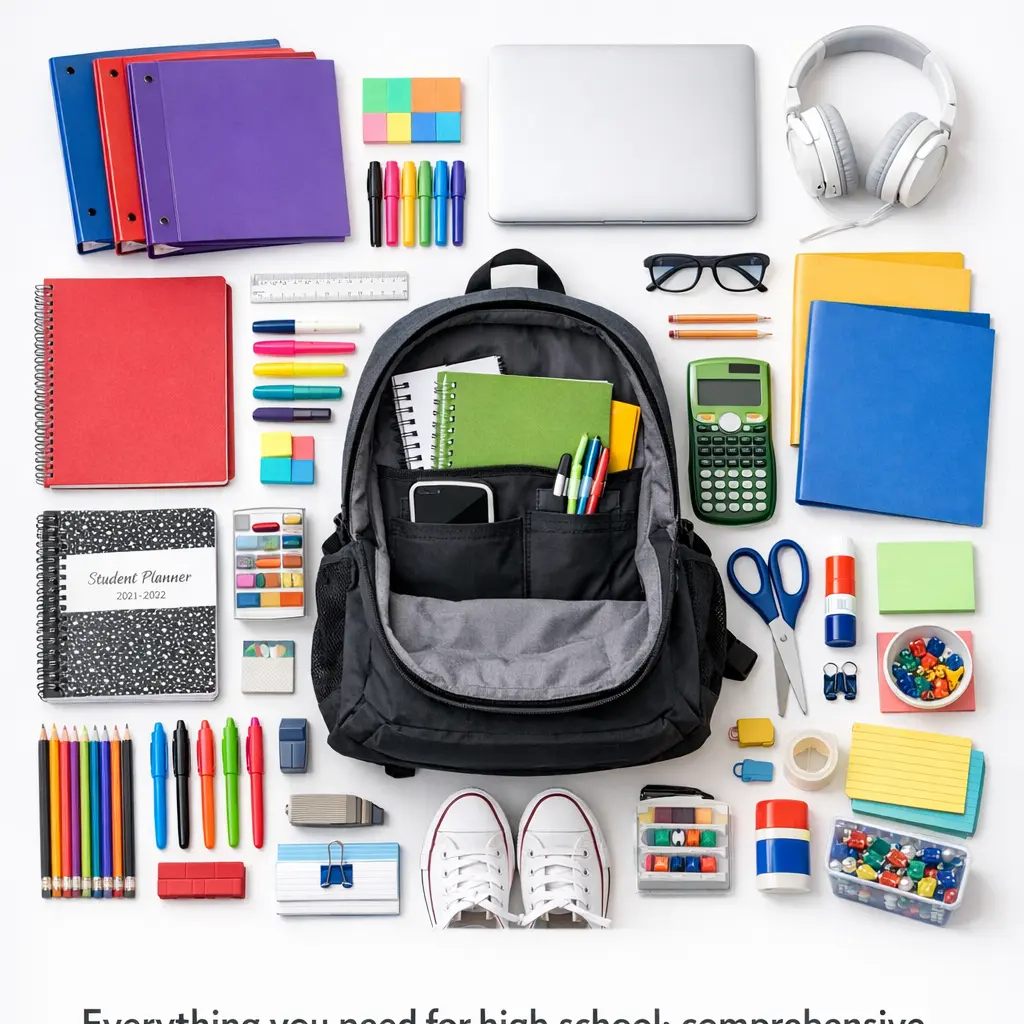
Preparing for high school requires more than just picking up a few notebooks and pencils. Whether your student is entering freshman year or heading into senior year, having the right supplies makes a significant difference in organization, productivity, and academic success. This high school supply list covers everything students in grades 9-12 actually need, with specific guidance for each grade level and course type.
High school differs from middle school in workload, expectations, and organizational demands. Students juggle multiple classes with different teachers, each having unique supply requirements. They manage heavier textbooks, more complex projects, and increased homework. The supplies that worked in eighth grade often fall short when facing advanced coursework, laboratory classes, and college preparation.
This comprehensive guide eliminates guesswork. You’ll find universal essentials every high schooler needs, grade-specific additions, subject-based requirements, and budget-friendly strategies. By the end, you’ll have a customized shopping list tailored to your student’s exact needs without wasting money on unnecessary items.
Universal High School Supply Essentials
These foundational items belong on every high school student’s supply list, regardless of grade level or course selection.
Writing Instruments
Pens: Purchase black and blue ballpoint pens in bulk. Students use pens constantly for notes, assignments, and tests. Buy a pack of 20-24 to start the year.
- Black pens for most assignments
- Blue pens for editing and revision work
- Avoid novelty or gel pens that smudge
- Medium point (1.0mm) provides best balance
Pencils: Stock up on #2 pencils for standardized tests, math work, and scantron forms. Mechanical pencils offer convenience but traditional wooden pencils remain necessary.
- #2 wooden pencils (box of 24)
- Mechanical pencils (2-3) with extra lead
- 0.7mm lead size works universally
- Quality eraser separate from pencil erasers
Highlighters: Multiple colors help with studying and organizing notes. Yellow, pink, blue, and green cover most needs.
- 4-color set minimum
- Chisel tip for versatility
- Replace when dried out (usually mid-year)
Common Mistake: Buying expensive, fashionable pens that students hesitate to use freely. High schoolers lose pens constantly—buy functional, affordable options in quantity.
Professional Tip: Keep a supply box at home stocked with extras. Students will lose or run out of writing instruments, and having backups prevents last-minute shopping trips.
Paper Products
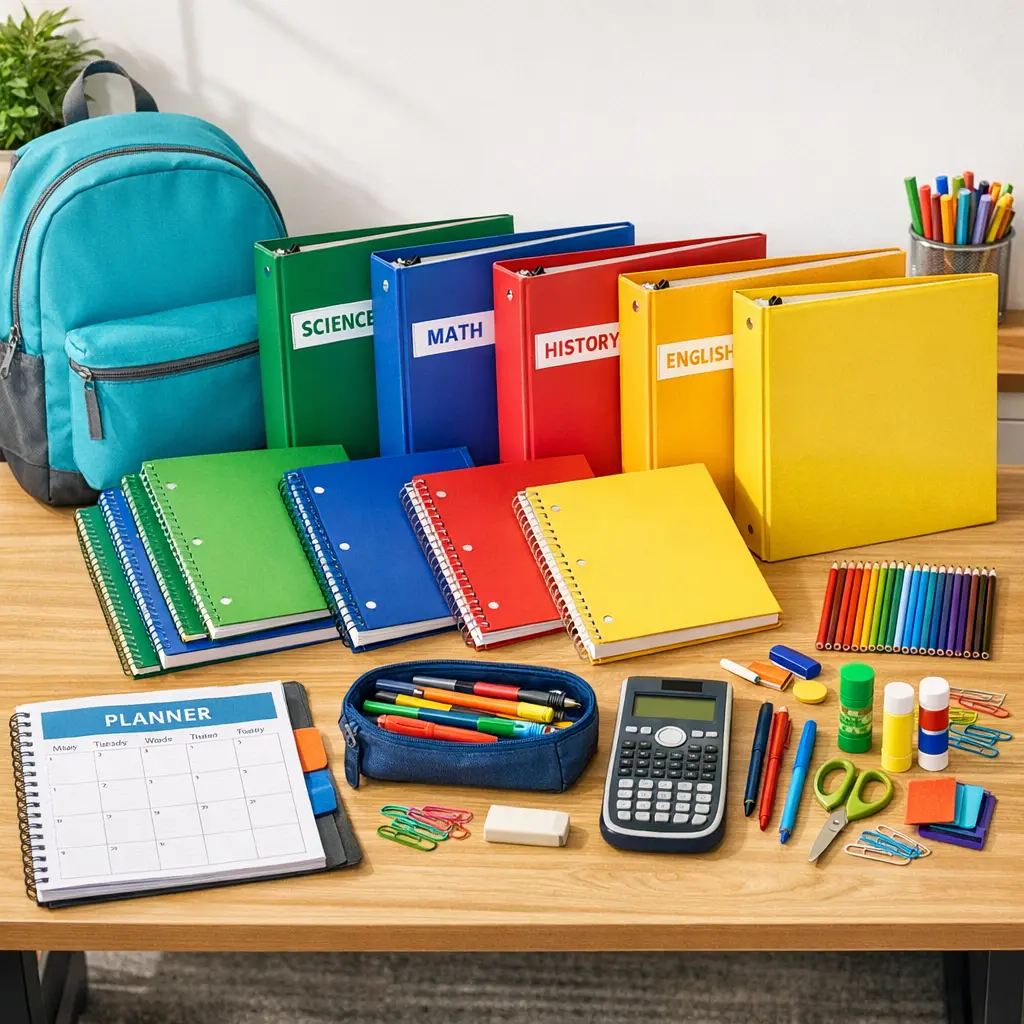
Notebooks: College-ruled composition notebooks and spiral notebooks form the backbone of note-taking systems.
- 5-6 one-subject spiral notebooks (70-100 pages)
- 2-3 composition notebooks for classes requiring bound notes
- College-ruled (not wide-ruled) for high school
- Consider color-coding by subject
Loose-Leaf Paper: Essential for binder-based organization and assignments.
- 500-sheet pack of college-ruled paper
- Reinforced holes last longer
- Buy extra mid-year when supplies run low
Graph Paper: Math and science classes frequently require graphing and diagrams.
- One pad of quad-ruled graph paper
- Additional pads for advanced math courses
Index Cards: Studying vocabulary, formulas, and concepts requires flashcards.
- 3×5 inch size, ruled on one side
- 300-500 cards to start
- Consider colored sets for different subjects
Sticky Notes: Quick reminders, marking textbook pages, and temporary labels.
- Standard 3×3 inch yellow notes
- Small tab-style flags for textbook marking
Organization Tools
Binders: The foundation of most high school organization systems.
- Three 1.5 to 2-inch binders OR one 3-inch binder
- D-ring binders prevent paper tearing
- Clear-view covers allow customization
- Durable construction for daily use
Dividers: Separate subjects or units within binders.
- 5-tab dividers for each binder
- Plastic lasts longer than paper
- Write-on tabs for flexibility
Folders: Portable organization for daily assignments and handouts.
- 6-8 two-pocket folders with prongs
- Plastic folders outlast paper versions
- Color-code to match notebooks
Planner or Agenda: Time management becomes critical in high school.
- Academic year planner (July/August through June)
- Daily or weekly view based on preference
- Space for assignments, tests, activities
- Some students prefer digital planners (calendar apps)
Pencil Pouch: Contains writing supplies within backpack.
- Three-ring pouch that fits in binder OR
- Standalone pencil case
- Clear pouches help locate items quickly
Benefits: Proper organization tools reduce lost papers, missed assignments, and academic stress. Students spend less time searching for materials and more time learning.
Technology Essentials
Calculator: Math courses from Algebra I through Calculus require specific calculator types.
- Scientific calculator minimum (freshman year)
- Graphing calculator (TI-84 Plus most common) by sophomore year
- Check specific teacher requirements before purchasing
- Expect $15-30 for scientific, $90-150 for graphing
Laptop or Tablet: Most high schools integrate technology into daily instruction.
- Check if school provides devices
- If purchasing, confirm school platform (Windows, Mac, Chromebook)
- Protective case essential
- Consider school discounts or refurbished options
USB Drive: Backup for important documents and projects.
- 16GB or 32GB capacity
- Attach to keychain to prevent loss
- Many students now use cloud storage instead
Headphones or Earbuds: Required for many computer-based assignments and language classes.
- Over-ear or in-ear based on preference
- Wired often required (check school policy)
- Backup pair recommended
Common Mistake: Buying calculators that don’t meet course requirements. Check with math teachers before purchasing expensive graphing calculators.
Professional Tip: Label all technology with student name and contact information. Devices look identical and get mixed up or lost frequently.
Backpack Requirements
A high school backpack endures heavy daily use carrying textbooks, binders, technology, and supplies.
Size Specifications:
- 25-35 liter capacity
- Dimensions approximately 18″H x 12″W x 8″D
- Large enough for binders and 13-15″ laptop
Essential Features:
- Padded, adjustable shoulder straps
- Padded back panel for comfort
- Laptop/tablet compartment with padding
- Water bottle pockets (side mesh)
- Multiple organizational pockets
- Durable material (polyester or nylon)
- Reinforced bottom
Quality Considerations: A quality backpack lasts multiple years. Cheap backpacks fail within months under high school demands, requiring replacement and ultimately costing more.
Limitations: Trendy backpacks often sacrifice functionality for style. Prioritize ergonomics and durability, then consider appearance.
Action Step: Test backpacks with weight (use books or water bottles in store). Straps should sit comfortably, weight should distribute evenly, and zippers should operate smoothly under load.
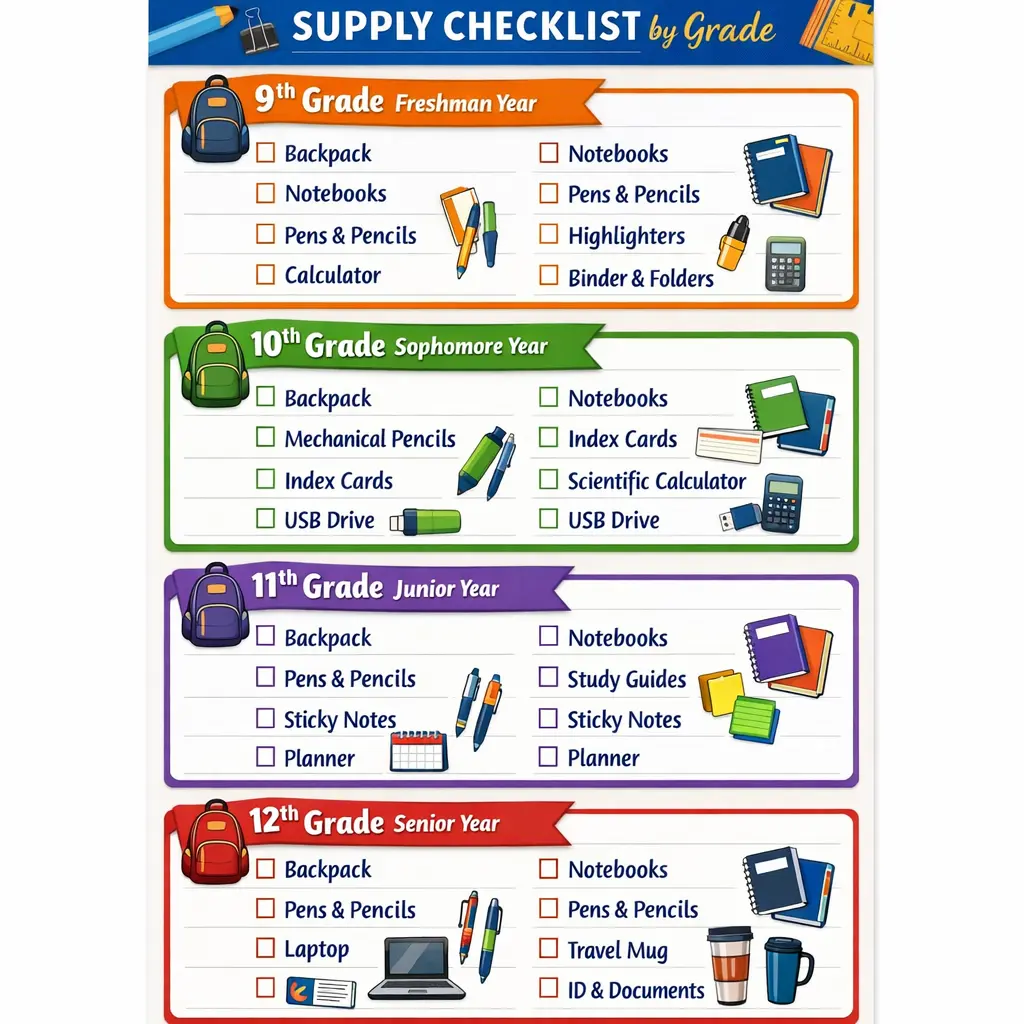
Grade-Specific Supply Lists
Supply needs evolve as students progress through high school. Each grade level introduces new academic demands requiring specific additions.
9th Grade (Freshman) Supplies
Freshman year transitions students from middle school structure to high school independence. Organization and time management tools become critical.
Additional Items Beyond Universal List:
- Scientific calculator: Required for Algebra I or Geometry
- Extra organizational supplies: Adjusting to new system
- Color-coding materials: Different color folders/notebooks per subject
- Locker shelf or organizer: Maximizing locker space
- Combination lock: If not provided by school
- Gym bag: Separate from main backpack for PE clothes
Freshman-Specific Considerations:
Students carry more supplies as they navigate new building layouts and may not return to lockers between classes. Organizational systems require trial and error. Build redundancy into supply purchasing.
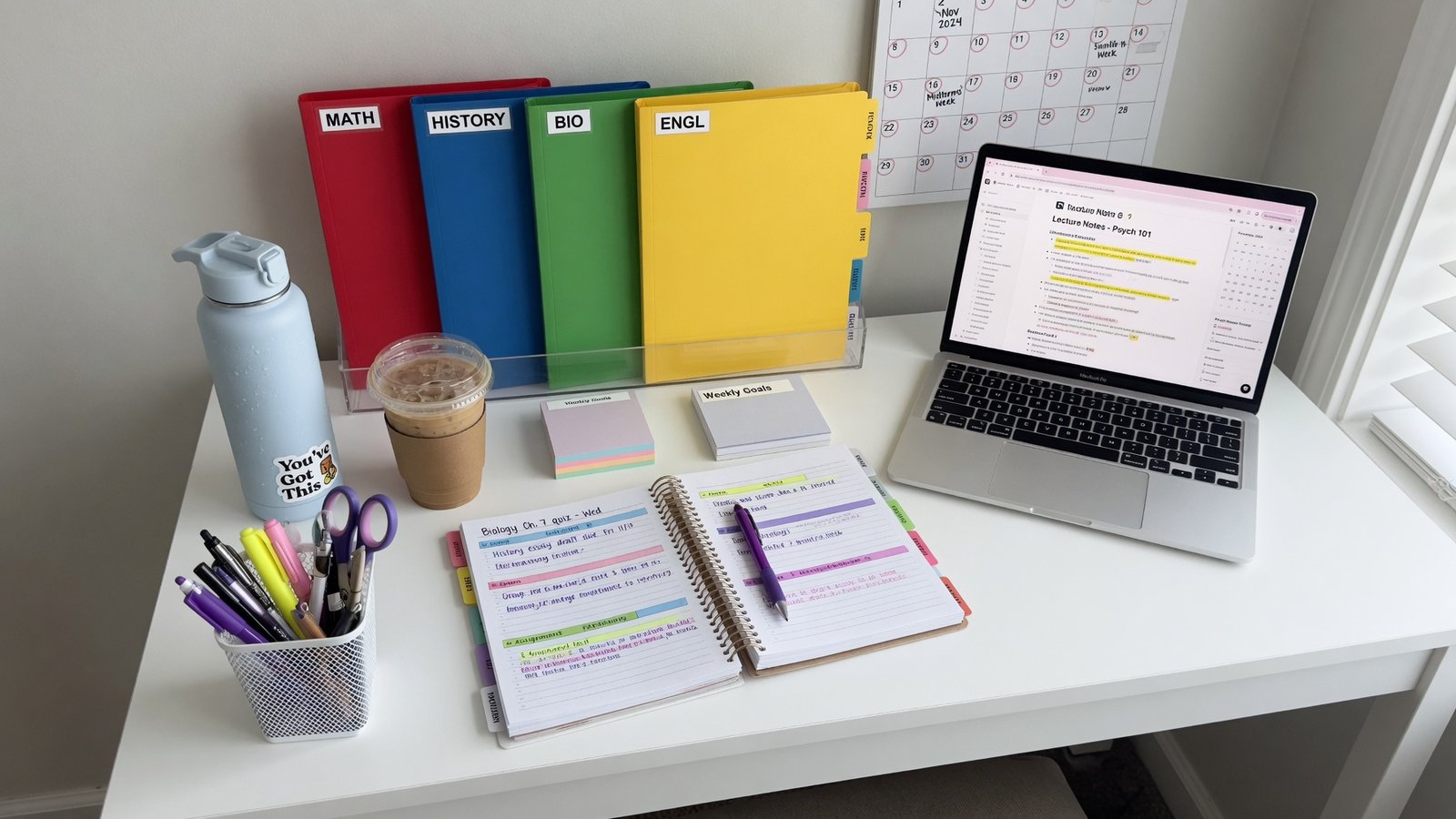
Example Setup: Many freshmen succeed with a color-coded system—red folder and notebook for English, blue for math, green for science, yellow for social studies, orange for foreign language. This visual system helps during transition period.
Professional Tip: Purchase an extra set of basic supplies (pens, pencils, paper) to leave at home for homework. Freshmen often forget to bring materials home or leave homework supplies at school.
10th Grade (Sophomore) Supplies
Sophomore year intensifies coursework. Students take more advanced classes and prepare for standardized testing.
Additional Items Beyond Universal List:
- Graphing calculator: If taking Algebra II or Geometry Honors
- College prep materials: SAT/PSAT preparation books (spring semester)
- Advanced binders: More subjects require dedicated organization
- Expanded planner use: Balancing increased homework load
- Subject-specific materials: Determined by course selection
Sophomore-Specific Considerations:
Students typically establish preferred organization methods by sophomore year. Some commit fully to binder systems, others to separate notebooks. Support the system that works for individual students rather than forcing change.
Standardized testing preparation begins sophomore year with PSAT practice. Budget for test prep materials and potential tutoring.
Common Mistake: Assuming freshman year supplies automatically work sophomore year. Course difficulty increases, and organizational systems need upgrading.
11th Grade (Junior) Supplies
Junior year presents the most academically demanding high school year. Advanced Placement courses, SAT/ACT testing, and college preparation require specialized supplies.
Additional Items Beyond Universal List:
- Multiple graphing calculators: Some students keep one at home, one at school
- SAT/ACT prep materials: Official study guides, practice tests
- College planning materials: College search binders, application organizers
- AP course-specific supplies: Determined by AP classes
- Professional portfolio: For students in career/technical programs
- Resume materials: For college applications and scholarships
Junior-Specific Considerations:
Students balance rigorous coursework with standardized testing and college preparation. Organization and time management determine success more than any other factor.
Many juniors benefit from academic coaching or tutoring. Budget accordingly if student struggles with workload management.
Professional Tip: Create a dedicated college preparation binder or digital folder junior year. Store college research, test scores, activity lists, and application materials in one location.
12th Grade (Senior) Supplies
Senior year balances continued academic work with college applications, scholarship searches, and transition preparation.
Additional Items Beyond Universal List:
- Application organization system: Physical or digital tracking
- Professional clothing: College interviews, scholarships
- Thank you cards: Post-interview and recommendation requests
- Document portfolio: Transcripts, essays, recommendation copies
- Financial aid materials: FAFSA worksheets, scholarship applications
- Reduced supply quantities: Many seniors need less as year progresses
Senior-Specific Considerations:
First semester requires full academic engagement. Second semester (post-college decisions) needs significantly fewer supplies for many students.
Students applying to competitive programs or scholarships need materials for creating professional presentations and portfolios.
Common Mistake: Over-purchasing supplies senior year. Many students coast second semester and don’t use full-year quantities of consumable supplies.
Action Step: Purchase conservative quantities in fall. Re-evaluate in January based on second semester course load and post-graduation plans.
Subject-Specific Supply Additions
Core supply lists cover general needs. Specific courses require additional specialized materials.
Math and Science Classes
Standard Math Courses (Algebra, Geometry):
- Scientific calculator
- Ruler with metric and imperial measurements
- Protractor
- Compass
- Graph paper (quad-ruled)
Advanced Math Courses (Trigonometry, Pre-Calculus, Calculus):
- Graphing calculator (TI-84 Plus or TI-Nspire)
- Additional graph paper
- Formula sheet holder
Science Classes with Labs:
- Lab notebook (composition-style, bound pages)
- Safety goggles (if not provided)
- Lab apron or old clothing
- Disposable gloves (latex or nitrile)
- Scientific calculator
Benefits: Having proper math and science supplies prevents borrowing, delays, and inability to complete assignments. Calculators especially impact grades when students lack required technology.
English and Language Arts
Standard English Classes:
- Additional notebooks or dedicated binder section
- Book covers for assigned novels
- Sticky tabs for marking literature passages
- Extra folders for essay drafts and revisions
Advanced English/AP Literature:
- Literary analysis guides or study aids
- Expanded notebook/paper supply for extensive writing
- Citation guide (MLA, APA)
- Quality printer paper for essays
Common Mistake: Assuming standard supplies suffice for reading-heavy English classes. Students need organization systems specifically for managing multiple texts, essay drafts, and literature analysis.
Foreign Language Classes
All Foreign Language Levels:
- Dedicated notebook for vocabulary
- Index cards for flashcard creation
- Two-pocket folder for handouts
- Audio capability (headphones, language lab access)
Advanced Language Classes:
- Translation dictionary (if allowed)
- Additional index cards for grammar patterns
- Cultural project supplies (vary by assignment)
Professional Tip: Color-code foreign language materials differently than other subjects. The dedicated visual distinction helps students mentally switch language modes.
Art and Creative Courses
Art supply requirements vary dramatically by specific course. Confirm exact requirements with instructors before purchasing.
General Art Classes:
- Sketchbook (size specified by teacher)
- Drawing pencils (various grades)
- Eraser (kneaded and standard)
- Basic art supply kit
Specialized Art Courses:
- Course-specific materials (paints, clay tools, digital design software)
- Portfolio case for transporting artwork
- Smock or old clothing
Limitations: Art supplies get expensive quickly. Purchase only confirmed required items. Many schools provide basic materials, with students supplementing as needed.
Physical Education
Standard PE Requirements:
- Athletic shoes (non-marking soles)
- Gym clothes (typically school-specified)
- Gym bag separate from school backpack
- Personal hygiene items (deodorant, etc.)
- Combination lock for PE locker
- Water bottle
Specialized PE Courses (weight training, yoga, swimming):
- Activity-specific clothing or equipment
- Confirm school-provided vs. student-provided items
Advanced Placement Courses
AP courses demand more rigorous organization and additional reference materials.
All AP Courses:
- AP test prep book specific to course
- Extra notebooks for extensive notes
- Expanded organizational system
- Supplementary reference materials
AP STEM Courses:
- Graphing calculator with specific functions
- Additional graph paper and lab materials
- Formula sheets and reference cards
AP Humanities Courses:
- Citation guides
- Additional reading materials
- Expanded writing supplies
Professional Tip: Buy AP test prep books early in the school year. Waiting until spring creates unnecessary stress and reduces preparation time.
Organization Systems That Work
Supplies only help when organized effectively. High school students need consistent systems matching their learning style and school structure.
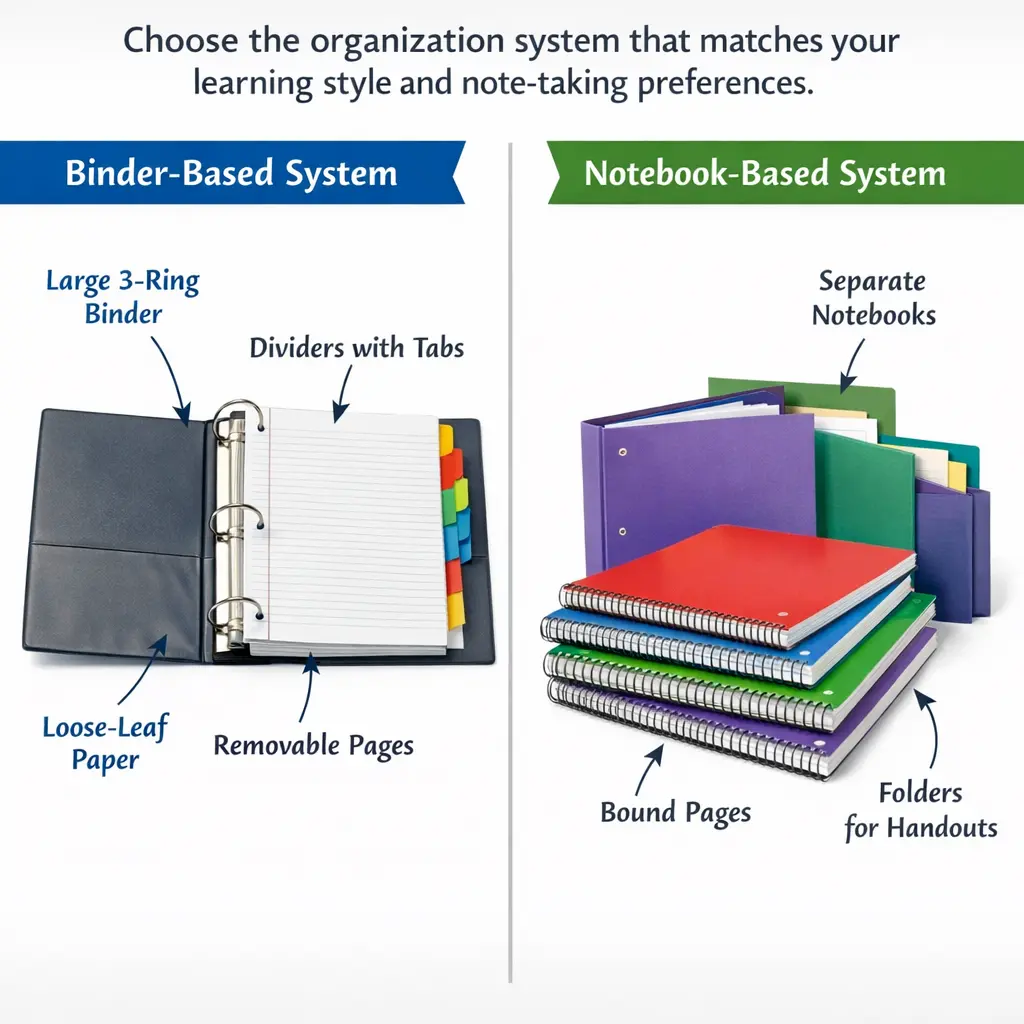
Binder vs. Notebook Method
Binder-Based System:
How it works: One large binder (3-inch) with dividers for each subject OR multiple smaller binders (1.5-inch) per subject.
Advantages:
- Consolidates all materials in one location
- Easily add/remove papers
- Customizable organization
- Works well for assignment-heavy classes
Disadvantages:
- Heavy to carry
- Pages tear out if binder quality poor
- Requires consistent hole-punching
Best for: Students with frequent handouts, those who prefer consolidation, organized students who maintain systems.
Notebook-Based System:
How it works: Separate spiral or composition notebook for each subject, supplemented with folders.
Advantages:
- Lightweight and portable
- Bound pages don’t fall out
- Less expensive than quality binders
- Simpler maintenance
Disadvantages:
- Cannot reorganize notes
- Difficult to add handouts
- More items to track
Best for: Students who take extensive notes, those carrying materials between home and school daily, students who lose papers from binders.
Hybrid Approach: Many successful students use notebooks for daily notes with one master binder at home for organizing handouts, graded assignments, and study materials.
Action Step: Try chosen system for 2-3 weeks. If materials get lost, assignments go missing, or frustration builds, switch systems. No single method works for everyone.
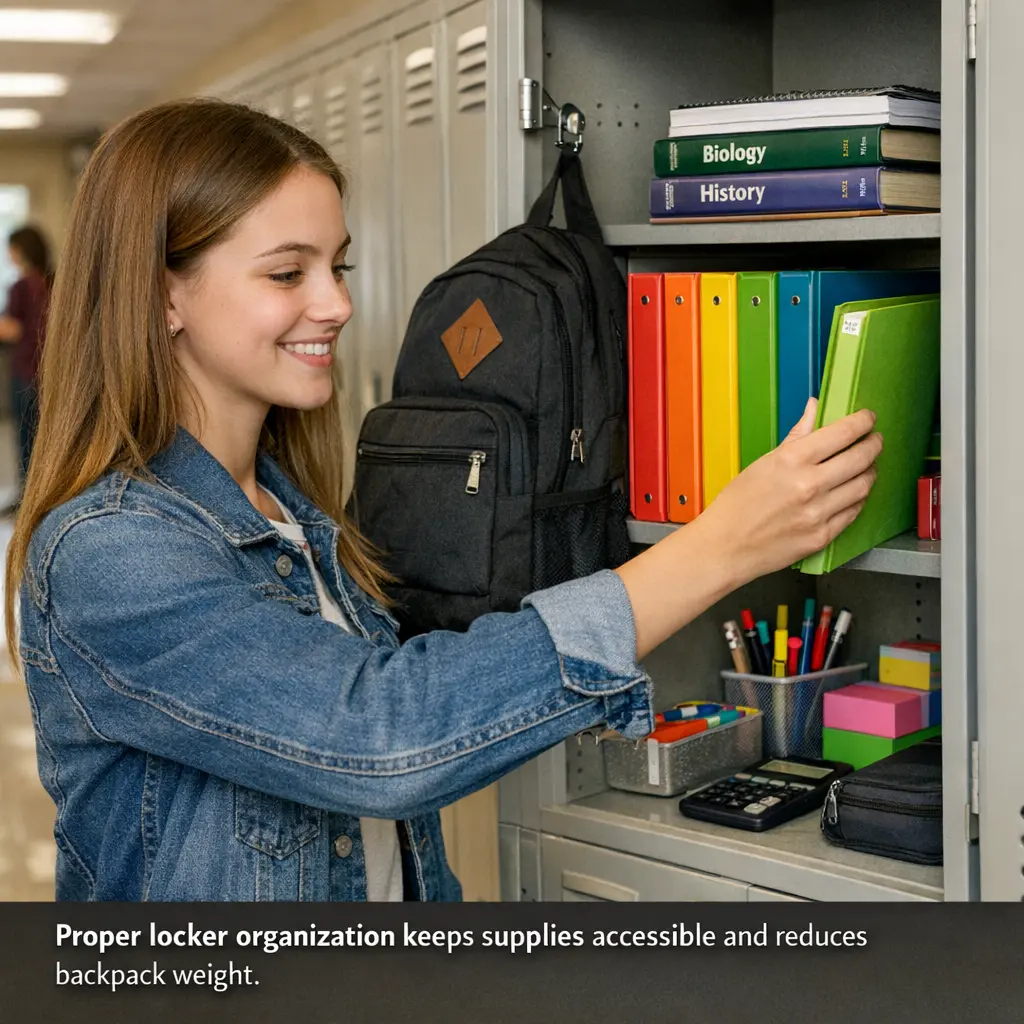
Locker Organization
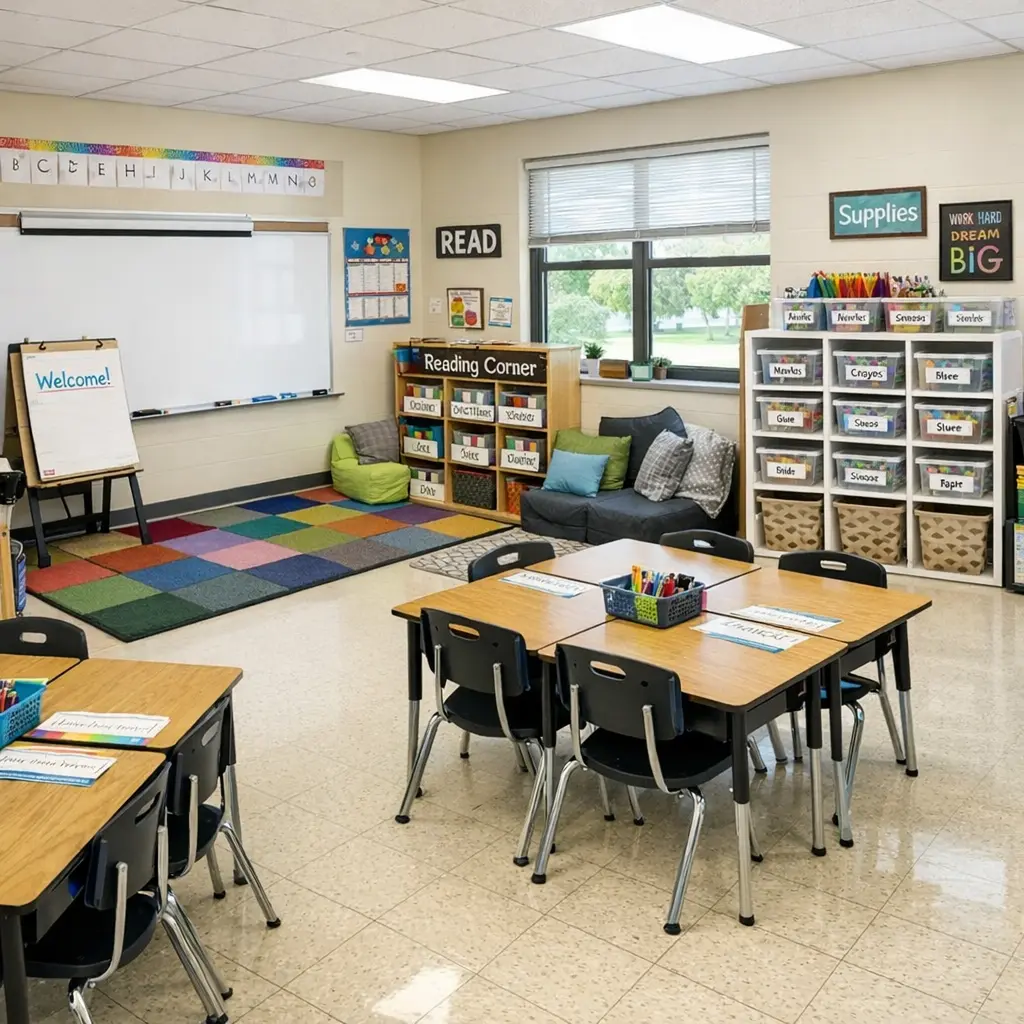
Efficient locker use prevents carrying unnecessary weight and helps retrieve materials quickly between classes.
Essential Locker Supplies:
- Locker shelf (doubles storage space)
- Magnetic hooks or organizers
- Magnetic dry erase board for reminders
- Mirror (if permitted)
- Extra supplies storage container
Organization Strategy:
- Top shelf: Textbooks for afternoon classes
- Middle area: Current class materials, backpack
- Bottom: Textbooks for morning classes, gym bag
- Door: Hooks for jackets, mirrors, schedules
Professional Tip: Visit locker between morning and afternoon classes to swap textbooks. Carrying all textbooks all day creates unnecessary physical strain and backpack wear.
Backpack Organization
Random supply placement leads to wasted time, bent papers, and broken materials.
Backpack Organization System:
Main compartment: Binders, folders, textbooks (spine down)
Laptop sleeve: Computer, tablet, or large notebooks
Front pocket: Frequently needed items (planner, pencil pouch, calculator)
Side pockets: Water bottle, headphones, small items
Hidden pockets: Valuable items (phone, wallet)
Maintenance Schedule:
- Daily: Remove trash, completed assignments to turn in
- Weekly: Reorganize contents, remove unnecessary items
- Monthly: Deep clean, repair issues, replace worn supplies
Common Mistake: Treating backpack as portable storage unit. Carrying unnecessary items adds weight, creates disorganization, and wears out backpack faster.
Digital File Management
Students using laptops or tablets need organization systems for digital materials.
Folder Structure:
textSchool Year 2024-2025/
  ├── English/
  │   ├── Essays/
  │   ├── Notes/
  │   └── Reading/
  ├── Math/
  ├── Science/
  ├── Social Studies/
  └── Electives/
File Naming Convention: Use consistent naming—Subject_Assignment_Date (English_Essay1_2024-09-15)
Backup Strategy:
- Cloud storage (Google Drive, OneDrive, Dropbox)
- External hard drive (monthly backup)
- USB drive for critical files
Professional Tip: Create new main folder each school year. Keep previous years’ materials in archive folder. Don’t delete old schoolwork—it serves as reference for future courses.
Budget-Friendly Shopping Strategies
Quality supplies don’t require premium spending. Strategic shopping saves money while meeting all academic needs.
Essential vs. Optional Items
Essential (Must Purchase):
- Writing instruments
- Paper products
- Basic organizational tools (binders, folders)
- Calculator meeting course requirements
- Backpack
- Technology if school doesn’t provide
Conditional (Wait for Confirmation):
- Specialized subject supplies
- Advanced calculators (until course requires)
- Extra organizational accessories
- Trendy or decorative items
Optional (Enhance but Not Required):
- Premium brands over functional alternatives
- Decorative organizational items
- Backup technology items
- Convenience items
Budget Allocation Example (Total: $150-200):
- Backpack: $40-60 (quality investment)
- Calculator: $15-30 (scientific), delay graphing until required
- Writing instruments: $15-20
- Paper products: $15-20
- Binders and folders: $20-25
- Technology accessories: $15-25
- Miscellaneous supplies: $20-30
- Reserve fund: $10-20
Professional Tip: Create two lists—”Buy Now” and “Wait and Confirm.” Purchase essentials immediately, but delay conditional items until teachers confirm requirements (usually first week of school).
When to Buy Quality
Strategic quality investment saves money long-term by preventing replacements.
Invest in Quality:
Backpack: Heavy daily use for 2-4 years justifies $40-80 investment. Cheap backpacks fail within months.
Graphing Calculator: Used for 2-4 years across multiple courses. Quality calculator ($100-150) lasts through college.
Binders: Heavy-duty binders ($5-8 each) last full year. Cheap binders ($2) break within semester, requiring replacement.
Planner: Well-constructed planner withstands daily use. Quality binding and paper prevent falling apart mid-year.
Buy Standard/Generic:
Paper products: Generic loose-leaf, notebooks, and index cards perform identically to name brands at half the cost.
Writing instruments: Basic Bic or generic pens work as well as premium brands. Students lose pens frequently—quantity over quality.
Folders: Generic plastic folders last as long as branded versions.
Pencils: Standard #2 pencils are commodity items. Any brand works.
Example: Spending $50 on quality backpack that lasts four years costs $12.50 annually. Buying $20 backpack that fails yearly costs $20 annually—60% more over time.
Generic vs. Brand Name
Brand Name Worth Paying For:
- Graphing calculators (TI-84 Plus industry standard, compatibility matters)
- Specific planner systems if student commits to method
- Backpack brands with warranty and durability reputation
- Technology meeting school platform requirements
Generic Works Equally Well:
- Paper products (loose-leaf, notebooks, index cards)
- Writing instruments (pens, pencils, highlighters)
- Folders and basic organization
- Most art supplies (unless professional-grade required)
Common Mistake: Assuming brand names indicate quality across all categories. Paper quality varies minimally between brands, while calculator compatibility significantly impacts coursework.
Shopping Timeline
Late July/Early August (6-8 weeks before school):
- Purchase backpack (best selection)
- Buy core supplies (avoid late-summer shortages)
- Take advantage of tax-free weekends
- Order specialized items online
Mid-August (2-3 weeks before school):
- Stock up during peak back-to-school sales
- Finalize general supply purchases
- Wait on subject-specific items
First Week of School:
- Attend class and collect supply lists
- Confirm calculator requirements
- Purchase subject-specific materials
- Buy items overlooked in initial shopping
September/October:
- Replace consumed supplies (pens, paper)
- Add items proven necessary
- Avoid this timeframe for initial shopping (limited selection, higher prices)
January (semester break):
- Replenish depleted supplies
- Replace worn organizational tools
- Prepare for second semester courses
Professional Tip: Buy next year’s basic supplies during current year’s back-to-school sales. Store until needed. Prices increase 20-40% outside peak sales periods.
Quality and Durability Guide
Understanding supply lifespan helps budget and prevent mid-year shortages.
Supplies Worth the Investment
Backpack ($40-80, lasts 2-4 years):
Quality indicators—padded straps, reinforced stitching, YKK zippers, water-resistant material, warranty coverage.
Brands known for durability—JanSport, L.L.Bean, North Face, Eastpak (all offer warranties).
Graphing Calculator ($100-150, lasts 4-8 years):
TI-84 Plus CE or TI-Nspire CX standard for high school through college. Durable construction, replaceable batteries, regular software updates.
Planner/Agenda ($15-30, lasts 1 year):
Quality binding, thick paper stock, durable cover. Popular systems—Blue Sky, Erin Condren, school-specific planners.
Binders ($5-8 each, lasts 1 year):
Heavy-duty construction, D-ring mechanism, reinforced edges. Avery, Five Star, Case-it brands offer reliable options.
Laptop ($300-800, lasts 3-5 years):
If purchasing, prioritize build quality and warranty. Schools often negotiate education discounts.
What to Replace Each Year
Annual Replacement Items:
- Backpack (if budget model) or every 2-4 years (quality model)
- Planner/agenda
- Worn binders (check rings and covers)
- Pencil pouch if torn
- Gym shoes when tread wears
Replenish Throughout Year:
- Pens (constantly lost or runs out)
- Pencils
- Notebook paper
- Notebooks (when filled)
- Folders (when torn or damaged)
- Highlighters (when dried out)
Expect Mid-Year Replacement:
- Calculator batteries
- Backpack zippers (repair or replace backpack)
- Binder rings if poor quality
- Planner if binding fails
Action Step: Check supplies monthly. Replenish before completely running out to avoid emergency purchases at premium prices.
Brand Recommendations
These brands consistently deliver reliability in school supply categories:
Backpacks:
- JanSport: Lifetime warranty, classic designs, $40-70
- L.L.Bean: Lifetime warranty, durable, $50-80
- North Face: High quality, 2-4 year lifespan, $60-90
- Eastpak: 30-year warranty, European brand, $50-80
Calculators:
- Texas Instruments: TI-84 Plus CE industry standard
- Casio: Scientific calculators, budget-friendly
Writing Instruments:
- Bic: Reliable pens, affordable
- Paper Mate: Comfortable grip options
- Ticonderoga: Best wooden pencils
- Pentel: Quality mechanical pencils
Binders:
- Five Star: Durable construction, flex design
- Avery: Heavy-duty options, clear pockets
- Case-it: All-in-one organizer binders
Notebooks:
- Mead: Standard quality, widely available
- Five Star: Reinforced spiral binding
- Composition notebooks: Any brand (minimal difference)
Paper Products:
- Generic store brands work well
- Reinforced loose-leaf: Five Star, Mead
Professional Tip: Read reviews before purchasing expensive items. Other parents and students identify quality issues and better alternatives.
Common Mistakes to Avoid
Learning from others’ errors saves money, time, and frustration.
Mistake 1: Buying Everything on School-Provided Lists
Many school lists include optional items, teacher preferences, or unnecessary quantities. Use provided lists as guides, not absolute requirements.
Solution: Wait until first week of classes. Teachers clarify actual requirements, often reducing lists significantly.
Mistake 2: Last-Minute Shopping
Late August shopping faces limited selection, frequent stockouts, and higher prices.
Solution: Shop 3-4 weeks before school starts. Take advantage of mid-summer sales and full inventory.
Mistake 3: Prioritizing Style Over Function
Trendy backpacks, decorative binders, and fashionable supplies often sacrifice durability and utility.
Solution: Balance style with function. Choose attractive options among durable, well-designed products.
Mistake 4: Buying Insufficient Quantities
Running out of basic supplies mid-year requires inconvenient shopping trips and paying non-sale prices.
Solution: Purchase generous quantities of consumables (pens, pencils, paper). Storage at home prevents shortages.
Mistake 5: Ignoring Organizational Systems
Buying supplies without system planning leads to disorganized backpacks and lost materials.
Solution: Decide on organizational method (binder vs. notebook) before shopping. Purchase cohesive system components.
Mistake 6: Over-Investing in Freshman Year
Students refine preferences throughout high school. Expensive system investments freshman year often change.
Solution: Buy functional quality freshman year. Invest in premium organizational systems once student identifies preferred methods.
Mistake 7: Skipping Quality for Initial Savings
Cheap backpacks, binders, and calculators fail quickly, requiring replacement and ultimately costing more.
Solution: Identify items used heavily over multiple years. Invest appropriately in those categories.
Mistake 8: Not Labeling Items
Unlabeled supplies get mixed up, lost, or taken by other students.
Solution: Label everything with student name. Use permanent marker or labels on all items, especially technology and calculators.
Mistake 9: Buying School Supplies at Office Supply Stores Only
Retail office supply stores offer convenience but often higher prices than discount retailers or online options.
Solution: Compare prices across retailers. Discount stores, warehouse clubs, and online retailers frequently offer better value.
Mistake 10: Forgetting Digital Organization
Students focus on physical supplies while neglecting digital file organization and backup systems.
Solution: Establish digital organization structure and backup routine before school starts. Prevent devastating file losses.
Professional Tips from Teachers
Educators share insights from years of observing student success and struggles.
Tip 1: Color-Code Thoughtfully
Assign consistent colors to subjects across all materials (folders, notebooks, binders). Visual association reduces grabbing wrong materials.
Tip 2: Keep Backup Supplies at Home
Maintain second set of basic supplies (pens, pencils, paper, calculator) at home. Students forget materials or leave homework supplies at school.
Tip 3: Establish Sunday Supply Check Routine
Weekly review ensures adequate supplies for coming week. Prevents Monday morning scrambles discovering empty pens or full notebooks.
Tip 4: Invest in Planner Training
Best planner means nothing if unused. Spend time first two weeks establishing planner habits. Consistency matters more than system choice.
Tip 5: Photograph Supply Lists
Take photos of teacher supply lists first week. Reference throughout year when replacing items or helping other students.
Tip 6: Create Assignment Turn-In Folder
Dedicated folder for completed homework prevents lost assignments. Check folder each morning before school.
Tip 7: Use Pencil Pouch Inventory System
Monthly pencil pouch check reveals consumption patterns. Adjust purchasing based on actual use rather than assumptions.
Tip 8: Don’t Buy Unnecessary Tech
Tablets, special keyboards, styluses seem helpful but often go unused. Confirm actual need before purchasing supplementary technology.
Tip 9: Prepare Locker for First Day
Set up locker organization before classes start. Installation during passing periods creates stress and tardiness.
Tip 10: Quality Calculator Matters for Math Success
Struggling students often use inadequate calculators. Proper calculator for course level removes unnecessary obstacles to learning.
Comparison Tables
Calculator Comparison for High School Math
| Calculator Type | Courses | Key Features | Price Range | When to Buy |
|---|---|---|---|---|
| Scientific | Algebra I, Geometry (basic) | Trigonometry, logarithms, fractions | $15-30 | 9th grade |
| Graphing (TI-84 Plus CE) | Algebra II, Pre-Calc, Calculus, AP courses | Graphing, programming, apps | $100-150 | 10th grade or when required |
| TI-Nspire CX | Advanced STEM courses | CAS capability, color display, advanced functions | $140-180 | Only if specifically required |
| Basic | Elementary math review | Four functions, percentages | $5-10 | Not recommended for high school |
Backpack Comparison
| Feature | Budget ($20-30) | Mid-Range ($40-60) | Premium ($70-100) |
|---|---|---|---|
| Expected Lifespan | 1 year | 2-3 years | 4+ years |
| Warranty | None | Limited (1 year) | Lifetime or extensive |
| Padding | Minimal | Adequate | Extensive |
| Organizational Pockets | 2-3 | 4-6 | 6-8 |
| Water Resistance | None | Light | Full |
| Laptop Protection | Basic sleeve | Padded compartment | Suspended, padded compartment |
| Best For | Temporary use, tight budgets | Most students | Heavy users, multi-year investment |
Organization System Comparison
| System | Setup Cost | Maintenance | Flexibility | Weight | Best For |
|---|---|---|---|---|---|
| Single Large Binder | $10-15 | Medium | High | Heavy | Organized students, locker access |
| Multiple Small Binders | $25-35 | Medium | High | Medium | Subject separation preference |
| Notebook + Folder | $20-30 | Low | Low | Light | Note-takers, simple systems |
| Hybrid (Notebooks + Home Binder) | $30-40 | Medium | High | Medium | Most students, balanced approach |
| Digital-First | $0-20 | Low | Very High | Very Light | Tech-savvy, school provides devices |
Checklists
Universal High School Supply Checklist
Writing Instruments:
- Black pens (20-24)
- Blue pens (10-12)
- #2 pencils (24)
- Mechanical pencils (2-3)
- Extra lead (0.7mm)
- Highlighters (4-color set)
- Quality erasers (2-3)
Paper Products:
- Loose-leaf paper (500 sheets)
- Spiral notebooks (5-6)
- Composition notebooks (2-3)
- Graph paper (1 pad)
- Index cards (300-500)
- Sticky notes
- Sticky flags
Organization:
- Binders (quantity based on system)
- Dividers with tabs
- Two-pocket folders (6-8)
- Pencil pouch
- Planner or agenda
Technology:
- Calculator (type based on grade/courses)
- Laptop/tablet (if required)
- USB drive (16-32GB)
- Headphones/earbuds
- Device chargers
- Protective cases
Backpack:
- Quality backpack with laptop compartment
- Water bottle
Locker/Personal:
- Combination lock
- Locker shelf or organizer
- Mirror (optional)
- Magnetic hooks
Physical Education:
- Athletic shoes
- Gym clothes
- Gym bag
- Personal hygiene items
- Water bottle
First Day Preparation Checklist
Week Before:
- Organize locker with shelf and supplies
- Test combination lock multiple times
- Prepare backpack with all supplies
- Charge all electronic devices
- Set up planner with school calendar
- Label all items with name
Day Before:
- Pack backpack with Day 1 essentials
- Prepare gym bag if PE scheduled
- Charge laptop/tablet fully
- Print schedule and map
- Prepare questions for teachers
- Lay out first-day outfit
Morning Of:
- Check backpack contents
- Verify calculator has batteries
- Bring extra supplies for sharing
- Carry schedule and map
- Arrive early to locate classes
Supply Maintenance Checklist (Monthly)
Inventory Check:
- Count remaining pens and pencils
- Assess paper supply
- Check notebook space remaining
- Verify calculator batteries
- Review folder condition
Organization Audit:
- Remove old papers from binders
- File or discard graded assignments
- Reorganize backpack contents
- Clean out locker
- Update planner
Replenishment:
- Purchase needed supplies
- Replace damaged items
- Add subject-specific materials as needed
Budget Shopping Checklist
Before Shopping:
- Review school-provided supply lists
- Inventory supplies from previous year
- Determine organization system
- Set budget limit
- Research calculator requirements
Shopping Priority:
- Purchase essentials first
- Compare prices across stores
- Look for multi-pack discounts
- Check for student discounts
- Save receipts for returns
After Shopping:
- Label all items
- Set up organization system
- Store backup supplies
- Keep receipts
- Note items to confirm with teachers
Decision Frameworks
Calculator Purchase Decision Tree
Question 1: What grade are you entering?
- 9th grade → Scientific calculator ($15-30)
- 10th-12th grade → Proceed to Question 2
Question 2: What math course are you taking?
- Algebra I or Geometry (standard) → Scientific calculator
- Algebra II, Pre-Calculus, Trigonometry → Graphing calculator (TI-84 Plus)
- AP Calculus, AP Statistics → Graphing calculator (TI-84 Plus or TI-Nspire)
Question 3: Does teacher have specific requirement?
- Yes → Purchase exactly what’s required
- No → TI-84 Plus CE (most versatile, widely accepted)
Question 4: Budget constraints?
- Tight budget → Scientific calculator now, upgrade when required
- Standard budget → TI-84 Plus (lasts through college)
- Flexible budget → TI-84 Plus CE (color screen, rechargeable)
Organization System Selection
Question 1: How do you prefer to take notes?
- Lots of written notes → Notebook-based system
- Moderate notes with handouts → Binder-based system
- Digital notes → Digital organization system
Question 2: Do you have reliable locker access?
- Yes, between most classes → Large binder or hybrid system
- Limited access → Lightweight notebook system
- No locker or don’t use → Portable notebook system
Question 3: How organized are you naturally?
- Very organized → Any system works, choose preference
- Moderately organized → Binder system with dividers
- Struggle with organization → Simple notebook system, one per subject
Question 4: What’s your budget?
- Limited ($20-30) → Notebook + folder system
- Moderate ($30-50) → Multiple binders or hybrid system
- Flexible ($50+) → Premium binder system or all-in-one organizer
Recommendation Matrix:
| Note Style | Locker Access | Organization Level | Best System |
|---|---|---|---|
| Heavy notes | Good | Any | Notebooks + home binder |
| Heavy notes | Limited | Any | Notebooks + folders |
| Moderate | Good | High | Large single binder |
| Moderate | Good | Low | Multiple small binders |
| Moderate | Limited | Any | Hybrid system |
| Digital | Any | High | Digital + minimal physical |
Backpack Selection Framework
Question 1: What’s your budget?
- Under $30 → Generic quality brands, expect 1-year lifespan
- $40-60 → Mid-range quality, 2-3 year lifespan
- $70+ → Premium with warranty, 4+ year lifespan
Question 2: How will you use it?
- School only → Standard backpack
- School + sports/activities → Larger capacity or dual bags
- Walk/bike to school → Weather-resistant priority
- Bus/car → Standard durability
Question 3: What will you carry?
- Laptop + heavy textbooks → Extensive padding, strong construction
- Tablet + notebooks → Moderate padding sufficient
- Minimal (digital school) → Compact, lightweight
Question 4: Physical considerations?
- Back/shoulder issues → Maximum padding, ergonomic design
- Smaller frame → Smaller dimensions, weight distribution priority
- Standard → Standard backpack features sufficient
Frequently Asked Questions
Q1: How much should I budget for high school supplies?
Budget $150-250 for a complete high school supply setup, with variation based on grade level and course requirements. Freshman year typically costs $150-200 covering basics, backpack, and scientific calculator. Sophomore through senior years range $100-150 annually, with major expenses being graphing calculator ($100-150, one-time purchase around sophomore year) and backpack replacement if needed. Students taking multiple AP courses or specialized electives may need an additional $50-75 for subject-specific materials. These figures assume purchasing new supplies; reusing items from previous years significantly reduces costs. Shopping during back-to-school sales in late July through early August provides 20-40% savings compared to regular pricing.
Q2: What’s the difference between supplies needed for 9th grade versus 12th grade?
Ninth graders need comprehensive organizational systems as they adjust to high school structure, typically requiring more folders, dividers, and basic supplies. They usually need only scientific calculators and simpler planning tools. Twelfth graders need fewer basic supplies but add college preparation materials—application organizers, professional portfolio materials, thank-you cards for interviews, and document storage for transcripts and essays. Seniors often reduce supply quantities second semester after college decisions. The most significant difference involves technology: freshmen may still use school-provided devices while upperclassmen often need personal laptops for college applications, advanced coursework, and scholarship essays. Senior year also introduces costs for application fees, test score reports, and college visit materials rather than traditional school supplies.
Q3: Can I use supplies from middle school or do I need all new items?
Reuse supplies in good condition to save money. Backpacks from 8th grade often work freshman year if undamaged, though high school demands may expose quality issues. Continue using functional binders, folders, pencil pouches, and organizational tools. Quality calculators, particularly graphing calculators, last through high school and college. Replace items showing wear—torn folders, broken binders, dried highlighters, or backpacks with broken zippers. Upgrade items that no longer meet needs: middle school single-subject notebooks may prove insufficient for high school workload, and smaller backpacks may not accommodate larger textbooks and laptops. The one critical upgrade involves switching from wide-ruled to college-ruled paper and notebooks, as high school requires the tighter line spacing. Assess each item individually rather than assuming complete replacement necessary.
Q4: Do I really need a graphing calculator, and which one should I buy?
Graphing calculator necessity depends on math course level. Students taking Algebra I or basic Geometry typically manage with scientific calculators ($15-30). Algebra II, Pre-Calculus, Trigonometry, and all AP math courses require graphing calculators. The TI-84 Plus CE represents the industry standard, accepted by all teachers, compatible with classroom instruction, and permitted on standardized tests including SAT and ACT. This calculator costs $100-150 but lasts through high school and college, making it a one-time investment. The TI-Nspire CX offers advanced features but costs more ($140-180) and is only necessary if specifically required by teachers. Avoid off-brand graphing calculators even at lower prices—incompatibility with classroom instruction and test restrictions creates problems. Check specific teacher requirements before purchasing, as some provide calculators or have school-sponsored rental programs. Used calculators from older students work well and save money.
Q5: How can I save money on high school supplies without sacrificing quality?
Strategic shopping saves money while maintaining quality. First, purchase only confirmed essentials initially, waiting until first week of school for subject-specific items teachers may not actually require. Shop during peak sales in late July/early August, particularly during tax-free weekends where available. Compare prices across retailers—discount stores and warehouse clubs typically beat office supply stores by 20-40% on identical items. Buy generic for paper products, basic writing instruments, and folders where brand names offer no functional advantage. Invest in quality for multi-year items like backpacks, graphing calculators, and durable binders. Purchase next year’s basic supplies during current year’s back-to-school sales when prices drop significantly. Buy consumables in bulk—large packs of pens, pencils, and paper cost less per unit. Consider used calculators from graduating seniors. Share bulk purchases with other families to access quantity discounts. Finally, reuse previous year’s supplies in good condition rather than assuming complete replacement necessary.
Q6: What organization system works best for high school students?
No single system works universally—effectiveness depends on individual learning style, note-taking habits, and organizational strengths. Students taking extensive notes often prefer dedicated notebooks for each subject, supplemented with folders for handouts. This lightweight system prevents carrying heavy binders but limits reorganization ability. Highly organized students succeed with binder-based systems, using one large binder with dividers or multiple subject-specific binders, allowing flexible paper reorganization and centralized storage. Many students find hybrid approaches most practical: notebooks for daily notes with master binder at home for filing handouts, graded work, and study materials. Digital-first students using school-provided devices minimize physical supplies, maintaining only essential paper backup. The critical factor involves consistency—commit to chosen system for at least one marking period before switching. Experiment early freshman year to identify personal preferences, then invest in higher-quality components of the proven system. Successful organization depends more on maintaining the system than choosing the “perfect” method.
Q7: When is the best time to shop for high school supplies?
Optimal shopping occurs 3-4 weeks before school starts, typically late July or early August. This timing provides full inventory selection before items sell out while capturing peak back-to-school sale prices. Major retailers launch competitive pricing during this period, offering 20-50% discounts on many items. Tax-free weekends in participating states provide additional savings. Shopping earlier allows ordering specialized items online with comfortable delivery windows. Avoid last-minute shopping in the week before school—selection becomes limited, popular items sell out, and prices increase as sales end. For subject-specific supplies, wait until first week of classes when teachers clarify actual requirements, preventing unnecessary purchases from generic school lists. Mid-year replenishment shopping works best in January during post-holiday clearance sales for basic supplies. Advanced planning enables year-round opportunistic buying—purchase next year’s supplies during current year’s peak sales for maximum savings. This requires storage space but cuts costs significantly.
Q8: How many notebooks and how much paper does a high school student actually need?
Supply consumption varies by student, courses, and note-taking style, but general guidelines help prevent shortages. Most students need 5-6 one-subject notebooks (70-100 pages each) covering major subjects, with note-heavy courses requiring dedicated notebooks. Alternatively, 2-3 multi-subject notebooks (3-5 subjects per notebook) serve students preferring consolidated note-taking. Extensive note-takers or students in advanced courses may fill notebooks by semester, requiring replacements. For loose-leaf paper, start with 500-sheet pack. Light users make this last full year, while heavy users need replenishment by January. Advanced Placement courses, particularly AP English and AP History, consume significantly more paper due to essay-intensive curriculum. Purchase paper in bulk for better value, storing excess at home. Monitor consumption first few months to establish individual patterns, then adjust future purchases. Digital note-taking dramatically reduces paper needs, though most teachers still require physical assignment submission. The key involves balancing adequate initial supply with avoiding excessive purchasing that goes unused.
Q9: What supplies do I need for AP classes specifically?
Advanced Placement courses require standard high school supplies plus course-specific additions. All AP classes benefit from official AP test preparation books ($15-30 each), ideally purchased early in school year for extended preparation time. Expanded organizational systems handle increased workload—consider dedicated binders or expanded notebook sections per AP course. AP STEM courses (Calculus, Statistics, Physics, Chemistry, Biology) require graphing calculators with specific functions; TI-84 Plus satisfies most requirements. Science APs need laboratory notebooks with bound pages, and some require safety equipment if not school-provided. AP Humanities courses (English Literature, English Language, US History, World History) demand significantly more paper for essay writing and reading response—budget double typical paper quantities. Additional index cards support memorization for AP Psychology, AP Human Geography, and foreign language APs. Some courses require supplementary reading materials or reference books beyond test prep guides. Check specific teacher requirements early, as AP teachers often provide detailed supply lists recognizing advanced course demands. Budget an extra $50-100 beyond standard supplies for each AP course taken.
Q10: Should my high schooler carry all supplies all day or use their locker?
Optimal approach balances convenience with physical health and organizational efficiency. Carrying all supplies all day creates excessive weight causing back and shoulder strain, wears out backpacks faster, and increases loss risk. However, limited passing time and crowded hallways make locker visits challenging at some schools. The recommended strategy involves strategic locker use: visit between morning and afternoon classes to swap textbooks and materials, effectively creating morning and afternoon backpack loads. Carry only current and next period materials plus essentials (planner, pencil pouch, calculator). Keep frequently used items in backpack and subject-specific materials in locker until needed. This requires efficient locker organization with morning materials accessible at bottom, afternoon materials on top shelf. Students with classes in distant building areas may need to carry more to avoid tardiness. Some schools provide class sets of textbooks, eliminating heavy carrying. Assess individual school layout, passing time allowances, and schedule patterns to develop personalized carrying strategy. Prioritize health—chronic back pain from overloaded backpacks creates long-term issues outweighing convenience of avoiding lockers.





Leave a Reply