

Starting college ranks among the biggest transitions you’ll experience. You’re navigating new academic expectations, living independently for the first time, and building an entirely new social network—all simultaneously. The college freshman tips that follow come from real experiences, common mistakes, and lessons learned the hard way. This guide covers what actually matters during your first year, from the classroom to the dorm room to your bank account.
These aren’t generic platitudes about “finding yourself” or “making memories.” These are specific, actionable strategies that help you avoid the pitfalls that trip up most freshmen and set you up for success from day one.
Academic Success Strategies
Show Up to Every Class
Class attendance seems obvious, but it’s where many freshmen first stumble. Unlike high school, most college professors don’t take attendance or chase you down for missing class. This freedom creates a dangerous illusion that attendance is optional.
Why this matters: Research consistently shows that students who attend class regularly earn higher grades than equally capable students who skip. You absorb information better through multi-sensory learning (hearing, seeing, writing) than reading notes later. Professors often emphasize what they consider most important through tone and repetition—cues you miss entirely when reading someone else’s notes.
Common mistake: Students skip class when assignments are due in other courses, thinking they’ll “catch up later.” This creates a negative spiral where you fall behind in multiple classes simultaneously.
Action step: Treat your class schedule like a work schedule. If you must miss class due to illness or emergency, email your professor beforehand, get notes from a classmate you trust, and review the syllabus for what you missed.
Professional tip: Sit in the front third of the classroom. This physical positioning reduces distractions, makes it easier to see and hear, and increases your engagement. Professors also remember students who sit up front, which helps when you need extensions or recommendation letters later.
Treat Your Syllabus Like a Contract
The syllabus isn’t just a suggested reading list. This document outlines every assignment, exam date, grading policy, attendance requirement, and professor expectation for the entire semester.
Why this matters: Most grade disputes and missed deadlines stem from students not reading the syllabus carefully. Professors design this document to answer common questions and set clear expectations. When you email asking something clearly stated in the syllabus, you signal that you’re not detail-oriented.
What to do: During the first week, transfer every important date from each syllabus into your planner or digital calendar. Note when major assignments are due, exam dates, and any unusual policies (like “lowest quiz grade dropped” or “late work not accepted”).
Common oversight: Many students ignore the “course policies” section covering late work, academic integrity, and grade calculation. These policies determine your grade as much as your actual performance.
Action step: Create a master calendar with all syllabi combined. This overview reveals when you’ll have multiple deadlines in the same week, allowing you to start early on assignments due during busy periods.
Office Hours Are Your Secret Weapon
Office hours represent free, one-on-one tutoring time with the person who writes your exams and grades your work. Yet most students never attend once during the entire semester.
Why this matters: Professors remember students who attend office hours. When your grade sits on a borderline (89.4% when you need a 90% for an A), professors give the benefit of the doubt to students who showed initiative and engagement throughout the semester.
Beyond grades: Office hours help you understand material more deeply, get feedback on assignment ideas before submitting, learn what professors emphasize on exams, and build professional relationships with experts in your field.
Common fear: Students worry they’ll look stupid or waste the professor’s time. In reality, professors appreciate students who care enough to seek help. Attending office hours with specific questions demonstrates intellectual curiosity and maturity.
Action step: Visit office hours at least twice per semester for each class, even if you’re not struggling. Go during weeks 2-3 to introduce yourself and ask about general study strategies for the course, then attend again before major exams or assignments to clarify specific concepts.
Professional tip: Prepare specific questions before attending. “I don’t understand chapter 5” is too vague. Instead: “I understand the basic concept of X, but I’m confused about how it applies in this specific example on page 127. Can you explain the reasoning?”
Start Assignments Early, Not the Night Before
Procrastination kills more GPAs than difficulty. College assignments require research, drafting, revision, and often technical skills you’re still developing. Quality work takes time.
Why this matters: When you start assignments the night before they’re due, you have zero buffer for technical problems (computer crashes, printer issues, internet outages), unexpected complexity, or discovering you misunderstood the assignment requirements.
The reality: Professors can immediately identify work completed in a rushed all-nighter. The quality difference between a paper started one day versus one week before the deadline is obvious and typically worth a full letter grade.
Common mistake: Students confuse “I work better under pressure” with “I’ve only ever worked under pressure, so I don’t know my actual capabilities.” Most people produce better work with adequate time, even if they feel motivated by deadlines.
Action step: Use the “start assignments within 48 hours” rule. Within two days of receiving an assignment, spend 30 minutes on initial steps: read requirements carefully, brainstorm ideas, create an outline, or identify needed resources. This small investment makes the actual work less overwhelming.
Time management framework: For papers, allocate time in stages: 20% research and planning, 40% initial drafting, 30% revision and refinement, 10% proofreading and formatting. For problem sets, do a few problems immediately after the related lecture while concepts are fresh.
Find Your Ideal Study Environment
Where you study affects how well you study. Your dorm room, designed for sleeping and socializing, is often the worst place for focused academic work.
Why this matters: Environmental cues trigger behavioral patterns. Your brain associates your dorm room with relaxation and social interaction, making it harder to focus on challenging material. The library triggers study mode through environmental design and social norms.
Common mistake: Students study in bed or at their desk with their roommate present, video games visible, and constant interruptions. This creates inefficient study sessions that take twice as long and produce half the retention.
Action step: Test different study locations during your first month: main library, departmental libraries, coffee shops, outdoor spaces, empty classrooms. Notice where you’re most productive, then make that your default study location.
Professional tip: Match your environment to your task. Passive reading and review work fine in comfortable, moderate-noise environments. Challenging problem sets and writing require quiet, distraction-free spaces. Group projects need collaborative spaces with whiteboards and tables.
Time Management Essentials
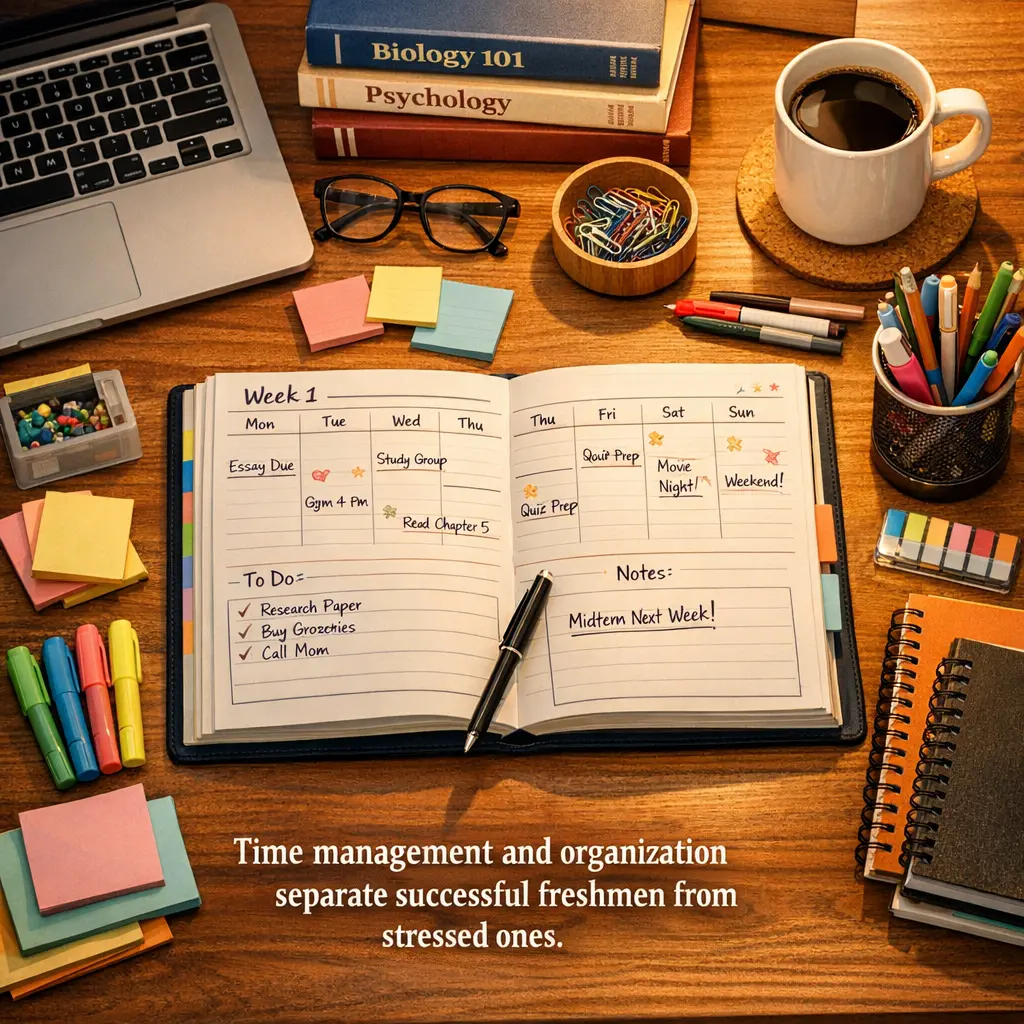
Use a Physical or Digital Planner Religiously
Your memory cannot reliably track classes, assignments, exams, club meetings, social events, work shifts, and personal commitments across multiple courses and activities. Every successful college student uses an external system.
Why this matters: College schedules are complex and irregular. Classes don’t meet daily like high school, assignments are spaced weeks or months apart, and deadlines cluster unpredictably. Without a planning system, you’ll miss deadlines and double-book commitments.
Physical vs. digital: Paper planners work well for visual learners who retain information better by writing. Digital calendars (Google Calendar, Apple Calendar, Notion) offer reminders, recurring events, and device syncing. Choose based on what you’ll actually use consistently.
Common mistake: Students keep their schedule “in their head” or rely on memory until they miss something important, then create a system in panic mode rather than proactively.
Action step: Every Sunday evening, review the upcoming week. Block out class times, work hours, and study sessions. Identify busy days when you’ll need to be strategic about meals and self-care. Add assignment deadlines with buffer time built in.
Professional tip: Use time blocking rather than just deadline tracking. Don’t just note “paper due Friday”—schedule “Tuesday 2-4pm: research for sociology paper” and “Thursday 10am-12pm: draft sociology paper.” This transforms abstract deadlines into concrete work sessions.
The Two-for-One Rule for Study Time
For every hour of class time, plan two hours of outside study time. This ratio applies to most college courses and helps you estimate your weekly time commitment accurately.
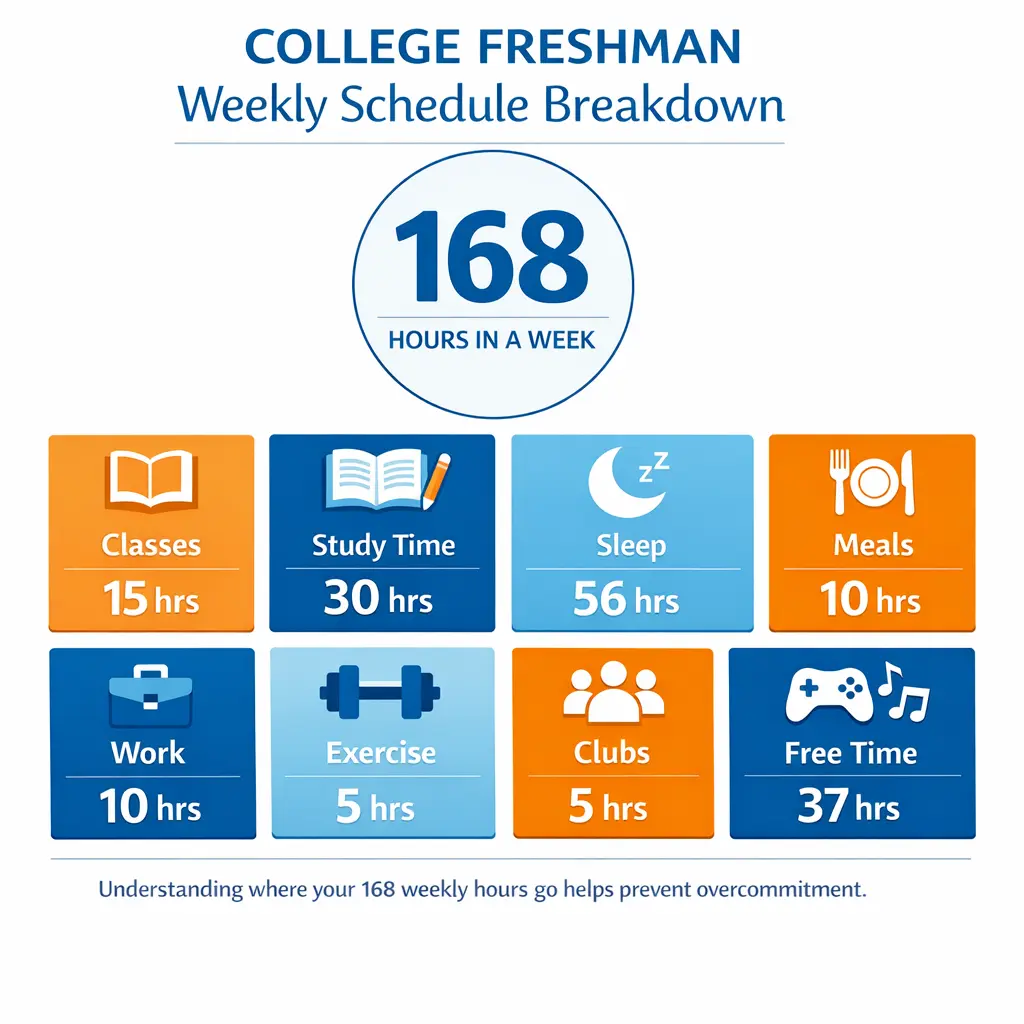
Why this matters: A standard 15-credit semester (five 3-credit courses) means 15 hours in class weekly. Using the 2:1 ratio, you need 30 hours of study time, totaling 45 hours—a full-time job. Students who don’t plan for this reality become overwhelmed and fall behind.
Course variation: Some courses demand more than 2:1 (upper-level STEM courses, foreign languages, writing-intensive seminars), while others need less (introductory lectures with minimal homework). Adjust based on your actual experience during weeks 2-4.
Common mistake: Students fill their schedules with classes, work, and activities without calculating available study hours. When they realize they need 30+ hours weekly for coursework, they have no time left.
Action step: Calculate your weekly commitments: classes (15 hrs) + study time (30 hrs) + work (10-15 hrs) + sleep (49-56 hrs) + meals (7-10 hrs) + exercise (3-5 hrs) + clubs (3-5 hrs). Notice how quickly you reach 168 hours in a week. Every new commitment requires reducing something else.
Block Schedule Your Entire Week
Looking at a blank calendar creates the illusion of unlimited time. Successful students block schedule their entire week, including classes, study sessions, meals, exercise, and social time.
Why this matters: When you see your available time visually represented, you make better decisions about commitments. You realize that adding a 10-hour-per-week part-time job when you already have only 3 hours of unscheduled time daily is unsustainable.
Implementation: Use a weekly template showing all 168 hours. Block non-negotiable commitments first (classes, work, sleep), then add study blocks using the 2:1 rule, then schedule self-care (meals, exercise, social time). What remains is your actual free time.
Common resistance: Students feel block scheduling is too rigid or restrictive. In reality, it creates freedom by preventing overcommitment and showing exactly when you have time for spontaneous activities.
Action step: Create your ideal week template during the first weekend of the semester. Include buffer time for transitions, meals that aren’t rushed, and at least one “flex block” daily for unexpected tasks or opportunities.
Professional tip: Schedule your most challenging coursework during your peak energy hours. If you’re a morning person, do complex problem sets at 9am, not 9pm. Match task difficulty to your natural energy patterns.
Learn to Say No Without Guilt
Every opportunity isn’t your opportunity. College bombards you with invitations: clubs, social events, volunteer positions, study groups, parties. Saying yes to everything means doing nothing well.
Why this matters: Overcommitment is the top complaint among stressed college students. You cannot maintain academic excellence, work a significant part-time job, lead three clubs, compete in intramural sports, and have an active social life—at least not without sacrificing sleep and health.
The cost of yes: Every commitment has hidden costs beyond the stated time. A club meeting listed as “Tuesdays 7-8pm” requires travel time, preparation time, and mental energy. A 2-hour shift at your campus job requires getting ready, commuting, and transitioning back to coursework.
Common mistake: Students commit to activities during the first weeks when coursework is light, not realizing that midterm season will make their schedule unsustainable.
Action step: Use the “one-week delay” rule for new commitments. When someone asks you to join something, say “Let me check my schedule and get back to you tomorrow.” This pause allows you to assess realistically whether you have capacity.
How to decline: “I appreciate you thinking of me, but my schedule is full right now” requires no elaborate justification. You don’t owe detailed explanations. Protect your time as your most valuable resource.
Social Life and Friendships
Join Clubs, Not Just Your Dorm Social Circle
Your dorm provides convenient proximity, not necessarily compatible friendships. The people living on your floor are random, assigned by housing algorithms, not shared interests.
Why this matters: Lasting college friendships typically form through shared activities and interests, not geographic convenience. People in your major, clubs, sports teams, or volunteer organizations share your values and passions, creating deeper connection foundations.
The dorm limitation: First-semester friendships often form quickly based on proximity and mutual newness, but don’t always develop into meaningful long-term relationships. Many students find their true friend group during sophomore year through organizations and classes.
Common mistake: Students spend all their social energy on dorm floor relationships, then feel confused when these friendships feel superficial or fade after freshman year when everyone lives in different locations.
Action step: During the first month, attend “club fairs” and informational meetings for 5-7 organizations that genuinely interest you. Attend three meetings for each before committing. Narrow down to 2-3 organizations where you’ll actively participate.
Professional tip: Choose at least one organization related to your potential career field. Pre-law society, engineering club, or education association members become your professional network and provide industry insights beyond classroom learning.
Quality Over Quantity in Friendships
Social media creates pressure to have dozens of “friends” and constant social plans. Meaningful college friendships are smaller, deeper, and more intentional.
Why this matters: Trying to maintain surface-level friendships with 50 people creates exhausting social obligations without genuine support. Three close friends who truly understand you provide more emotional support and life satisfaction than 30 acquaintances.
The exhaustion factor: Social interaction, even enjoyable interaction, requires energy. Introverts recognize this naturally, but even extroverts need recovery time. Overextending yourself socially leaves no energy for academics or self-care.
Common mistake: Students say yes to every social invitation during the first weeks, establishing unsustainable patterns. Friends expect this availability to continue, then feel rejected when you scale back to focus on academics.
Action step: Identify your “core people”—the 3-5 friends you genuinely enjoy and trust. Invest intentionally in these relationships through regular meals, study sessions, or activities. Maintain friendly acquaintance with others without obligation.
Boundary setting: It’s acceptable to decline party invitations when you’re tired or have work to complete. Real friends understand priorities and don’t pressure you to sacrifice your wellbeing for their social plans.
Roommate Boundaries Save Relationships
Your roommate doesn’t need to be your best friend. They need to be someone you can coexist with peacefully in a small space. Different expectations here cause most roommate conflicts.
Why this matters: When roommates try forcing friendship or spend all their time together, small annoyances escalate into major conflicts. Healthy roommate relationships include independence, clear boundaries, and mutual respect.
The roommate contract: During the first week, discuss practical matters: sleep schedules, study habits, guest policies, cleaning responsibilities, shared item boundaries, and noise preferences. Write this down and revisit monthly.
Common conflicts:
- Different sleep schedules (early riser vs. night owl)
- Cleanliness standards (neat vs. messy)
- Guest frequency and duration
- Sharing food, clothes, or school supplies without asking
- Noise during study time
- Room temperature preferences
Action step: Address small irritations immediately before they become big resentments. Use “I” statements: “I have trouble sleeping when the light is on after midnight. Can we use the desk lamp instead?” This invites cooperation rather than defensiveness.
Professional tip: Establish “quiet hours” from 10pm-8am on weeknights, regardless of whether you both have early classes. This creates predictable windows for sleep and focused study time.
Don’t Skip Orientation Activities
Orientation week feels cheesy and forced. The icebreakers are awkward, the campus tours feel endless, and you’re tempted to skip sessions. Don’t.
Why this matters: Orientation provides a rare moment when everyone is new, nervous, and open to connection. Three weeks later, friend groups have formed and people seem less approachable. The awkwardness is universal during orientation, which makes it easier to introduce yourself.
Practical information: Orientation sessions cover crucial information about campus resources, academic policies, registration procedures, and safety protocols. Students who skip these sessions spend months confused about basic campus navigation and systems.
Social foundation: Many students meet their first college friends during orientation. Even if these don’t become lifelong friendships, they provide a social foundation during those vulnerable first weeks when you’re adjusting to campus.
Common mistake: Students arrive on campus late or skip optional sessions to avoid awkwardness, not realizing everyone else feels equally uncomfortable and welcomes friendly faces.
Action step: Attend every scheduled orientation activity, even optional ones. Introduce yourself to at least five new people daily. Exchange contact information with 2-3 people who seem compatible for studying together or grabbing meals.
Financial Wisdom
Understand Your Meal Plan Reality
Most freshmen overestimate how much they’ll eat in dining halls. You’ll skip breakfast when you oversleep, eat off campus with friends, and receive care packages from home. That unlimited meal plan might be wasted money.
Why this matters: Meal plans represent significant costs—often $3,000-$5,000 per semester. Choosing an overly large plan wastes hundreds of dollars you could apply toward other expenses. Choosing too small a plan leaves you hungry or spending additional money on food.
How meal plans work: Most colleges offer several tiers: unlimited access, set number of meals per week, or declining balance. Unlimited sounds appealing but rarely makes financial sense unless you genuinely eat three meals daily in dining halls.
Common mistake: Students choose the largest meal plan “just to be safe,” not calculating their actual eating patterns. Track honestly: Will you wake up for breakfast? Do you prefer cooking simple meals in your dorm? Do social activities often revolve around off-campus restaurants?
Action step: During your first semester, choose the middle-tier meal plan. Track how many meals you actually eat in dining halls weekly for the first month. Adjust your plan second semester based on real data, not assumptions.
Money-saving tip: Many meal plans don’t roll over unused meals or dollars between semesters or years. If your plan includes “dining dollars” or “flex meals,” use them before they expire. Stock up on non-perishables, drinks, or snacks during the last week of the semester.
Track Every Dollar for the First Month
Financial independence starts with awareness. Most college students have no idea where their money goes until they’re broke three weeks before the semester ends.
Why this matters: Small daily expenses add up devastatingly fast. A $6 coffee daily costs $180 monthly. $15 food delivery twice weekly costs $120 monthly. These seemingly minor choices consume hundreds of dollars you might need later for textbooks, emergencies, or social activities.
The awareness gap: When you don’t track spending, your brain justifies each individual purchase as “only a few dollars.” You feel confused when your account empties because no single purchase seemed significant.
Common mistake: Students think budgeting means deprivation. Actually, budgeting means intentionally directing money toward what matters most to you rather than unconsciously spending on things you don’t value.
Action step: For the first month of college, track every expense in a simple app (Mint, YNAB, or even Notes app). Record purchases immediately, including cash transactions. At month’s end, categorize spending: dining out, entertainment, personal care, academic supplies, transportation.
What you’ll discover: You probably spend more than expected on convenience (food delivery, rideshares) and less than expected on entertainment. This data helps you create a realistic budget for subsequent months.
Professional tip: Use the 50/30/20 budgeting framework: 50% needs (food, toiletries, academic supplies), 30% wants (entertainment, dining out, hobbies), 20% savings (emergency fund, summer expenses). Adjust percentages based on whether you work during school.
Buy Textbooks Smart, Not Fast
Textbooks can cost $500-$1,000 per semester if you buy everything new from the campus bookstore. Smart purchasing strategies cut this cost by 70-90%.
Why this matters: Publishers intentionally inflate textbook prices and release new editions with minimal changes to prevent used book sales. You’re paying for required materials, not necessarily better learning tools. Saving $600 on textbooks funds other important expenses.
Purchasing strategies:
- Wait one week before buying: Attend the first class to confirm you actually need the textbook. Some professors assign readings they never use.
- Check international editions: Same content, paperback format, dramatically lower prices (often 75% less).
- Rent when possible: Textbooks you’ll never reference again are perfect rental candidates.
- Buy used from students: Facebook groups, campus bulletin boards, and student-to-student sales offer the best prices.
- Use library reserves: Professors often place textbook copies on reserve for short-term borrowing.
Common mistake: Students buy all textbooks from the campus bookstore during the first week, spending maximum money before determining what they truly need.
Action step: During the first week, create a spreadsheet of required materials for each course. Compare prices across Amazon, Chegg, campus bookstore, international editions, and student sellers. Calculate total cost for each purchasing combination.
Professional tip: For math and science courses where you’ll work problems, buying a used physical textbook makes sense for annotation and reference. For humanities readings you’ll read once, rentals or library reserves work perfectly.
Student Discounts Are Everywhere
Your student ID provides access to hundreds of discounts that collectively save thousands of dollars during your college years. Most students never ask.
Why this matters: Student discounts typically range from 10-50% off regular prices on software, technology, clothing, entertainment, food, and services. Over four years, these savings compound to significant amounts.
Common categories:
- Technology: Apple, Microsoft, Adobe, Spotify (with Hulu and Showtime included), Amazon Prime Student
- Clothing: Nike, Adidas, ASOS, Madewell, J.Crew
- Food: Chipotle, Qdoba, Subway, Buffalo Wild Wings, many local restaurants
- Entertainment: Movie theaters, museums, concerts, sporting events
- Transportation: Amtrak, Greyhound, many public transit systems
- Services: Gym memberships, phone plans, haircuts
Common mistake: Students assume businesses will automatically apply student discounts. You must ask and present your student ID. Many discounts aren’t advertised but exist when requested.
Action step: Before any purchase over $20, search “[company name] student discount.” Bookmark UNiDAYS and Student Beans—websites that aggregate verified student discounts across hundreds of retailers.
Professional tip: Amazon Prime Student costs half the regular Prime price and includes six months free. This pays for itself immediately through free two-day shipping on textbooks and school supplies.
Health and Wellness
Sleep Beats Studying After Midnight
All-nighters feel productive in the moment but harm your academic performance, physical health, and mental wellbeing. Sleep is when your brain consolidates learning into long-term memory.
Why this matters: Research on sleep and academic performance is unambiguous: students who sleep 7-9 hours nightly significantly outperform students who sacrifice sleep for extra study time. The quality of learning during sleep-deprived states is poor; you study longer to learn less.
What happens when you skip sleep:
- Memory consolidation decreases by 40%
- Immune function declines, increasing illness risk
- Emotional regulation weakens, increasing anxiety and irritability
- Decision-making and judgment become impaired
- Physical appearance suffers (acne, weight gain, premature aging)
Common mistake: Students view sleep as optional or lazy, believing that sacrificing sleep demonstrates dedication. In reality, chronic sleep deprivation signals poor time management and unsustainable habits.
Action step: Establish a non-negotiable sleep schedule: in bed by 11pm on weeknights, awake by 7am. This provides 8 hours of sleep opportunity. Protect this schedule as fiercely as you protect class attendance.
Sleep hygiene basics:
- No screens 30 minutes before bed (blue light disrupts melatonin)
- Keep room dark, cool (65-68°F), and quiet
- Use bed only for sleep, not studying or watching videos
- Avoid caffeine after 2pm
- Establish a bedtime routine (shower, reading, etc.)
Professional tip: If you must choose between one more hour of studying or one more hour of sleep before an exam, choose sleep. Your rested brain will perform better on the material you already studied than your exhausted brain will on additional material you barely absorbed.
The Freshman 15 Is Avoidable
Weight gain during freshman year results from environmental changes, not inevitability. Unlimited dining hall access, stress eating, alcohol consumption, and reduced physical activity create perfect conditions for weight gain.
Why this matters: Significant weight gain during freshman year affects physical health, self-esteem, and energy levels. More importantly, establishing healthy habits early prevents patterns that become harder to change later.
Contributing factors:
- Unlimited dining hall access encourages overeating
- Stress triggers emotional eating
- Alcohol contains significant empty calories
- Less structured physical activity than high school sports or PE classes
- Late-night studying paired with snacking
- Socializing often revolves around food
Common mistake: Students think they’ll maintain their high school activity levels without structured sports or parental meal planning. The new environment requires new intentional strategies.
Action step: During your first month, establish three sustainable health habits: (1) Walk or bike when campus destinations are under 15 minutes away, (2) Choose vegetables and protein at most meals instead of defaulting to pizza and pasta, (3) Limit alcohol to weekends if you drink.
Practical strategies:
- Use smaller plates in dining halls to avoid unconscious overeating
- Eat sitting down in the dining area, not while walking or studying
- Stock your dorm with healthy snacks (fruit, nuts, yogurt) for late-night hunger
- Find enjoyable physical activity (intramural sports, climbing wall, dance classes, gym)
- Drink water throughout the day; thirst often masquerades as hunger
Professional tip: The campus recreation center is included in your tuition and fees. Group fitness classes provide built-in accountability and social connection while maintaining fitness.
Mental Health Resources Are Not Just for Crisis
College counseling centers exist for preventive care and skill-building, not only emergencies. Anxiety, homesickness, relationship issues, and stress management are common, treatable concerns.
Why this matters: Mental health challenges are the norm during college, not the exception. According to national surveys, over 60% of college students experience overwhelming anxiety, and nearly 40% feel so depressed they struggle to function. Early intervention prevents escalation.
What counseling centers provide:
- Individual therapy (typically 6-12 free sessions)
- Group therapy for common concerns (anxiety, depression, eating disorders, LGBTQ+ support)
- Crisis intervention and emergency services
- Workshops on stress management, time management, sleep hygiene
- Referrals to off-campus providers for long-term care
- Psychiatric evaluation and medication management
Common barriers: Students worry about stigma, fear judgment, think their problems “aren’t serious enough,” or don’t know services exist. None of these concerns reflect reality. College counselors expect and welcome students managing normal developmental challenges.
Action step: During orientation week or the first month, locate your campus counseling center. Learn their hours, whether they take walk-ins or appointments only, and what services they offer. Save their crisis hotline number in your phone.
When to seek help: You don’t need to wait for crisis. Seek support when you notice persistent sadness lasting more than two weeks, anxiety interfering with daily functioning, sleep or appetite changes, difficulty concentrating, social withdrawal, or simply feeling overwhelmed and unsure how to cope.
Professional tip: Many counseling centers offer drop-in hours for brief consultations. If you’re unsure whether you need ongoing therapy, attend drop-in hours to discuss your concerns and get professional guidance about next steps.
Homesickness Is Normal and Temporary
Missing home doesn’t mean you made the wrong college choice or that you’re weak. Homesickness affects 60-70% of college freshmen, even students who feel excited about independence.
Why this matters: Homesickness can feel shameful, especially when social media suggests everyone else is thriving. This shame prevents students from seeking support and using effective coping strategies. Understanding homesickness as normal reduces its emotional power.
What homesickness feels like:
- Persistent thoughts about home, family, high school friends
- Sadness, loneliness, or anxiety
- Difficulty concentrating on coursework
- Loss of interest in activities
- Comparing college unfavorably to home
- Frequent crying or emotional sensitivity
Why it happens: You’re grieving the loss of familiar people, routines, and environments while simultaneously adjusting to new academic demands, social dynamics, and independence. This represents enormous change compressed into a short timeframe.
Common mistake: Students either suppress homesick feelings and pretend they’re fine, or they call home constantly, preventing themselves from building new connections and routines that ease homesickness.
Action step: Establish a balanced home contact schedule. Call or video chat with family 2-3 times weekly on a regular schedule, not constantly throughout the day. This maintains connection without preventing campus integration.
Coping strategies:
- Bring a few familiar comfort items (photos, blanket, stuffed animal)
- Establish new routines that create structure and predictability
- Stay busy, especially during traditional family times (Sunday mornings, dinner time)
- Connect with other students experiencing similar feelings
- Give yourself a timeline: “I’ll reassess how I feel after six weeks”
- Limit social media comparisons with high school friends
Professional tip: Homesickness typically peaks during weeks 2-4, improves after fall break, then may resurface briefly after winter break. Knowing this pattern helps you recognize temporary feelings rather than permanent dissatisfaction.
Practical Life Skills
Learn Basic Laundry Before You Ruin Clothes
Laundry seems straightforward until you turn your white shirts pink or shrink your favorite sweater. Basic laundry literacy prevents expensive clothing replacement and embarrassment.
Why this matters: College students notoriously damage clothing through laundry mistakes: mixing colors, using wrong water temperatures, over-drying delicates, or ignoring care labels. Replacing a ruined wardrobe costs hundreds of dollars you don’t need to spend.
Essential laundry rules:
- Separate loads: Whites, darks, and colors wash separately (at minimum, separate whites from everything else)
- Read care labels: “Cold water only” and “lay flat to dry” exist for reasons
- Don’t overload: Clothes need room to agitate; crammed washers leave clothes dirty
- Remove promptly: Wet clothes sitting in the washer develop mildew smell and wrinkles
- Clean the lint trap: Before every dryer load, or you’ll cause fires
Water temperature guide:
- Cold water: Darks, jeans, delicates, anything that might shrink or bleed color
- Warm water: Light colors, synthetics, moderately soiled items
- Hot water: Whites, towels, heavily soiled items, bed sheets
Common mistakes:
- Washing new red items with white clothes (hello, pink wardrobe)
- Using too much detergent (creates residue and doesn’t rinse clean)
- Drying everything on high heat (shrinks cotton, damages elastic)
- Leaving clothes in the washer overnight (causes smell)
Action step: Before college, practice doing your own laundry at home for at least a month. Make mistakes when your parent can help fix them, not when you’re alone at college.
Dorm laundry specific tips: Bring your own detergent and dryer sheets. Don’t leave clothes unattended in shared laundry rooms; set a phone timer to retrieve loads promptly. Have a backup outfit in case all your clothes are dirty.
Keep Your Dorm Room Minimally Organized
Dorm rooms are tiny. Clutter accumulates quickly when you share 150 square feet with another person and all your belongings. Minimal organization prevents chaos.
Why this matters: A disorganized dorm creates stress, wastes time when you can’t find items, and damages your roommate relationship. You don’t need military precision, just basic systems that prevent disaster.
Essential organization:
- Bed area stays clear of clothes and trash (bed is for sleeping)
- Desk area stays functional for homework (clear one workspace)
- Dirty clothes go in a hamper immediately, not on the floor
- Trash goes directly in the trash can, not accumulated on surfaces
- School supplies have designated spots (backpack, desk drawer, shelf)
Storage solutions:
- Under-bed storage containers for off-season clothes and extra supplies
- Over-door hooks for bags, coats, and towels
- Desk organizers for pens, chargers, and small items
- Closet doubling rods to maximize vertical hanging space
- Shelf risers to create additional storage in tight spaces
Common mistake: Students bring too much stuff, then have no space to organize it. Your dorm room isn’t your childhood bedroom; it can’t accommodate your entire wardrobe, sports equipment collection, and hobby supplies.
Action step: Implement the “one-minute rule.” If a task takes less than one minute (hanging up a coat, putting dishes in the sink, throwing away trash), do it immediately rather than letting it accumulate.
Professional tip: Do a 10-minute reset of your room every Sunday evening. Put away clean laundry, clear your desk, take out trash, and organize scattered items. This weekly maintenance prevents overwhelming mess from developing.
Know Your Campus Safety Resources
College campuses are generally safe, but you need to know available resources and basic safety awareness practices. Preparation prevents problems.
Why this matters: Campus safety threats range from minor (locked out of your dorm at 2am) to serious (medical emergency, assault, feeling unsafe walking alone at night). Knowing resources before you need them enables quick, effective response.
Essential safety resources:
- Campus police/security phone number: Save in your phone; this is faster than calling 911 for campus-specific issues
- Emergency blue light phones: Outdoor call boxes that directly connect to campus police
- Safe ride/walk programs: Many campuses offer free nighttime escorts or shuttle services
- Medical services: Health center hours, location, and after-hours nurse line
- Title IX office: Reports sexual harassment, assault, and discrimination
Basic safety practices:
- Travel in groups after dark when possible
- Tell someone your plans when going somewhere alone
- Trust your intuition; leave situations that feel uncomfortable
- Lock your dorm room, even for “just a minute”
- Don’t share your room access code or leave your door propped open
- Be cautious about drink safety at parties (watch your drink, don’t accept open containers)
Common mistake: Students feel invincible and skip basic safety awareness, assuming “nothing bad will happen to me.” Most campus safety issues are preventable through awareness and preparation.
Action step: During your first week, take a campus safety tour or review your college’s safety resources webpage. Program campus police, safe ride service, and health center numbers into your phone contacts.
Professional tip: Register for your campus emergency alert system. This sends text/email notifications about campus safety threats, severe weather, or building emergencies.
Long-Term Success Habits
Your Major Can Change (And Probably Will)
Approximately 75% of college students change their major at least once. Your intended major freshman year is a starting point, not a binding contract. Growth and exploration are expected.
Why this matters: Students create unnecessary stress by treating their initial major choice as permanent. Fear of “wasting time” or “falling behind” prevents exploration that leads to better-aligned careers. Changing majors is normal and often beneficial.
When major changes make sense:
- You’re consistently unhappy or unmotivated in required courses
- A different field excites you more than your current major
- Your interests and strengths have evolved
- You discovered a field through general education courses
- Career research revealed your major doesn’t align with your goals
What to consider before changing:
- How many major requirements have you completed?
- Will the new major extend your graduation timeline?
- What career outcomes interest you in the new field?
- Have you talked with academic advisors and professors in both departments?
Common mistake: Students either change majors impulsively every semester (indicating avoidance rather than genuine exploration) or stick with ill-fitting majors out of stubbornness or fear of judgment.
Action step: Use freshman year for exploration. Take diverse general education courses in areas that interest you. Attend department information sessions. Talk with upperclassmen in various majors. Shadow professionals in fields you’re considering.
Professional tip: Many successful careers don’t require specific majors. Employers often value critical thinking, communication, and problem-solving skills over specialized undergraduate study. Choose a major you find intellectually engaging, then build job-specific skills through internships and experiences.
Build Relationships with at Least Two Professors
Professor relationships provide mentorship, recommendation letters, research opportunities, career connections, and academic support. These relationships shape your college experience and post-graduation opportunities.
Why this matters: Strong professor relationships open doors you can’t access alone: competitive internships, research positions, graduate school recommendations, and professional network introductions. Professors remember engaged students and invest in their success.
How to build relationships:
- Attend office hours regularly, even when not struggling
- Participate actively in class discussions
- Ask thoughtful questions that show genuine interest
- Complete assignments with care and attention
- Follow up after the course ends; email updates on your progress
What these relationships provide:
- Personalized academic and career advice
- Research assistant or teaching assistant positions
- Strong, detailed recommendation letters for jobs or graduate school
- Introductions to professionals in your field
- Mentorship during challenging academic or personal periods
Common mistake: Students view professors as distant authority figures rather than mentors and resources. This transactional relationship mindset misses the collaborative, supportive relationships possible in college.
Action step: By the end of freshman year, identify two professors with whom you’ve built initial rapport. Continue taking courses with them when possible, stop by office hours occasionally, and maintain the relationship throughout college.
Professional tip: Choose professors in different departments or areas. One in your major provides discipline-specific guidance; one outside your major offers broader perspectives and interdisciplinary connections.
Start a Simple Filing System for Important Documents
College generates crucial paperwork: financial aid documents, tax forms, immunization records, housing contracts, course registration materials, and official transcripts. Disorganization creates expensive headaches.
Why this matters: Missing documents leads to late fees, missed deadlines, administrative holds on your account, and frantic searching when you urgently need something. A basic filing system takes 30 minutes to create and saves hours of stress.
What to keep and organize:
- Financial: Financial aid award letters, loan documents, scholarship information, 1098-T tax forms, payment receipts
- Academic: Unofficial transcripts, degree audit worksheets, AP/transfer credit documentation, registration confirmations
- Medical: Immunization records, health insurance cards, medical history forms
- Housing: Dorm contracts, meal plan agreements, damage assessment forms
- Legal/Identity: Birth certificate copy, social security card, passport, driver’s license (keep originals in a safe location)
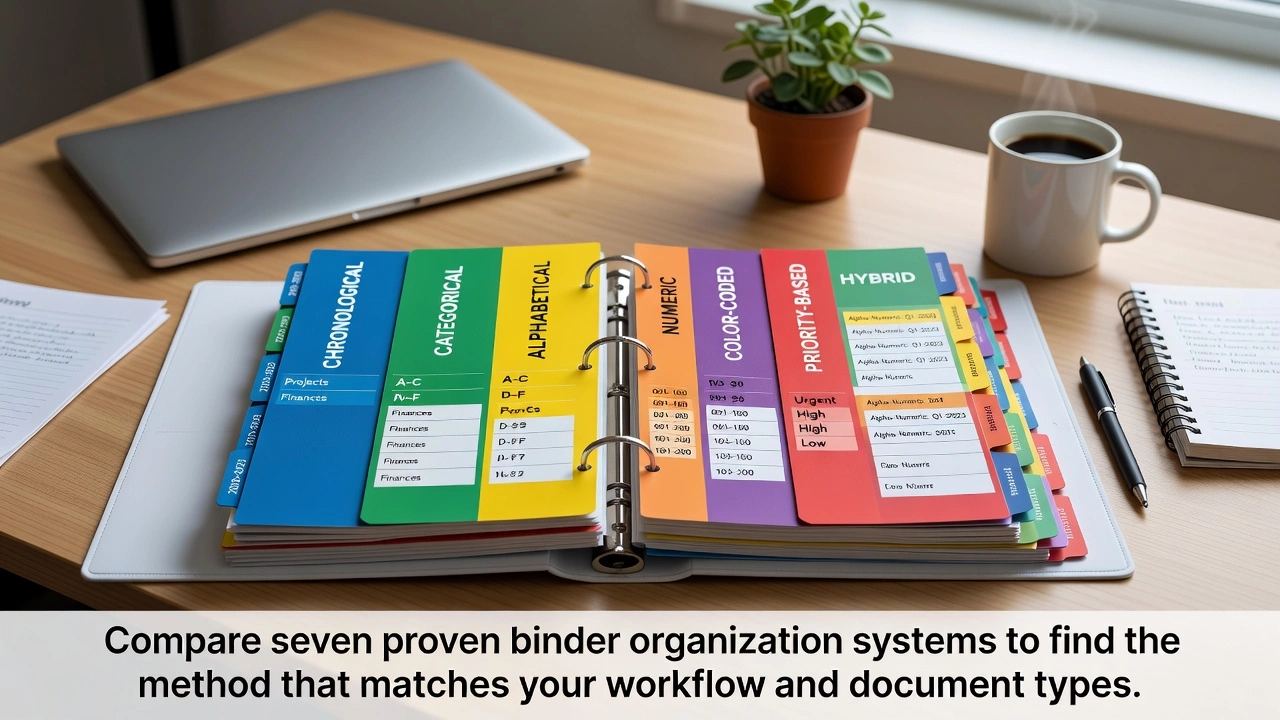
Organization system:
Physical option: Accordion folder with labeled sections for each category
Digital option: Organized folder structure in Google Drive or Dropbox with scanned copies of paper documents
Common mistake: Students throw everything in a drawer or backpack, then spend hours searching for one document or lose important paperwork entirely.
Action step: During your first week on campus, create your filing system. As you receive important documents throughout the semester, immediately file them in the appropriate section. Scan paper documents to create digital backups.
Professional tip: Keep financial aid documents for at least seven years (IRS tax return support). Keep academic records permanently (you may need transcripts decades later for career changes or certifications).
Key Insights Summary
Starting college successfully requires balancing academic rigor with self-care, social connection with healthy boundaries, and present engagement with future planning. The college freshman tips that matter most involve showing up consistently (classes, office hours, campus activities), managing time proactively rather than reactively, building genuine relationships through shared interests, and maintaining your physical and mental health as non-negotiable priorities.
Financial literacy and practical life skills—from laundry to meal planning to document organization—support your academic mission. Your major will likely change, your friend group will evolve, and your interests will develop. This growth is the point of college, not a sign of failure.
Success doesn’t require perfection. It requires showing up, asking for help when you need it, and learning from inevitable mistakes. The students who thrive aren’t the ones who never struggle; they’re the ones who use campus resources, maintain perspective during challenges, and treat college as a four-year learning experience rather than a series of unrelated semesters.
COMPARISON TABLES
Meal Plan Decision Guide
| Meal Plan Type | Best For | Avoid If | Average Cost |
|---|---|---|---|
| Unlimited access | Athletes with high caloric needs; students who prefer all meals in dining halls | You skip breakfast regularly; you cook in your dorm; social life centers on off-campus restaurants | $5,000-6,000/semester |
| 14-19 meals/week | Most freshmen; balanced on/off campus eating | You eat fewer than 2 meals daily in dining halls | $4,000-5,000/semester |
| 10-12 meals/week | Students who cook often; light eaters; those with kitchen access | Your schedule makes regular dining hall visits difficult | $3,000-4,000/semester |
| Block plans (100-150 meals/semester) | Students with irregular schedules; those who prefer flexibility | You want predictable daily meal access | $2,500-3,500/semester |
Textbook Purchasing Strategy Comparison
| Method | Cost Savings | Pros | Cons | Best For |
|---|---|---|---|---|
| Campus bookstore new | 0% (baseline) | Convenient; guaranteed correct edition; easy returns | Most expensive option | Emergency only |
| Campus bookstore used | 25-40% | Convenient; still guaranteed correct edition | Still expensive compared to other options | Last-minute needs |
| Amazon/Chegg rental | 50-70% | Significant savings; free return shipping | Can’t highlight extensively; return deadlines | Courses you won’t reference again |
| Student-to-student sales | 60-80% | Best prices; support fellow students | Requires advance planning; limited availability | Most courses |
| International editions | 70-90% | Identical content; dramatic savings | Paperback quality; potential customs delays | Math/science with expensive texts |
| Library reserve | 100% | Free; forces you to avoid procrastination | Limited time periods; competition for access | Supplementary readings |
Study Environment Effectiveness Matrix
| Location | Focus Level | Collaboration Suitable | Availability | Best For |
|---|---|---|---|---|
| Main library quiet floors | Excellent | No | High competition during exams | Individual deep work; test prep; writing papers |
| Main library group areas | Moderate | Excellent | Usually available | Group projects; study groups; collaborative work |
| Departmental libraries | Excellent | Limited | Often available | Advanced major coursework; research |
| Coffee shops | Low-Moderate | Moderate | Variable | Light reading; moderate noise tolerance; social studying |
| Empty classrooms | Excellent | Yes | Hit or miss | Group projects; presentation practice; whiteboard work |
| Dorm room | Poor-Moderate | No | Always | Quick homework between classes (when roommate absent) |
| Outdoor campus spaces | Low | Limited | Weather dependent | Reading; review; mental health breaks |
CHECKLISTS
First Week of College Checklist
Academic Setup:
- Attend all classes and introduce yourself to professors
- Obtain all syllabi and review thoroughly
- Create master calendar with all assignment deadlines and exam dates
- Identify professor office hours for each course
- Determine textbook needs; compare purchasing options
- Locate key academic buildings for upcoming classes
- Visit campus writing center and tutoring center to learn services
- Meet with academic advisor to review degree requirements
Social Connection:
- Attend orientation activities, even optional ones
- Exchange contact information with 5+ new acquaintances
- Explore 3-5 clubs or organizations at activities fair
- Have roommate expectations conversation
- Attend at least one floor/dorm social event
- Join one organization that interests you
Practical Setup:
- Learn campus shuttle/bus routes and schedules
- Activate student ID card for building access and meals
- Set up campus email on phone and computer
- Learn laundry room location and hours
- Stock dorm with basic supplies (toiletries, snacks, school supplies)
- Program important numbers: campus police, health center, safe ride
- Register for emergency alert system
- Locate health center, counseling center, and campus police
Financial Organization:
- Set up student bank account if needed
- Activate meal plan and understand how it works
- Create basic budget for semester
- Sign up for student discounts (Amazon Prime Student, Spotify, UNiDAYS)
- Understand financial aid disbursement dates
- Create filing system for important documents
Midterm Season Survival Checklist
Two Weeks Before Midterms:
- Review syllabi for exact midterm dates, formats, and material covered
- Create study schedule allocating time to each exam
- Gather all notes, assignments, and study materials for each course
- Identify concepts you don’t understand; list questions for office hours
- Form or join study groups for complex courses
- Visit professor office hours to clarify difficult concepts
One Week Before Midterms:
- Create condensed study guides for each exam
- Complete practice problems or past exams if available
- Attend review sessions offered by professors or TAs
- Quiz yourself on key concepts using flashcards or practice questions
- Teach concepts to a friend or study group (teaching reveals gaps)
- Maintain regular sleep schedule (no all-nighters)
48 Hours Before Each Exam:
- Do final review of condensed study guides
- Focus on areas of weakness rather than what you already know
- Gather required materials (calculator, blue books, pencils, ID)
- Get 8 hours of sleep the night before
- Eat protein-rich breakfast the morning of the exam
- Arrive 10 minutes early to exam location
After Midterms:
- Review graded exams to understand mistakes
- Visit office hours to discuss exam performance
- Adjust study strategies based on what worked and what didn’t
- Calculate current course grades to identify where you stand
- Identify courses requiring extra attention for remainder of semester
End-of-Semester Organization Checklist
Academic Wrap-Up (2 weeks before finals):
- Review syllabi for final exam dates, times, and comprehensive vs. non-comprehensive
- Calculate what grade you need on each final to achieve desired course grade
- Create final exam study schedule with daily goals
- Compile all semester materials for each course
- Complete any remaining assignments or extra credit
- Turn in final papers or projects early to avoid deadline stress
Dorm Move-Out Preparation (1 week before departure):
- Review housing contract for move-out requirements and timeline
- Clean room to avoid damage fees (vacuum, wipe surfaces, remove adhesive)
- Document room condition with photos before leaving
- Pack non-essential items in boxes or storage containers
- Return borrowed items to friends
- Ship or mail items home to reduce what you carry
- Arrange transportation home
Administrative Tasks:
- Complete housing application for next year if required
- Register for next semester’s courses during registration window
- Submit FAFSA renewal for next academic year
- Schedule any required health appointments before leaving campus
- Return library books and settle any fines
- Check campus email for important end-of-semester announcements
Personal Closure:
- Exchange summer contact information with friends
- Thank professors who provided support during the semester
- Reflect on semester successes and areas for improvement
- Set goals for next semester based on this semester’s experience
- Take photos of campus and friends for memories
DECISION FRAMEWORKS
Should I Change My Major? Decision Framework
Step 1: Identify Your Concern
Ask yourself specifically what’s motivating consideration of a major change:
- Lack of interest in required courses?
- Better performance/enjoyment in another field?
- Career outcome concerns?
- Difficulty level of coursework?
- Influence from friends or family?
- Discovered new passion through general education?
Step 2: Evaluate Time Investment
Calculate:
- How many major requirements have you completed?
- How many semesters would the new major add to graduation?
- What courses would transfer vs. what wouldn’t count?
- Financial impact of additional semesters?
Decision Rule:
If you’re in first semester freshman year: Exploration is low-risk; changing has minimal consequences
If you’re in second semester: Still relatively safe to change without graduation delay
If you’re in sophomore year: Carefully calculate impact; may add 1-2 semesters
If you’re in junior/senior year: Consider minor, certificate, or graduate study instead
Step 3: Test Your Interest
Before officially changing:
- Take 1-2 courses in the potential new major
- Talk with professors in that department
- Shadow professionals working in that field
- Join student organizations related to that major
- Research career outcomes and job market
Decision Rule:
Change if interest remains high after exposure
Don’t change if excitement fades after realistic preview
Step 4: Consult Resources
Required conversations:
- Current academic advisor
- Potential new major advisor
- Career center counselor
- Professionals in desired field
- Current professors whose opinion you value
Decision Rule:
Proceed if advisors confirm the change aligns with your goals and timeline
Pause if advisors identify concerns you hadn’t considered
Step 5: Make Decision
Change your major if:
- ✓ Genuine, sustained interest in new field
- ✓ Minimal impact on graduation timeline (0-1 extra semesters acceptable)
- ✓ Career outcomes align with your goals
- ✓ Academic performance in new field courses is strong
- ✓ Advisors support the change
Stay in current major if:
- ✗ Interest is temporary or based on one difficult course
- ✗ Change adds 2+ semesters or significant cost
- ✗ Decision is primarily about avoiding difficult coursework
- ✗ You haven’t explored the new field adequately
- ✗ Career outcomes are unclear or don’t match your goals
Should I Join This Club/Organization? Decision Framework
Time Availability Assessment:
Calculate your current weekly commitments:
- Classes: _____ hours
- Required study time (class hours × 2): _____ hours
- Work: _____ hours
- Current clubs/activities: _____ hours
- Sleep (7-8 hours × 7 days): _____ hours
- Meals, exercise, self-care: _____ hours
- Total committed: _____ hours out of 168 weekly hours
Available discretionary time: 168 – total committed = _____ hours
Decision Rule:
If you have fewer than 10 hours of discretionary time weekly, don’t add commitments
If you have 10-20 hours, carefully consider one commitment
If you have 20+ hours, you can explore new activities
Interest and Alignment Check:
Ask yourself:
- Does this organization connect to my values, interests, or career goals?
- Am I joining because I genuinely care, or because of social pressure?
- Will this teach me skills or create experiences I can’t get elsewhere?
- Does this provide something missing from my current activities?
Decision Rule:
Join if answers show genuine interest and unique value
Decline if you’re joining out of obligation or FOMO
Commitment Level Assessment:
Research the organization:
- Weekly time requirement (meetings, events, preparation): _____ hours
- Seasonal variation (busy periods vs. slow periods)?
- Attendance expectations (mandatory vs. optional)?
- Leadership opportunities and additional time requirements?
- Financial costs (dues, equipment, travel)?
Decision Rule:
Join if stated commitment fits your available time plus 25% buffer
Decline if commitment equals or exceeds all your discretionary time
Trial Period Approach:
For any organization:
- Attend 2-3 meetings before officially joining
- Talk with current members about realistic time commitments
- Assess whether you enjoy the culture and activities
- Evaluate whether your schedule can sustain participation
Final Decision:
Join this organization if:
- ✓ You have adequate discretionary time with buffer for flexibility
- ✓ The organization aligns with your genuine interests or goals
- ✓ Time commitment is clearly defined and manageable
- ✓ You enjoyed the trial meetings and felt welcomed
- ✓ This won’t compromise your academic performance or health
Decline if:
- ✗ Your schedule is already full or overwhelming
- ✗ You’re joining primarily for resume-building without genuine interest
- ✗ Time commitment is vague or seems likely to expand
- ✗ Trial meetings felt uncomfortable or uninteresting
- ✗ Joining would require sacrificing sleep, study time, or self-care
FAQS
How many classes should I take my first semester?
Most freshmen should take 12-15 credit hours (typically 4-5 classes) during their first semester. This represents a full-time course load without being overwhelming as you adjust to college-level expectations. Avoid the temptation to take 18+ credits your first semester, even if you performed well in high school. College courses require significantly more independent work, and you’re simultaneously adjusting to living independently and navigating a new social environment. If you work more than 15 hours weekly, consider taking just 12 credits. You can always increase your course load in later semesters once you understand your capacity. Taking a reasonable course load first semester sets you up for academic success and allows time to explore campus, make friends, and develop effective study habits.
Is it better to live in a dorm or get an apartment freshman year?
Living in campus housing during your freshman year provides significant advantages for most students. Dorms place you in immediate proximity to classes, libraries, dining halls, and campus resources, reducing logistical stress while you’re adjusting to college. More importantly, residence halls create built-in social opportunities through floor communities, organized activities, and casual hallway interactions that help you make friends during the vulnerable first weeks. Resident assistants provide support and campus knowledge. Off-campus apartments often seem appealing due to more space and independence, but they typically increase social isolation, add commuting challenges, and require managing utilities, groceries, and household responsibilities that compete with your study time. Most colleges require or strongly encourage freshmen to live on campus specifically because research shows dorm residents have higher GPAs, better retention rates, and stronger campus connection than comparable students living off-campus.
How do I make friends in college if I’m shy or introverted?
Making friends as a shy or introverted person requires leveraging structured environments that facilitate connection without requiring aggressive extroversion. Join 2-3 clubs or organizations related to your genuine interests—these provide repeated exposure to the same people around shared activities, allowing friendships to develop gradually rather than through forced immediate connection. Attend regularly so people recognize you and conversations can build over time. Study groups for challenging courses create natural collaboration opportunities. Small group settings like discussion-based seminars or club leadership teams work better for introverts than large parties. Focus on quality over quantity—you need 2-3 close friends, not 50 acquaintances. Use one-on-one interactions (coffee, meals, studying together) rather than large group hangouts. Remember that many people who seem confident are equally nervous about making friends; your vulnerability in reaching out often feels relieving to others experiencing the same uncertainty. Give friendships time to develop; meaningful college friendships often form during second semester or sophomore year rather than the first weeks.
What GPA should I aim for freshman year?
Aim for at least a 3.0 GPA (B average) during your freshman year, with 3.5+ being ideal if you’re considering competitive graduate programs, scholarships, or career paths. Your freshman year GPA establishes your cumulative GPA foundation—early strong performance provides cushion for potential challenges in later, more difficult courses. Many scholarships require maintaining a 3.0 minimum. Graduate and professional schools (medical, law, business) typically expect 3.5+ GPAs, and it’s much easier to achieve this by starting strong than recovering from a low freshman year. That said, don’t sacrifice your health or wellbeing for perfect grades. A 3.3 GPA with balanced involvement, healthy habits, and genuine learning outweighs a 4.0 achieved through chronic stress and isolation. If you’re struggling to maintain a 2.5 GPA, seek help immediately from professors, tutoring services, and academic advisors rather than hoping things will improve independently. Your freshman year establishes study habits and academic strategies that carry throughout college, so developing effective approaches matters as much as the specific GPA you achieve.
Should I work during my freshman year?
Whether to work during freshman year depends on financial necessity and your time management capabilities. If you must work to afford college expenses, limit employment to 10-15 hours weekly during your first semester while you’re adjusting to academic expectations. On-campus jobs (library, recreation center, dining hall, department assistant) typically offer more flexibility around your class schedule and eliminate commute time compared to off-campus employment. These positions also connect you to campus and often provide study time during slow periods. If you don’t have financial pressure to work immediately, consider focusing entirely on academics and campus involvement during fall semester, then adding part-time work in spring semester once you’ve established effective study routines. Research consistently shows that students working more than 20 hours weekly experience declining academic performance, higher stress levels, and reduced campus engagement. Work-study positions through financial aid often provide the best balance of schedule flexibility and campus connection. If you do work, treat your class and study schedule as non-negotiable—request work hours that don’t conflict with prime study times or important campus activities.
How do I know if I should go to office hours?
You should attend professor office hours at least 2-3 times per semester for every course, regardless of your performance level. Office hours aren’t exclusively for struggling students—they’re for building relationships, deepening understanding, and demonstrating engagement. Attend during weeks 2-3 to introduce yourself and ask about effective study strategies for that specific course. Visit before major exams to clarify concepts you partially understand (not topics you haven’t studied at all). Stop by when genuinely interested in material beyond the course requirements to discuss related topics. Go when you’re considering that field as a major or career to ask about the professor’s path and advice. Always bring specific questions rather than vague requests like “I don’t understand anything.” Review material before attending so you can say “I understand X but I’m confused about Y.” Professors remember students who attend office hours and are significantly more willing to provide recommendation letters, research opportunities, and grade flexibility to students who’ve demonstrated consistent effort and engagement throughout the semester.
What should I do if my roommate and I aren’t getting along?
Address roommate conflicts early, directly, and calmly before they escalate into major problems. Schedule a specific conversation (not a spontaneous confrontation) to discuss the issue using “I” statements: “I have trouble sleeping when the TV is on after midnight” rather than “You’re so inconsiderate.” Focus on specific behaviors and practical solutions rather than personality attacks. Many conflicts stem from different expectations about cleanliness, noise, guests, or shared resources—these are negotiable through clear communication. If direct conversation doesn’t resolve the issue, involve your Resident Assistant (RA), who is trained in mediation and can facilitate productive discussions. RAs can help you draft a roommate agreement outlining specific expectations and compromises. If conflicts persist despite mediation, investigate room change options through your residence life office. However, recognize that running from every difficult relationship prevents developing conflict resolution skills you’ll need throughout life. Change rooms if the situation is truly toxic or threatening, but try communication and mediation first. Not every roommate becomes a best friend—peaceful coexistence is a successful outcome.
How can I avoid the freshman 15?
Prevent freshman year weight gain through three core strategies: conscious eating in unlimited dining halls, regular physical activity, and limited alcohol consumption. Use smaller plates and eat sitting down in dining areas rather than grabbing food to go—this increases awareness of portion sizes and satiety signals. Fill half your plate with vegetables and protein rather than defaulting to pizza, pasta, and dessert at every meal. Keep healthy snacks in your dorm (fruit, nuts, yogurt, vegetables with hummus) to avoid vending machine or late-night pizza orders when hungry. Find enjoyable physical activity that fits your schedule—group fitness classes at the rec center, walking to class instead of taking shuttles, intramural sports, or workout routines between classes. Consistency matters more than intensity; 30 minutes of movement daily outweighs occasional intense workouts. If you drink alcohol, recognize that it contains significant calories (a night of drinking can add 1,000+ calories) and often leads to late-night eating. Limit drinking to weekends and alternate alcoholic drinks with water. Maintain regular sleep patterns, as sleep deprivation increases hunger hormones and decreases impulse control around food. Monitor your body and habits honestly—if clothes feel tighter after two months, adjust behaviors rather than waiting until you’ve gained 20 pounds.
When should I declare my major?
Most colleges require declaring a major by the end of sophomore year, but requirements vary by institution and specific programs. Some competitive majors (engineering, nursing, business) require application during freshman year with specific prerequisite courses. Liberal arts majors typically allow more flexibility. Use your freshman year for genuine exploration—take general education courses in diverse fields to discover subjects that engage you intellectually. Pay attention to which courses you genuinely enjoy, not just which earn easy grades. Talk with professors, academic advisors, and career counselors about how different majors align with your interests and career goals. Understand that your major doesn’t determine your career as directly as you might think—many successful professionals work in fields unrelated to their undergraduate major. If you’re truly undecided between two fields, consider whether one could be a major and the other a minor, or whether both could complement each other (economics and environmental studies, psychology and business, etc.). Don’t rush to declare simply to feel decided—thoughtful exploration leads to better alignment than premature commitment. However, don’t avoid declaring because you’re waiting for perfect clarity that may never arrive. By spring of sophomore year, choose the field that seems most engaging based on available information, knowing you can adjust if needed.
How do I balance social life and academics?
Balancing social life and academics requires viewing them as complementary rather than competing priorities, structured around time management and boundaries. Use a weekly schedule that blocks non-negotiable commitments first: classes, required study time (2 hours per class hour), work, sleep, and meals. Social activities fill remaining discretionary time rather than replacing essential commitments. Implement “no social plans Sunday through Thursday nights” during busy academic periods, reserving those evenings for studying and sleep. Friday and Saturday provide social opportunities without compromising weekly academic performance. Study in focused blocks with true breaks, rather than attempting to multitask social media and homework—this “half studying” wastes time and produces poor work. Join clubs and organizations that meet weekly on consistent schedules, providing structured social connection without daily decisions about socializing versus studying. Build friendships through shared productive activities (study groups, club meetings, campus jobs) rather than only through parties and entertainment. Understand that social FOMO (fear of missing out) creates anxiety, but academic failure creates real consequences for your future. Communicate boundaries to friends without over-explaining: “I can’t hang out tonight, but I’m free Saturday” needs no justification. Quality social connections develop through consistent, smaller interactions rather than constant availability.
Tags: college freshman tips, freshman year advice, first year college tips, college tips for freshmen, things to know before college, freshman survival guide, college freshman advice, starting college tips, college first year tips, university freshman advice, what I wish I knew before college, freshman year college, college dorm life, time management college, study habits, college classes, roommate relationships, campus resources, college GPA, student budgeting, office hours, syllabus week, college social life, campus involvement, mental health college, homesickness, meal plan tips, what to bring to college dorm room, how to balance college social life and studies, how to manage money in college, how to choose college classes freshman year, how to make friends in college as a freshman, what should college freshmen know, what do I need for freshman year, how do I prepare for college freshman year, what mistakes do freshmen make, how can I succeed in college first year








Leave a Reply