

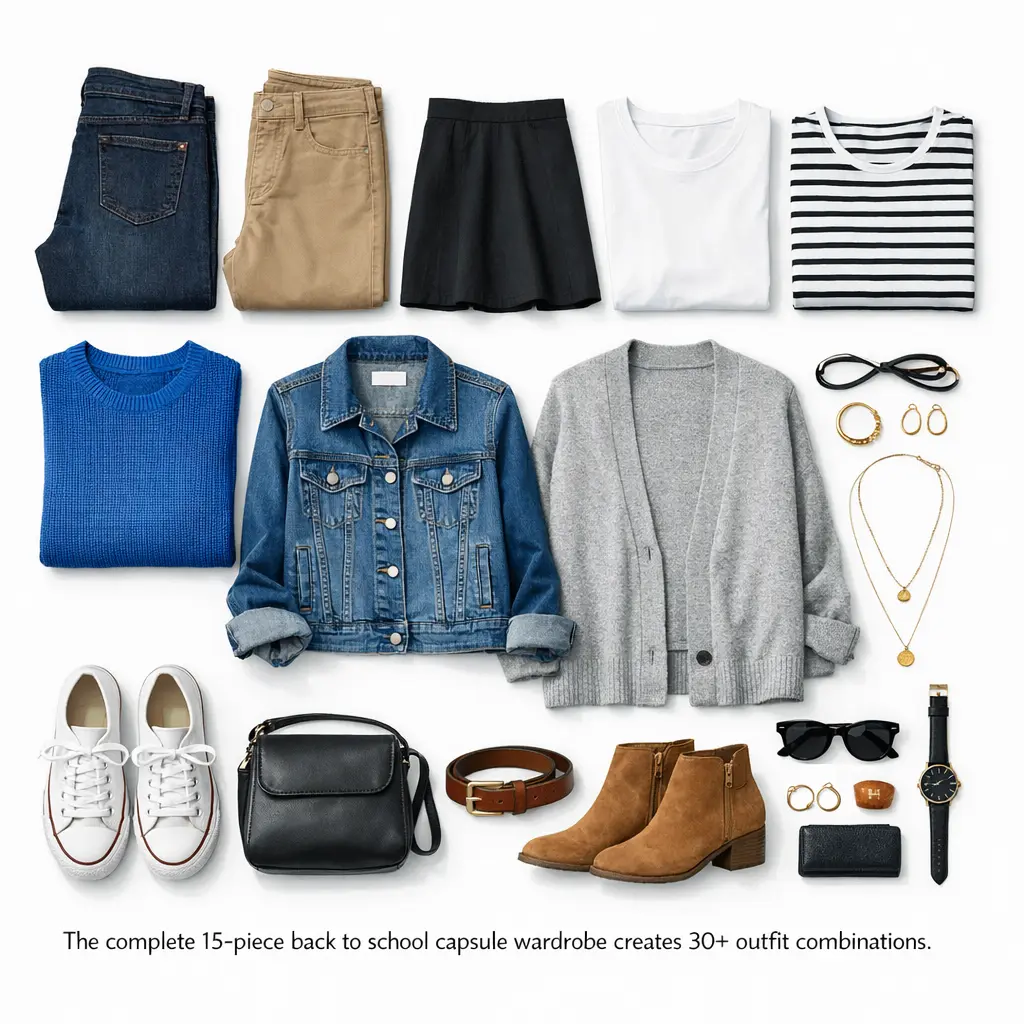
School mornings should not start with wardrobe meltdowns. A back to school capsule wardrobe solves the daily “nothing to wear” crisis while saving money and reducing stress. This guide shows you how to build a complete school wardrobe with just 15 carefully chosen pieces that create over 30 different outfit combinations.
Parents and students face the same challenge every August: buying enough clothes for variety without overspending or creating closet chaos. The capsule wardrobe approach offers a proven solution that works from middle school through college.
You will learn exactly which 15 pieces to buy, how to combine them into 30+ outfits, and how to make the system work within your budget and school dress code requirements.

What Is a Back to School Capsule Wardrobe?
A capsule wardrobe is a small collection of clothing pieces that work together interchangeably. For school purposes, this means selecting 15 versatile items in coordinating colors that can be mixed and matched to create numerous complete outfits.
The concept originated with London boutique owner Susie Faux in the 1970s and gained mainstream popularity through designers who advocated for quality over quantity. The school application focuses on practicality, durability, and age-appropriate style.
Core Components
Bottoms (3 pieces): Form the foundation since they can pair with multiple tops.
Tops (8 pieces): Provide the variety needed to avoid repetitive looks.
Layering pieces (2 pieces): Add warmth and visual interest while extending outfit options.
Shoes (2 pairs): Balance comfort with versatility.
This 3-8-2-2 formula creates mathematical combinations far exceeding 30 outfits while remaining manageable for busy school mornings.
How It Differs from Regular Wardrobes
Traditional school wardrobes often contain 30-50 pieces with poor coordination. Students wear 20% of their clothes 80% of the time, leaving money wasted on unworn items.
Capsule wardrobes reverse this pattern through intentional selection. Every piece earns its place by working with at least five other items. Nothing sits unused.
Benefits:
- Faster morning routines
- Lower overall cost
- Reduced laundry loads
- Easier packing for activities
- Less closet clutter
- Improved style consistency
Limitations:
- Requires planning upfront
- Less impulse shopping freedom
- May feel repetitive to the wearer (though others rarely notice)
- Demands higher quality per piece
Common Mistake: Buying the cheapest version of each piece. This approach backfires when items wear out quickly, requiring replacement and ultimately costing more.
Professional Tip: Take photos of successful outfit combinations on your phone. Create a quick-reference album for rushed mornings.
Why Choose a Capsule Wardrobe for School?
The benefits extend beyond simple convenience into financial, psychological, and practical advantages.
Time Savings
Morning efficiency: Students using capsule wardrobes report 10-15 minute reductions in getting-ready time. Everything matches, eliminating decision paralysis.
Pre-planning outfits the night before becomes simple when all options work together. This proves particularly valuable during exam weeks or early morning activities.
Financial Benefits
Upfront investment vs. ongoing costs: A quality 15-piece capsule wardrobe costs $200-$600 depending on brand choices. Traditional school shopping often exceeds this while delivering less wearability.
Cost per wear calculation: A $40 pair of jeans worn twice weekly for 36 school weeks equals 72 wears, or $0.56 per wear. That same item in a large, poorly coordinated wardrobe might see only 10 wears before being outgrown or discarded, costing $4 per wear.
Reduced Decision Fatigue
Psychologists recognize decision fatigue as a real phenomenon draining mental energy. Students face hundreds of daily choices at school. Removing the clothing decision preserves mental resources for academics and social navigation.
Example: Former President Barack Obama famously wore only gray or blue suits to reduce daily decisions. Students can apply this principle proportionally.
Sustainability
Fewer pieces mean reduced environmental impact through decreased manufacturing demand, less water usage, and lower textile waste. This resonates with environmentally conscious families and students.
Benefits:
- Clear morning routine
- Budget predictability
- Outfit confidence
- Sustainable consumption
- Teachable planning skills
Limitations:
- Initial planning time required
- Parental supervision needed for younger students
- Potential peer pressure concerns
- Limited trend participation
Common Mistake: Copying someone else’s capsule exactly. Body types, school climates, dress codes, and personal preferences vary. Customize the framework.
Professional Tip: Involve students in the planning process. They will wear the clothes more willingly when they helped select them.
The 15 Essential Pieces Breakdown
Each category serves specific functions within the system.
Bottoms (3 Pieces)
Piece 1: Dark Wash Jeans
The workhorse of school wardrobes. Choose a straight or slim fit that matches current style preferences without extreme trends.
Selection criteria:
- Mid to dark wash (hides stains better)
- Comfortable waistband for all-day wear
- Appropriate length for school rules
- Quality denim that holds shape
Pairs with: All 8 tops, both layering pieces, both shoe options
Piece 2: Neutral Pants or Khakis
Provides dressier alternative for presentations, photos, or varied weekly looks.
Selection criteria:
- Classic fit (straight, bootcut, or current modest trend)
- Neutral color (black, navy, gray, khaki, or olive)
- Wrinkle-resistant fabric blend
- Machine washable
Pairs with: 7 of 8 tops (skip the most casual tee), both layering pieces, both shoes
Piece 3: Versatile Bottom (Skirt, Shorts, or Second Pants)
Choose based on climate, dress code, and preference.
Selection criteria:
- Coordinates with color scheme
- Appropriate length
- Comfortable for active school day
- Different silhouette from other bottoms
Pairs with: 6-8 tops, both layering pieces, both shoes
Tops (8 Pieces)
Piece 4: White or Cream Basic Tee
Piece 5: Striped Long-Sleeve Tee
Piece 6: Solid Color Tee (in accent color)
Piece 7: Button-Up Shirt or Blouse
Piece 8: Casual Flannel or Chambray Shirt
Piece 9: Simple Sweater or Sweatshirt
Piece 10: Graphic or School Spirit Tee
Piece 11: Dressy Top or Polo
Selection criteria for all tops:
- Coordinating color palette (detailed in next section)
- Mix of sleeve lengths
- Variety in formality levels
- Quality construction in shoulder seams
- Pre-shrunk or size-stable fabrics
Fabric recommendations:
- Cotton blends for breathability
- Performance fabrics for active students
- Avoid 100% polyester (traps odors)
Layering Pieces (2 Pieces)
Piece 12: Cardigan or Hoodie
Adds warmth without bulk. Ties around waist when not needed.
Selection criteria:
- Neutral color matching both bottoms
- Medium weight
- Full zip or open-front style
- Machine washable
Piece 13: Jacket or Blazer
Provides structured layer for cooler days or dressier needs.
Selection criteria:
- Weather appropriate (denim jacket, bomber, utility jacket, or blazer)
- Coordinates with color scheme
- Allows arm movement
- Pocket functionality
Shoes (2 Pairs)
Piece 14: Clean Sneakers
Primary footwear for 70% of outfits.
Selection criteria:
- Neutral color (white, black, gray)
- Adequate support for walking between classes
- Dress code compliant
- Easy to clean
Piece 15: Versatile Second Pair
Choose based on climate and dress code: ankle boots, loafers, slip-ons, or casual flats.
Selection criteria:
- Different from sneakers in style
- Works with jeans and dressier pants
- Comfortable for all-day wear
- Durable construction
Benefits of this breakdown:
- Mathematical outfit variety
- Covers all weather scenarios
- Meets most dress codes
- Balances casual and dressy needs
Limitations:
- Requires trying combinations before purchase
- May need adjustments for specific school requirements
Common Mistake: Choosing pieces you love individually without testing how they work together. Everything must coordinate.
Professional Tip: Shop for bottoms first, then select tops that pair with all three. This ensures maximum compatibility.
Color Coordination Strategy
The capsule wardrobe system succeeds or fails based on color choices.
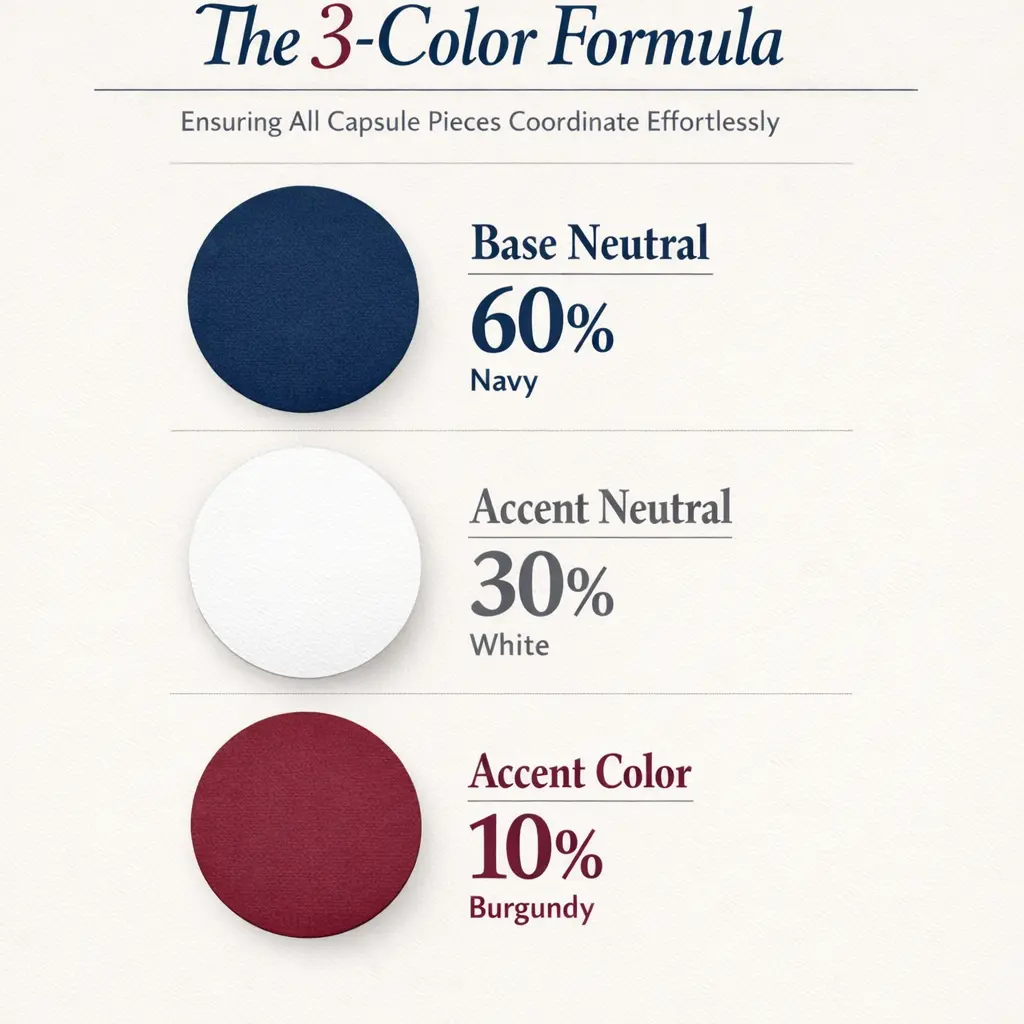
The 3-Color Formula
Base neutral (50% of pieces): Navy, black, gray, or khaki
Accent neutral (30% of pieces): White, cream, gray, or denim
Accent color (20% of pieces): One color that works with both neutrals
Example Palette 1:
- Base: Navy
- Accent neutral: White
- Accent color: Burgundy
Example Palette 2:
- Base: Black
- Accent neutral: Gray
- Accent color: Olive
Example Palette 3:
- Base: Khaki
- Accent neutral: White
- Accent color: Coral
How to Apply the Formula
Bottoms: All in base neutral or one in accent color
Tops: 5 in neutrals, 3 incorporating accent color
Layering pieces: Both in neutrals
Shoes: Primary in neutral, secondary can introduce accent
This distribution ensures every bottom pairs with nearly every top.
Pattern Integration
Patterns add visual interest without breaking coordination:
Stripes: Choose colors from your palette
Plaids/Checks: Ensure dominant color matches scheme
Graphic tees: Background color should coordinate
Pattern rule: Only one patterned piece per outfit
Testing Compatibility
Before finalizing purchases, use this test:
- Lay out all bottoms
- Place each top with each bottom
- If combination looks odd, identify why
- Adjust color or style choice
Aim for 90%+ compatibility across pieces.
Benefits:
- Foolproof coordination
- Professional appearance
- Easy shopping decisions
Limitations:
- Less color variety than large wardrobes
- Requires discipline to avoid off-palette purchases
Common Mistake: Choosing a base color you never actually wear. Be honest about preferences.
Professional Tip: Take photos of your color palette on your phone. Reference it when shopping to avoid impulse purchases that won’t integrate.

30 Complete Outfit Combinations
Here are 30 tested outfit formulas using the 15-piece system. Each bottom creates 10 outfits through different top and layer combinations.
With Dark Jeans (Outfits 1-10)
- White tee + sneakers
- White tee + cardigan + sneakers
- Striped tee + sneakers
- Striped tee + jacket + second shoes
- Accent color tee + sneakers
- Button-up + sneakers
- Button-up + cardigan + second shoes
- Flannel shirt + sneakers
- Sweater + second shoes
- Graphic tee + jacket + sneakers
With Neutral Pants (Outfits 11-20)
- White tee + cardigan + second shoes
- Striped tee + jacket + second shoes
- Accent color tee + sweater (layered) + sneakers
- Button-up + second shoes
- Button-up + cardigan + second shoes
- Button-up + jacket + second shoes
- Flannel shirt + sneakers
- Sweater + second shoes
- Dressy top + second shoes
- Dressy top + jacket + second shoes
With Third Bottom (Outfits 21-30)
- White tee + sneakers
- White tee + cardigan + sneakers
- Striped tee + second shoes
- Striped tee + jacket + second shoes
- Accent color tee + sneakers
- Button-up + sneakers
- Flannel shirt + cardigan + sneakers
- Sweater + second shoes
- Graphic tee + sneakers
- Dressy top + cardigan + second shoes
Plus bonus combinations:
- Any outfit with accessories switched
- Cardigan worn open vs. closed
- Button-up worn alone vs. layered
- Flannel worn as jacket vs. shirt
Outfit Selection Strategy
Monday: Fresh, polished look (Button-up + neutral pants + second shoes)
Tuesday-Thursday: Comfortable repeats with variation (Different tee + jeans combinations)
Friday: Casual or spirit wear (Graphic tee + jeans + sneakers)
Special events: Dressy top + neutral pants + jacket + second shoes
Benefits:
- Clear daily options
- No repeated exact outfit within month
- Quick morning selection
Common Mistake: Wearing favorite outfit too frequently. Rotate deliberately to extend piece lifespan.
Professional Tip: Assign outfits to weekdays each Sunday. Removes daily decision entirely.
Shopping List and Budget Guide
Transform the 15-piece concept into actionable shopping.
Budget-Friendly Tier ($200-$300)
Bottoms:
- Jeans: $25-40 (Old Navy, Target, H&M)
- Neutral pants: $20-35 (Walmart, Target, Amazon Essentials)
- Third bottom: $15-30
Tops:
- Basic tees (3): $8-12 each
- Button-up: $20-30
- Flannel: $15-25
- Sweater: $20-30
- Graphic tee: $10-15
- Dressy top: $18-28
Layering:
- Cardigan/hoodie: $18-30
- Jacket: $30-50
Shoes:
- Sneakers: $35-50 (Nike, Adidas, Vans)
- Second pair: $25-40
Total: $259-385
Mid-Range Tier ($350-$450)
Bottoms:
- Jeans: $45-70 (Levi’s, Gap, American Eagle)
- Neutral pants: $40-60
- Third bottom: $35-50
Tops:
- Basic tees (3): $15-20 each
- Button-up: $35-50
- Flannel: $30-45
- Sweater: $35-50
- Graphic tee: $18-25
- Dressy top: $35-50
Layering:
- Cardigan/hoodie: $35-50
- Jacket: $60-90
Shoes:
- Sneakers: $60-85
- Second pair: $50-70
Total: $463-650
Quality Investment Tier ($500-$600)
Focus on durability and ethical production.
Bottoms:
- Jeans: $80-120 (Madewell, Everlane)
- Neutral pants: $70-100
- Third bottom: $60-90
Tops:
- Basic tees (3): $25-35 each
- Button-up: $60-80
- Flannel: $50-70
- Sweater: $60-85
- Graphic tee: $28-40
- Dressy top: $65-90
Layering:
- Cardigan/hoodie: $60-85
- Jacket: $100-150
Shoes:
- Sneakers: $90-130
- Second pair: $80-110
Total: $748-1,085
Where to Shop
Budget-conscious:
- Thrift stores (Goodwill, local consignment)
- Target
- Old Navy
- H&M
- Walmart
- Amazon Essentials
Mid-range:
- Gap
- J.Crew Factory
- American Eagle
- Uniqlo
- Nordstrom Rack
Investment:
- Everlane
- Madewell
- L.L.Bean (durability)
- Patagonia (sustainability)
Shopping Timeline
8 weeks before school: Research and plan
6 weeks before: Start shopping basics during summer sales
4 weeks before: Complete majority of purchases
2 weeks before: Fill gaps and make adjustments
Common Mistake: Waiting until the week before school when sizes and styles are picked over.
Professional Tip: Buy one size up in tops for growing teens. Slightly oversized fits current style trends anyway.
How to Choose Quality Pieces
Quality directly impacts cost-effectiveness and satisfaction.
Fabric Evaluation
Check labels:
- Cotton content: 60%+ for breathability
- Avoid 100% polyester in tops (traps odors)
- Blends with 2-5% spandex provide comfort
Feel the fabric:
- Weight (substantial without being heavy)
- Texture (smooth, not scratchy)
- Recovery (does it bounce back when stretched?)
Construction Check
Seams: Straight, even stitching with no loose threads
Buttons: Securely attached with reinforcement stitching
Hems: Even width, no puckering
Zippers: Smooth operation, quality metal or strong plastic
Shoulder seams: Fall at natural shoulder point
Fit Assessment
Proper fit extends wearability and comfort.
Bottoms:
- Waistband comfortable when sitting and standing
- Rise appropriate (not too low or high)
- Length skims floor with shoes on
- Room for movement
Tops:
- Shoulder seams at shoulder edge
- Sleeve length reaches wrist bone when arms down
- No pulling across chest or back
- Length appropriate for tucking or untucking
Layering pieces:
- Fits over thickest top
- Allows arm movement
- Not restrictive across shoulders
Durability Indicators
High-quality signs:
- Reinforced stress points
- French seams or serged edges
- Quality brand reputation
- Higher thread count in wovens
- Colorfast dyes
Red flags:
- Thin, sheer fabric
- Unfinished interior seams
- Loose threads
- Off-grain patterns
- Chemical smell
Professional Tip: Buy the best quality bottoms your budget allows. They see the most wear and anchor every outfit.
Adapting for Different School Dress Codes
Dress codes vary widely. Adjust piece selection accordingly.
Casual/No Dress Code
Freedom in choices: Standard 15-piece formula works perfectly.
Modifications: Can include distressed jeans, crop tops (if age-appropriate), or athleisure pieces.
Business Casual Requirement
Adjustments needed:
- Replace jeans with two pairs of dress pants
- All tops should have collars or structured necklines
- Add blazer as one layering piece
- Both shoes should be closed-toe and polished
Modified piece list:
- Dress pants (2)
- Khakis or third bottom (1)
- Polo shirts (3)
- Button-ups (3)
- Sweaters (2)
- Blazer (1)
- Cardigan (1)
- Dress shoes (1)
- Loafers (1)
Uniform with Flexibility
Work within parameters:
- Required uniform pieces (provided separately)
- Use 15-piece system for non-uniform days or partial uniform days
- Focus on allowable colors
- Select pieces that coordinate with uniform colors
Religious/Modesty Requirements
Length and coverage:
- Longer tops that cover hips
- Midi or maxi skirts
- Loose-fitting pants
- Long-sleeve options
- Layering pieces for coverage
Hijab wearers: Coordinate scarf colors with the 3-color palette. 2-3 scarves in palette colors extend outfit variety.
Professional Tip: Request dress code handbook before shopping. Avoid returned items by planning correctly from the start.
Seasonal Transition Strategies
Extend capsule wardrobe across fall, winter, and spring terms.
Fall Foundation (August-October)
The 15-piece core wardrobe handles early fall perfectly.
Temperature range: 55-75°F
Adjustments: None needed from core list
Winter Addition (November-February)
Add 3-5 pieces without rebuilding:
- Heavy coat (worn over everything)
- 2 long-sleeve base layers in neutral colors
- Thicker sweater or sweatshirt
- Winter boots (if climate demands)
Strategy: Layer base layers under existing tops. The core pieces remain, just enhanced.
Temperature range: 25-55°F
Spring Transition (March-May)
Swap 3-5 pieces:
- Replace heavy jacket with lightweight version
- Swap sweater for lighter cardigan
- Replace winter boots with canvas sneakers
- Add shorts or lighter third bottom
Temperature range: 55-75°F
Regional Adaptations
Warm climates (year-round 60°F+):
- Focus on lighter fabrics
- Include more short-sleeve options
- Second bottom should be shorts
- Skip heavy layering pieces
Cold climates (extended winters):
- Invest in quality base layers
- Choose heavier fabric weights
- Both layering pieces should be substantial
- Budget for quality winter coat (worn daily)
Variable climates:
- Standard formula works well
- Emphasize layering pieces
- Choose medium-weight fabrics
Professional Tip: Store off-season pieces in labeled bins. Swap seasonally rather than crowding closet year-round.
Laundry and Maintenance Tips
Small wardrobes require smart care routines.
Washing Frequency
After each wear:
- Underwear
- Socks
- Workout clothes
- Visible stain items
After 2-3 wears:
- Jeans (unless soiled)
- Pants
- Sweaters
- Jackets
After 1 wear:
- Tops directly on skin
Care Strategies
Extend piece lifespan:
- Wash in cold water
- Turn jeans and graphic tees inside out
- Use gentle cycle for delicates
- Air dry when possible (especially jeans and sweaters)
- Zip zippers before washing
- Button buttons to prevent warping
Stain response:
- Treat immediately (carry stain pen)
- Blot, never rub
- Rinse with cold water
- Pre-treat before washing
Weekly Laundry Schedule
With 15-piece wardrobe:
- 2 loads per week typical
- Wash Wednesday evening (mid-week refresh)
- Wash Sunday evening (week prep)
Benefit: Never runs out of clean outfit combinations
Maintenance Calendar
Monthly:
- Check for loose buttons
- Inspect seams
- Touch up scuffs on shoes
Quarterly:
- Deep clean shoes
- Evaluate piece condition
- Make replacement list
Annually:
- Professional shoe cleaning/conditioning
- Dry clean wool items
- Replace worn basics
Professional Tip: Keep basic sewing kit in closet. Reattach buttons immediately to prevent loss.
Common Mistakes to Avoid
Learn from others’ capsule wardrobe failures.
Mistake 1: Ignoring Personal Style
The error: Copying Pinterest boards exactly without considering individual preferences.
The fix: Use formulas as frameworks, but personalize colors and styles. A capsule wardrobe you hate wearing defeats the purpose.
Mistake 2: Trend Chasing
The error: Building capsule around current trend that will look dated in six months.
The fix: Choose classic silhouettes in current fits. A well-fitted straight-leg jean outlasts extreme wide-leg or ultra-skinny trends.
Mistake 3: Wrong Size Purchases
The error: Buying pieces that do not fit properly because they were on sale or available.
The fix: Fit matters more than price. Ill-fitting bargains sit unworn.
Mistake 4: Ignoring Lifestyle Needs
The error: Creating dressy capsule for active student with PE daily.
The fix: Match formality to actual school life. Athletic students need performance fabrics and comfortable fits.
Mistake 5: Insufficient Testing
The error: Buying all pieces in one shopping trip without testing combinations.
The fix: Buy bottoms first, test with existing tops, then complete purchases over 2-3 trips.
Mistake 6: Skipping the Try-On
The error: Online ordering without verification, especially for growing students.
The fix: Order multiple sizes, return what doesn’t fit. Or shop in-store for foundation pieces.
Mistake 7: No Backup Plan
The error: Relying entirely on 15 pieces with no extras during laundry emergencies.
The fix: Keep 1-2 complete outfits from previous year as backup during transition period.
Professional Tip: Take photos of unsuccessful outfits too. Knowing what doesn’t work together prevents future mistakes.
Making It Work for Different Body Types
Capsule principles adapt to all body types through smart piece selection.
Pear Shape (Wider Hips than Shoulders)
Bottom choices:
- Dark wash jeans in straight or bootcut
- Avoid extreme taper
- Mid-rise to balance proportions
Top choices:
- Boat necks or wider necklines
- Patterns on top, solids on bottom
- Structured shoulders
Layering:
- Longer cardigans that skim hips
- Open-front styles
Apple Shape (Broader Shoulders and Midsection)
Bottom choices:
- Pants with flat front
- Slightly wider leg for balance
Top choices:
- V-necks to elongate
- Avoid clinging fabrics at midsection
- Structured fabrics that skim
Layering:
- Open-front cardigans
- Longer lengths past hips
Rectangle Shape (Similar Measurements Throughout)
Bottom choices:
- Any style works
- Choose based on preference
Top choices:
- Create definition with belts
- Peplum or fitted styles
- Layering creates dimension
Layering:
- Cropped jackets
- Fitted cardigans
Hourglass Shape (Defined Waist, Balanced Top and Bottom)
Bottom choices:
- Fitted through hip and thigh
- Avoid excess fabric
Top choices:
- Fitted or semi-fitted
- Avoid boxy cuts that hide shape
Layering:
- Belted cardigans
- Fitted jackets
Petite Frame
All pieces:
- Avoid oversized trends
- Proper hemming essential
- Proportional patterns (smaller prints)
Plus Size
All pieces:
- Quality stretch fabrics
- Proper undergarments for support
- Avoid clingy materials
- Structure in shoulders
Professional Tip: Know your measurements and reference size charts. Brand sizing varies significantly.
Accessories That Multiply Options
Strategic accessories extend the capsule without adding bulk.
Essential Accessories (Not Counted in 15)
Belts (2):
- Basic neutral belt
- Statement belt in accent color
Uses: Define waist over cardigan, add interest to plain outfits, adjust pant fit
Scarves (2):
- Lightweight neutral
- Patterned incorporating accent color
Uses: Neck warmth, pop of color, hair accessory
Jewelry (Minimal):
- Simple necklace
- Stud or small hoop earrings
- Watch or bracelet
Uses: Personal expression, polish simple outfits
Bags (2):
- School backpack (primary)
- Small crossbody or tote
Uses: Not fashion accessories but functional necessities
How Accessories Change Outfits
Example transformation:
Basic outfit: White tee + jeans + sneakers
Add belt: Creates more polished look
Add scarf: Introduces color and interest
Add statement earrings: Elevates casualness
Result: Same base pieces create different impression for different school activities
Storage
Keep accessories visible and organized:
- Hooks for scarves
- Small tray for jewelry
- Belt hanger or hooks
Professional Tip: Limit accessories to what actually gets worn. Unused items create clutter without value.
Storage and Organization
Proper organization maintains the capsule wardrobe system.
Closet Setup
Hanging:
- Button-ups
- Dressy tops
- Jackets
- Pants (if space allows)
Folding:
- Tees
- Sweaters
- Jeans (can hang too)
Shoe storage:
- Clear floor space
- Shoe rack or boxes
- Keep both pairs accessible
Visual Organization
Color block: Arrange by color family for quick identification
Type grouping: All tees together, all button-ups together
Outfit prep area: Designated space to lay out next day’s outfit
Morning System
Sunday prep:
- Plan week’s outfits
- Photograph combinations if helpful
- Identify any needed laundry
Evening routine:
- Select and lay out next day’s complete outfit
- Check for needed repairs
- Set out shoes and accessories
Morning execution:
- Get dressed in pre-selected outfit
- 3 minutes maximum
Professional Tip: Use same-style hangers throughout closet. Creates visual calm and maximizes space.
When to Replace Pieces
Knowing replacement timing maintains wardrobe quality.
Replacement Indicators
Jeans:
- Holes in non-decorative locations
- Worn-through fabric at inner thighs
- Stretched-out waistband that won’t recover
- Fading beyond preference
- Typical lifespan: 1-2 school years with proper care
Tops:
- Pilling across visible areas
- Stretched necklines
- Permanent stains
- Fading
- Typical lifespan: 1-2 years for tees, 2-3 years for button-ups
Layering pieces:
- Pilling that won’t remove
- Stretched cuffs
- Broken zippers
- Typical lifespan: 2-3 years
Shoes:
- Worn soles with poor traction
- Separated uppers
- Lost support
- Typical lifespan: 1 school year for daily sneakers
Replacement Strategy
Proactive replacement: Don’t wait for complete failure. Replace when item looks tired but before wardrobe gaps appear.
Like-for-like: Replace worn jeans with similar jeans to maintain coordination.
Budget planning: Set aside $50-100 annually for piece replacement.
Growth considerations: Students growing rapidly may need full capsule refresh annually. Slower growers can maintain pieces 2-3 years.
Professional Tip: Keep photo record of original purchases. Makes replacement shopping faster and ensures color/style consistency.

Comparison Tables
Budget Tier Comparison
| Price Tier | Total Cost | Cost Per Piece | Typical Lifespan | Cost Per Year |
|---|---|---|---|---|
| Budget | $200-300 | $13-20 | 1 year | $200-300 |
| Mid-Range | $350-450 | $23-30 | 2 years | $175-225 |
| Investment | $500-600 | $33-40 | 2-3 years | $167-300 |
Analysis: Mid-range offers best value for most families, balancing quality and affordability.
Capsule vs. Traditional Wardrobe
| Factor | 15-Piece Capsule | Traditional 40-Piece Wardrobe |
|---|---|---|
| Outfit combinations | 30+ | 40-50 (but many unworn) |
| Morning decision time | 2-3 minutes | 10-15 minutes |
| Items regularly worn | 100% | ~30% |
| Annual cost | $200-600 initial, $50-100 maintenance | $400-800 annually |
| Closet space needed | Half standard closet | Full closet + overflow |
| Laundry frequency | 2x weekly | 1x weekly (larger loads) |
| Outfit confidence | High (all pieces coordinate) | Variable (many poor combinations) |
Piece Priority Ranking
| Priority | Item | Reasoning | Budget Allocation |
|---|---|---|---|
| 1 | Dark jeans | Most versatile foundation piece | 15-20% |
| 2 | Quality sneakers | Daily comfort and durability | 15-20% |
| 3 | Neutral pants | Second most-worn bottom | 10-15% |
| 4 | Button-up shirt | Dresses up any outfit | 8-10% |
| 5 | Layering jacket | Weather versatility | 12-15% |
| 6 | Basic tees (3) | Everyday staples | 10-12% |
| 7 | Third bottom | Completes rotation | 8-10% |
| 8 | Cardigan | Indoor layering | 6-8% |
| 9 | Remaining tops (4) | Variety and interest | 15-18% |
| 10 | Second shoes | Complete the system | 8-10% |
Checklists
Pre-Shopping Checklist
□ Reviewed school dress code requirements
□ Measured current sizes (waist, inseam, chest, sleeve)
□ Identified preferred color palette
□ Set budget and allocated by piece priority
□ Scheduled shopping time across multiple trips
□ Researched store sales and promotions
□ Created shopping list with specific pieces
□ Photographed current favorite pieces for reference
□ Cleared closet space for new items
□ Planned donation of outgrown clothes
Shopping Day Checklist
□ Bring measurements
□ Wear or bring shoes for length checking
□ Try on every item
□ Check fabric content labels
□ Test range of motion (sit, reach, bend)
□ Inspect construction quality
□ Verify color coordinates with palette
□ Check return policy before purchasing
□ Keep receipts organized
□ Photograph purchases with tags for return reference
First Week of School Checklist
□ Tested all outfit combinations
□ Photographed successful looks
□ Identified any gaps or problems
□ Established morning routine
□ Set up weekly outfit planning time
□ Confirmed laundry schedule works
□ Made any needed returns or exchanges
□ Added accessories that enhance system
□ Organized closet for maximum efficiency
□ Created outfit rotation plan
Seasonal Transition Checklist
□ Evaluated condition of current pieces
□ Identified items needing replacement
□ Determined seasonal additions needed
□ Stored off-season items properly
□ Cleaned and repaired pieces before storage
□ Planned seasonal shopping budget
□ Researched upcoming sales
□ Updated color palette if needed
□ Refreshed accessories
□ Reset outfit rotation
Decision Frameworks
The Capsule Piece Test
Before adding any item to your capsule wardrobe, it must pass this test:
Question 1: Does this item pair with at least 5 other pieces already in the capsule?
- YES: Continue to Question 2
- NO: Do not purchase
Question 2: Does this item fill a genuine wardrobe gap or replace a worn piece?
- YES: Continue to Question 3
- NO: Do not purchase
Question 3: Does the color fit within your established palette?
- YES: Continue to Question 4
- NO: Do not purchase
Question 4: Is the quality sufficient for expected wear frequency?
- YES: Continue to Question 5
- NO: Do not purchase
Question 5: Does it fit properly right now (not aspirational sizing)?
- YES: Purchase approved
- NO: Do not purchase
Budget Allocation Framework
Total Budget = $X
Step 1: Allocate 35% to bottoms (jeans + pants + third bottom)
Step 2: Allocate 30% to tops (8 pieces)
Step 3: Allocate 20% to shoes (2 pairs)
Step 4: Allocate 15% to layering pieces (2 items)
Example with $400 budget:
- Bottoms: $140 (jeans $60, pants $50, third bottom $30)
- Tops: $120 ($15 average per piece)
- Shoes: $80 ($50 sneakers, $30 second pair)
- Layering: $60 ($30 each)
Adjust percentages based on priorities, but maintain proportional thinking.
Outfit Selection Framework
For busy mornings, follow this decision tree:
What is today’s schedule?
→ Regular classes only: Jeans + any top + sneakers
→ Presentation or photo: Neutral pants + button-up or dressy top + second shoes
→ PE/Active day: Jeans + casual tee + sneakers
→ Field trip: Neutral pants + comfortable top + sneakers
→ Spirit day: Jeans + graphic tee + sneakers
→ Casual Friday: Third bottom + favorite top + sneakers
What is the weather?
→ Above 65°F: No layering needed
→ 55-65°F: Add cardigan
→ Below 55°F: Add jacket, consider base layer
FAQs
1. Can a capsule wardrobe really work for an entire school year?
Yes, a properly planned 15-piece back to school capsule wardrobe easily lasts an entire school year when you account for seasonal layering additions. The core 15 pieces remain constant while you add 3-5 seasonal items for winter months (base layers, heavier coat) and swap them for lighter versions in spring. The key is selecting quality pieces in coordinating colors that genuinely work together.
Most families find their students wear capsule wardrobe pieces much more consistently than traditional larger wardrobes where many items go unworn. The mathematical reality of 30+ outfit combinations from strategic mixing prevents repetition that others would notice. Students report feeling more confident with a curated wardrobe than overwhelmed closets.
2. What if my child gets bored wearing the same 15 pieces?
Boredom typically stems from perception rather than reality. Consider that most people naturally gravitate toward wearing 20% of their closet 80% of the time anyway. A capsule wardrobe simply formalizes this pattern while ensuring that 20% actually coordinates well.
Combat boredom through strategic accessories, different styling of the same pieces (tucked vs. untucked, sleeves rolled vs. down, cardigan worn vs. tied around waist), and the outfit photography technique. When students see their 30+ distinct outfit combinations documented, they recognize the variety exists. Additionally, replacing 2-3 pieces mid-year with fresh versions in the same color family provides novelty without system disruption.
3. How do I handle growth spurts with a capsule wardrobe?
Growth spurts actually cost less with capsule wardrobes than traditional approaches. Because you own fewer pieces, replacing items as they become too small impacts the budget less severely. Purchase tops slightly oversized initially—current style trends favor relaxed fits anyway. For bottoms, buy true-to-size but monitor fit monthly.
Keep one complete outfit from the previous size as backup during the transition period when new pieces are being acquired. Many families find buying mid-range quality for rapidly growing middle schoolers, then investing in higher quality for high schoolers whose growth has stabilized, offers the best value. Consider consignment sales and thrift stores for replacement pieces since you know exactly what you need.
4. Can boys use this same 15-piece formula?
The 15-piece capsule wardrobe framework works equally well for boys, girls, and non-binary students. The formula remains identical: 3 bottoms, 8 tops, 2 layering pieces, 2 pairs of shoes. Specific piece selections adjust for typical preferences—boys might choose all pants for bottoms while girls might include a skirt, but the mathematical mix-and-match principles stay constant.
Boys’ capsules typically feature simpler color palettes (navy/gray/white or khaki/white/green are popular), fewer pattern variations, and more performance fabric options. The outfit combinations work identically. Many boys appreciate the simplified decision-making even more than girls, as social pressure around fashion variety often weighs less heavily.
5. What if my school has a very specific dress code?
Strict dress codes actually make capsule wardrobes easier to implement. The parameters narrow your choices, reducing decision fatigue during both shopping and daily outfit selection. Start with the dress code requirements, then apply the 15-piece formula within those boundaries.
For uniform schools with free-dress Fridays, build a mini 8-piece capsule (2 bottoms, 4 tops, 1 layering piece, 1 pair of shoes) specifically for those days. For business casual requirements, shift the entire wardrobe toward dress pants, polos, button-ups, and closed-toe shoes. The coordination principles remain the same even when formality levels change. Contact the school office if any dress code provisions are unclear before purchasing.
6. How do I transition from a large wardrobe to a capsule wardrobe?
Transition gradually to avoid overwhelm and buyer’s remorse. Start by identifying current favorite pieces that coordinate well—this becomes your capsule foundation. Identify gaps using the 15-piece framework, then shop specifically for those gaps in coordinating colors.
As you acquire the planned capsule, move non-capsule items to storage rather than donating immediately. After 6-8 weeks, evaluate what you actually missed from storage. Most families find they missed nothing and confidently donate stored items. This trial period provides psychological safety during the adjustment. Include students in the process at age-appropriate levels—forced minimalism breeds resentment, but collaborative planning builds life skills.
7. Can I include athleisure or athletic wear in a school capsule wardrobe?
Athletic pieces can absolutely function within capsule wardrobes for schools allowing them. A performance fabric tee substitutes for a regular tee. Joggers or athletic pants can serve as one bottom choice. Hoodies work as layering pieces.
The same coordination rules apply: choose athletic pieces in your color palette that pair with other capsule items. Avoid sports-specific gear with team logos unless it is your designated graphic tee. The risk with athleisure is drifting toward comfort at the expense of put-together appearance, which can impact how teachers and peers perceive students. Balance athletic pieces with more structured items, and reserve full athletic outfits for PE days or after-school sports.
8. Should siblings share capsule wardrobe pieces to save money?
Sharing works when siblings are similar sizes and have compatible style preferences, but proceed cautiously. Capsule wardrobes function through frequent wear rotation, meaning pieces need washing every 2-3 wears. Sharing reduces availability and complicates outfit planning.
Better approach: build complementary capsules in the same color family. Siblings can occasionally borrow specific pieces for variety without depending on shared items for daily wardrobes. This strategy works especially well for expensive layering pieces like jackets. For families with tight budgets, hand-me-downs between school years work better than simultaneous sharing during the same school year.
9. What about seasonal school events like homecoming or concerts?
Capsule wardrobes address daily school wear. Special event outfits exist outside the 15-piece system and are not included in the count. These occasion-specific pieces (homecoming dresses, suit components, concert attire) serve different functions with different wear frequency expectations.
However, strategic special-event shopping can complement your capsule. A blazer purchased for a concert can become a capsule layering piece. Dress pants for a presentation can substitute as capsule bottoms. Look for overlap opportunities, but do not force capsule pieces into formal situations they were not designed for. Budget separately for 2-3 special events per year.
10. How do I convince my teen to try a capsule wardrobe if they resist?
Present the capsule wardrobe as an experiment, not a permanent lifestyle change. Propose trying it for one semester with a review date built in. Emphasize benefits that matter to teens: more time in the morning, elimination of “nothing to wear” stress, potentially more budget for quality pieces they actually love, and positive environmental impact if they value sustainability.
Involve them completely in the planning, color selection, and piece choices. Forced minimalism fails, but collaborative problem-solving often succeeds. Show them visual examples of 30 outfits from 15 pieces to prove variety exists. Some teens appreciate the mental relief tremendously once they try it. Others remain committed to larger wardrobes, which is also valid. The goal is teaching decision-making skills, not enforcing minimalism.
Tags: back to school capsule wardrobe, capsule wardrobe for school, school wardrobe essentials, mix and match school outfits, minimalist school wardrobe, teen capsule wardrobe, back to school clothing essentials, school capsule wardrobe list, 15 piece wardrobe, capsule wardrobe for students, wardrobe planning, outfit combinations, school dress code, wardrobe basics, clothing coordination, mix and match clothing, versatile pieces, wardrobe essentials, outfit formulas, clothing cost per wear, how to build a capsule wardrobe for middle school, capsule wardrobe for high school girl, affordable back to school capsule wardrobe, how many outfits can you make with 15 pieces, back to school shopping list clothing, how many pieces in a capsule wardrobe, what is a capsule wardrobe for school, how to create a school capsule wardrobe, what clothes do I need for back to school, how to mix and match school clothes, best basics for school wardrobe, where to buy capsule wardrobe pieces, affordable school clothing brands





Leave a Reply