
Introduction
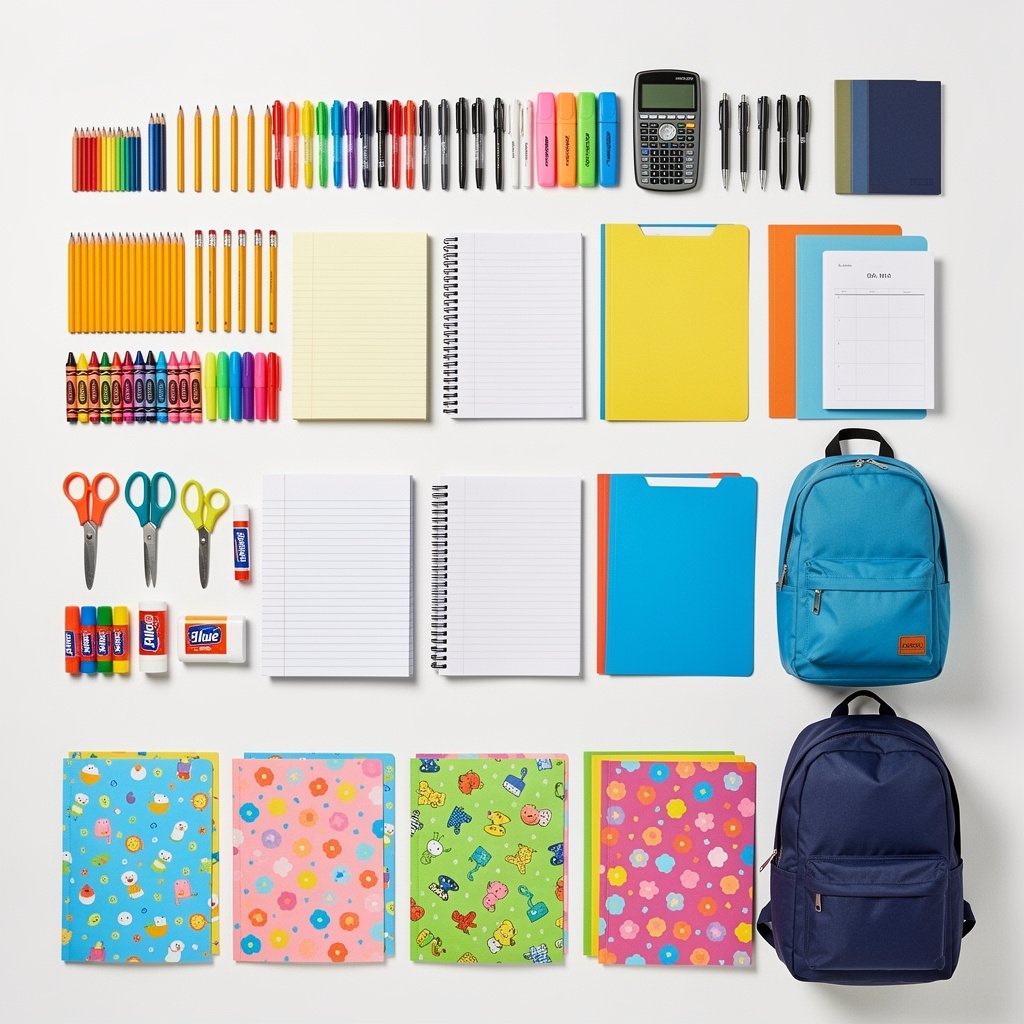
Preparing your student for middle school means rethinking the supply approach that worked in elementary school. Between locker transitions, multiple teachers, and increased academic demands, middle schoolers need durable, well-organized supplies that support independence and responsibility.
This complete middle school supply list covers everything your 6th, 7th, or 8th grader needs for academic success. You’ll discover grade-specific recommendations, organization strategies that reduce morning chaos, and budget-friendly approaches that don’t sacrifice quality. Whether your child is entering middle school for the first time or you’re a veteran parent preparing for another year, this guide provides practical solutions for the unique challenges of grades 6-8.
Understanding Middle School Supply Needs
Middle school creates different supply demands than elementary school. Students rotate between classrooms, manage their own schedules, and take responsibility for materials across six to eight different subjects daily.
The average middle schooler opens their locker eight to twelve times per day. Supplies must survive this constant handling while remaining organized enough for quick access between four-minute passing periods.
What makes middle school supplies different:
Multiple teachers mean multiple requirements. Each subject teacher has preferences. Your student might need college-ruled paper for English but graph paper for math, composition notebooks for science but spiral notebooks for social studies.
Locker storage replaces desk storage. Elementary students kept supplies in desks with teacher oversight. Middle schoolers maintain personal lockers and carry materials independently. This requires compact, durable organizational tools.
Academic rigor increases. More homework, long-term projects, and studying require planners, organizational systems, and quality materials that support higher-level work.
Independence becomes essential. Teachers expect students to arrive prepared without reminders. Forgetting supplies has bigger consequences, making organization systems necessary, not optional.
Universal Supplies for All Middle School Grades
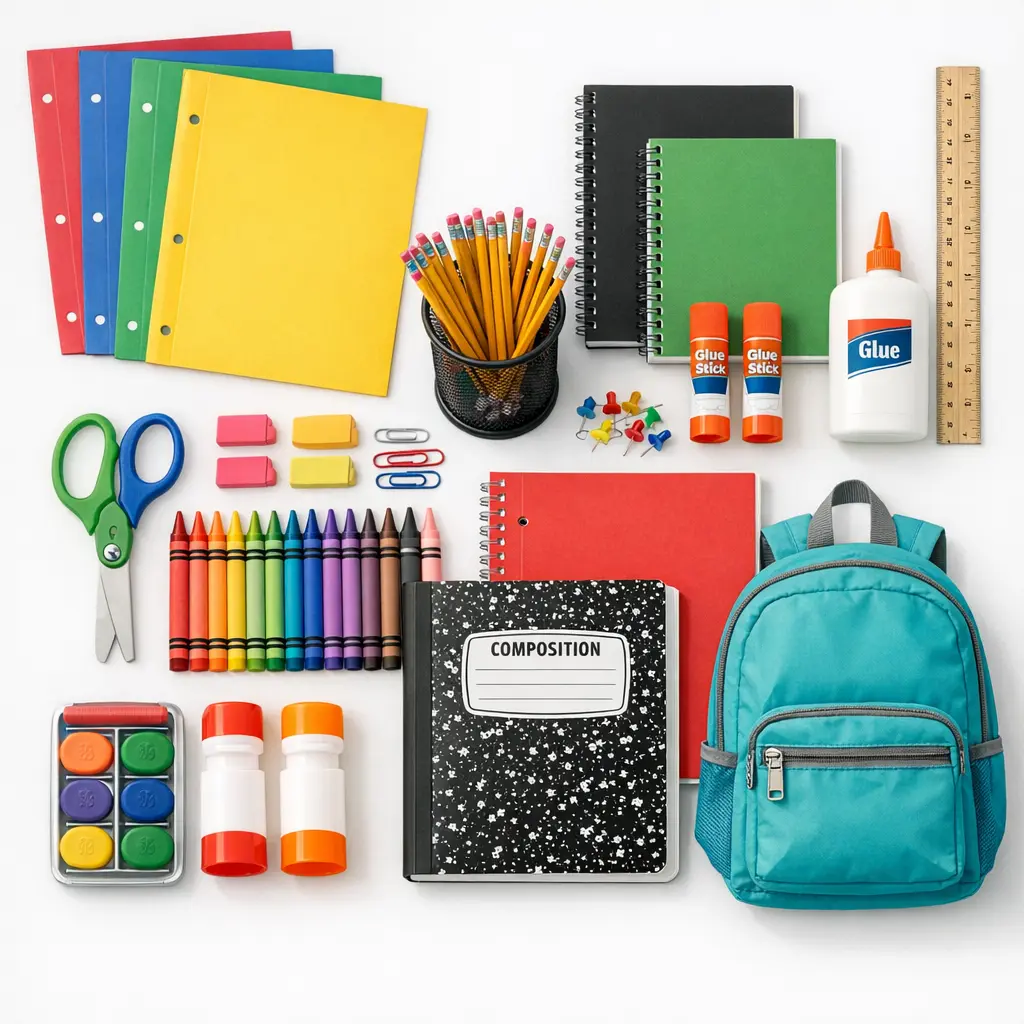
These supplies form the foundation for every middle school student, regardless of grade level or school district.
Backpack
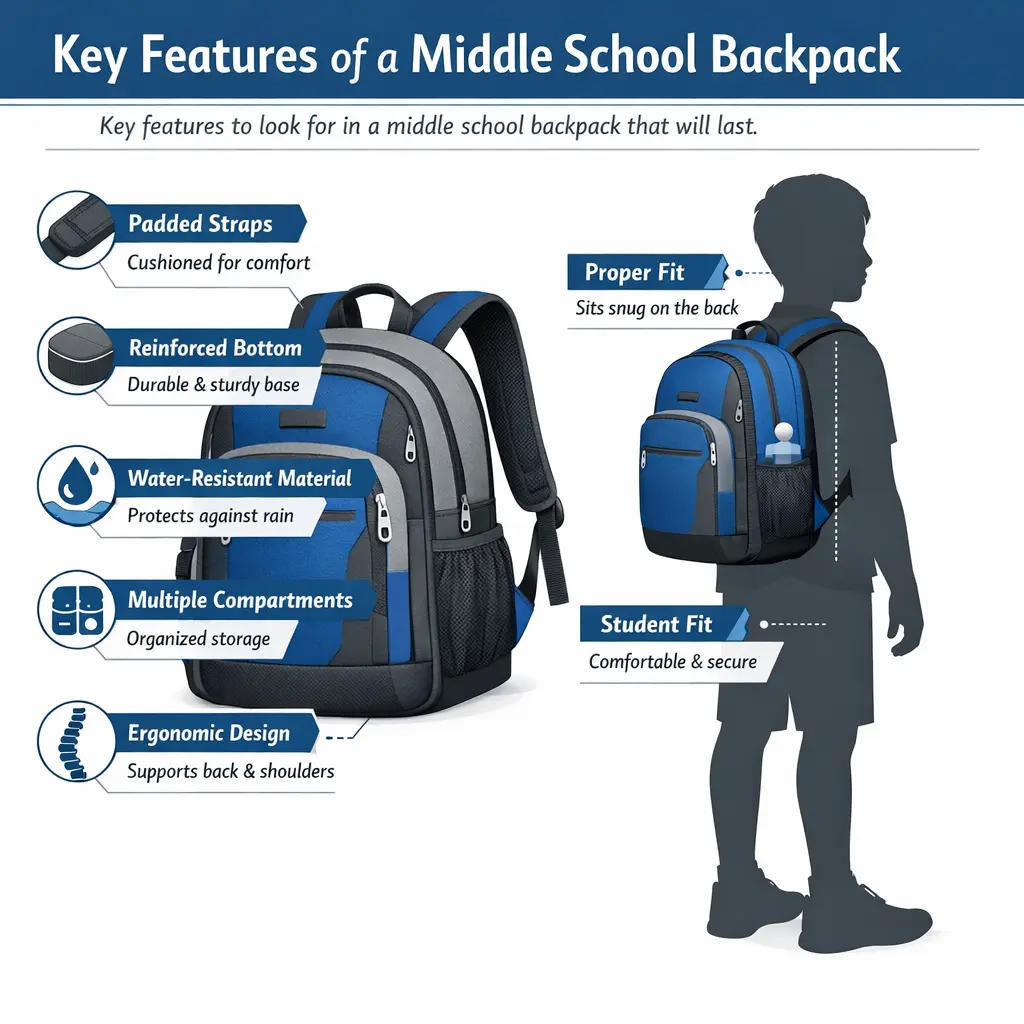
Choose a backpack with padded shoulder straps, reinforced bottom, and multiple compartments. Middle schoolers carry 15-25 pounds of materials daily. Ergonomic design prevents back and shoulder problems.
Look for water-resistant material and heavy-duty zippers. Backpacks must survive daily stuffing, locker storage, and occasional floor-sitting during lunch.
Size recommendation: 1,500-2,000 cubic inches for most middle schoolers. Larger students or those in schools without lockers may need 2,500 cubic inches.
Notebooks and Paper
Five-subject notebooks work well for students who prefer one carrier for all classes. Choose 200 pages or more with durable covers and reinforced spiral binding.
Individual subject notebooks give better organization for students who forget materials or have heavy course loads. One-subject notebooks (70-100 pages) in different colors help students grab the right materials quickly.
Loose-leaf paper: Buy 500 sheets at the school year start. Students use 2-3 sheets daily across all subjects. College-ruled becomes standard in middle school, though some 6th grade teachers still accept wide-ruled.
Binders and Organization
1.5 to 2-inch binders with interior pockets work for most subjects. Some students prefer one binder per subject, while others use a single large binder with dividers.
Binders with clear overlay pockets on the cover and spine help students label and identify contents quickly.
3-ring pocket folders protect papers inside binders. Use different colors for different subjects.
Tab dividers separate sections within binders. Look for durable plastic dividers rather than paper, which tears within weeks.
Writing Instruments
Mechanical pencils reduce sharpening disruptions and maintain consistent writing. Buy 0.7mm lead, which breaks less frequently than 0.5mm. Stock 2-3 mechanical pencils and extra lead refills.
Traditional wooden pencils remain necessary for standardized tests and some teachers’ preferences. Purchase 2-3 dozen #2 pencils for the school year.
Blue or black pens for assignments requiring ink. Many teachers specify pen requirements. Buy a dozen to start, with refills available.
Red pens for peer editing and self-correction work.
Highlighters in multiple colors for note-taking and textbook marking (if allowed). Yellow, pink, and green provide good variation.
Pencil Pouch or Case
Hard-shell pencil boxes from elementary school break in lockers and backpacks. Choose a zippered fabric pouch that flexes with backpack contents.
Large enough to hold pencils, pens, highlighters, small scissors, eraser, and calculator, but compact enough to fit in backpack side pockets.
Student Planner
Non-negotiable for middle school success. Students track assignments across multiple subjects, long-term projects, test dates, and extracurricular commitments.
Choose planners with monthly and weekly views. Middle schoolers need to see the full month for project planning while tracking daily homework.
Look for planners starting in August and running through June. Academic-year planners align with school schedules better than calendar-year versions.
Folders
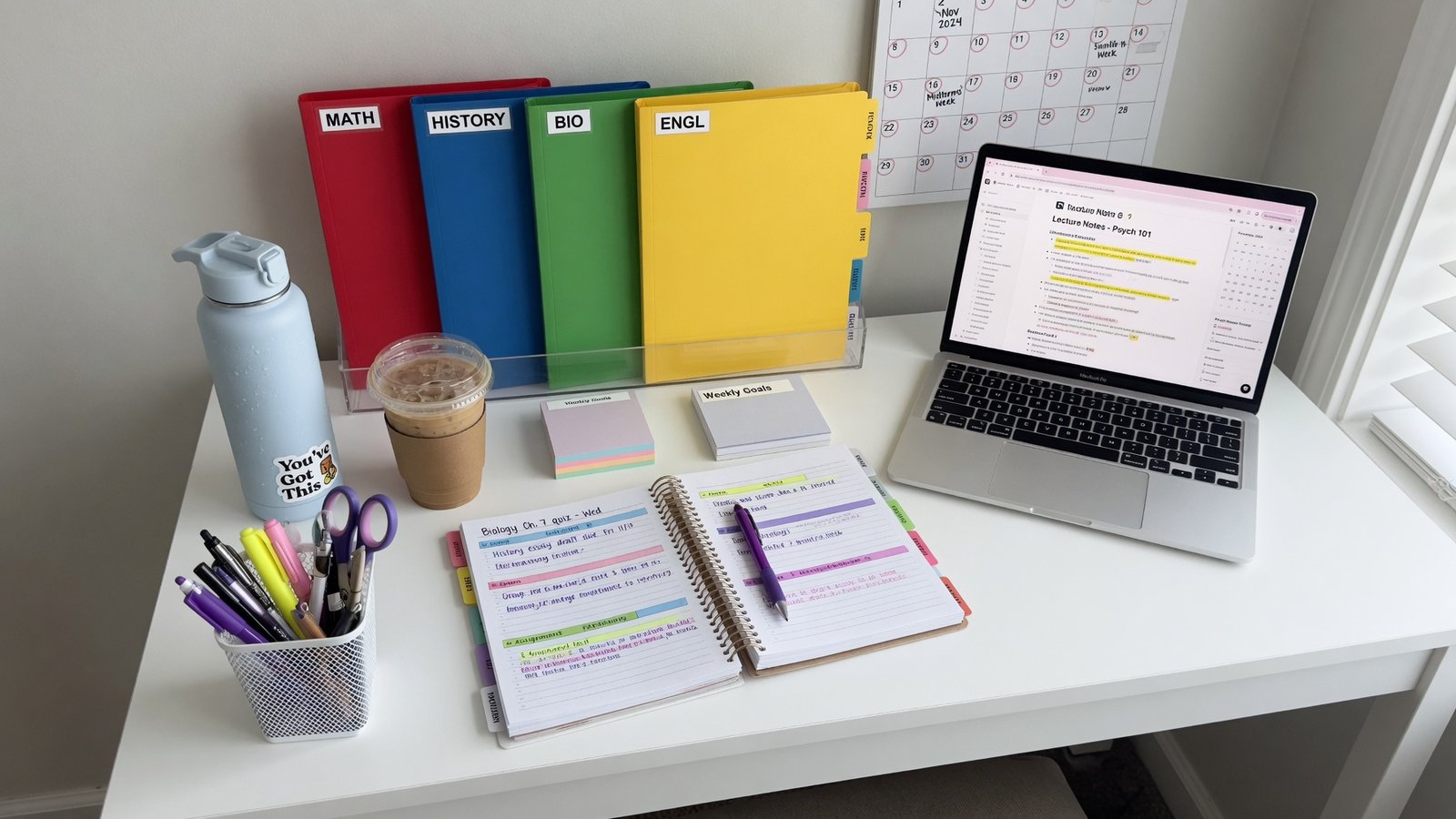
Pocket folders in durable plastic or poly material last longer than paper or cardboard folders. Assign one color per subject for quick identification.
Three-prong folders that fit inside binders combine folder and binder benefits. Students keep current work in folders while storing completed work in binder sections.
Basic Supplies
Erasers: Both pencil-top erasers and larger block erasers. Mechanical pencil erasers wear down quickly.
Glue sticks: 4-6 for the year. Required for interactive notebooks, projects, and assignments.
Scissors: 5-inch pointed scissors for detailed work. Blunt elementary scissors don’t cut precisely enough for middle school projects.
Ruler: 12-inch ruler with both inches and centimeters. Clear plastic rulers work well for geometry and graphs.
Index cards: 3×5 and 4×6 sizes for studying, flashcards, and presentations. Buy 200-300 cards for the school year.
Book covers: Protect textbooks from damage fees. Stretchy fabric covers fit multiple book sizes and don’t tear like paper covers.
Grade-Specific Supply Recommendations
6th Grade Essentials
Sixth grade represents the transition year. Students develop organizational habits while adjusting to middle school routines.
Calculator: Scientific calculator with fraction capabilities. Most 6th grade math courses require scientific calculators but not graphing calculators. Texas Instruments TI-30X IIS is standard for this grade level.
Assignment notebook emphasis: Sixth graders need consistent planner use coaching. Choose planners with clear, large spaces for writing assignments.
Color-coded organization: Sixth graders benefit from simple color systems. Assign each subject a color and use matching folders, notebooks, and binder tabs.
Extra supplies: Keep duplicate basic supplies (pencils, erasers, glue sticks) at home and in locker. Sixth graders forget supplies more frequently and need backup options.
Composition notebooks: Many 6th grade science and social studies teachers require composition notebooks for structured notes and interactive notebooks.
7th Grade Additions
Seventh graders handle increased academic demands and longer-term projects.
Upgraded calculator: Some 7th grade advanced math courses introduce graphing calculator concepts. Confirm with teachers before purchasing, as standard scientific calculators remain sufficient for most 7th grade courses.
USB drive or cloud storage: 7th graders complete more typed assignments and projects. An 8-16GB USB drive provides portable storage, though many schools now use cloud-based platforms.
Expanded project supplies: Keep poster boards, markers, colored pencils, and construction paper at home. Seventh grade includes more visual projects and presentations.
Multi-subject organization: Seventh graders often take 7-8 different courses. Organization systems must handle complexity. Consider separate binders for core subjects (math, science, English, social studies) and a shared binder for electives.
Expanded planner use: Look for planners with sections for goals, notes, and project planning, not just assignment tracking.
8th Grade Requirements
Eighth grade prepares students for high school academic demands and independence.
Graphing calculator: Most 8th grade algebra and geometry courses require graphing calculators. Texas Instruments TI-84 Plus remains the standard for middle and high school. This represents the biggest single supply investment ($90-120), but the calculator will serve through high school.
Confirm specific calculator requirements with math teachers. Some districts provide calculators for classroom use but require students to purchase their own for homework.
Professional presentation supplies: Eighth graders give more formal presentations. Consider a portfolio folder for keeping presentation materials organized and protected.
Subject-specific materials: Advanced 8th grade courses may require specialty items:
- Protractors and compasses for geometry
- Graph paper notebooks for advanced math
- Lab notebooks for science
- Specific novel editions for English
Independent organization: Eighth graders should select organizational systems that work for their learning style rather than parent-imposed systems. Student buy-in improves consistency.
High school preparation: Use 8th grade to establish systems that will transfer to high school. Focus on sustained organization, long-term project planning, and independent responsibility.
Organization Systems That Actually Work
Middle school organization requires systems that survive daily locker-classroom transitions while supporting quick material access.
Color-Coding System
Assign each subject a color. Use matching notebooks, folders, binder covers, and tabs. Students grab the right materials instinctively without reading labels during four-minute passing periods.
Example color system:
- Math: Blue
- Science: Green
- English: Red
- Social Studies: Yellow
- Electives: Purple or Orange
Binder vs. Notebook Systems
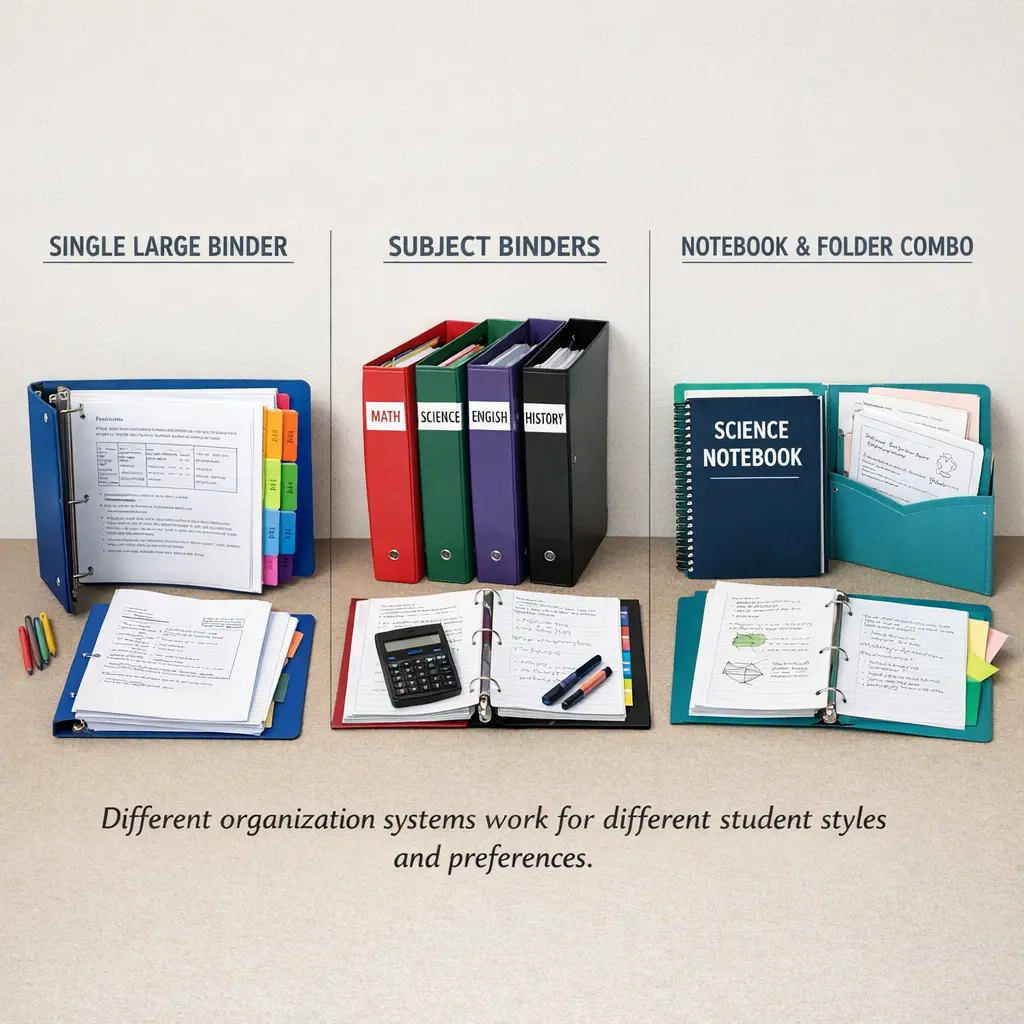
Single large binder method: One 3-inch binder with dividers for all subjects. Students carry one binder all day, reducing forgotten materials. Works well for organized students but becomes heavy and unwieldy.
Individual subject binders: Separate 1-inch binder for each core subject. Students carry only needed binders, reducing weight. Risk of forgotten materials increases.
Notebook + folder combination: One notebook per subject with matching pocket folder. Lightweight and simple. Current work stays in folders, while completed work goes in binders at home. Reduces backpack weight while maintaining organization.
Accordion folder system: Multi-pocket accordion folder for all subjects combined with subject notebooks. Everything stays together with minimal weight. Best for students who struggle with multiple components.
Test different systems during the first month of school. What works in theory may not match your student’s habits and preferences.
Daily Organization Routine
Morning locker stop: Organize materials for morning classes. Take only needed binders, notebooks, and textbooks.
Lunchtime reorganization: Switch materials. Return morning supplies and grab afternoon class materials.
End-of-day locker clean-out: Transfer completed work to take-home folders. Collect homework materials and textbooks.
Evening backpack organization: Complete homework, pack finished work in proper folders, and set up backpack for the next day.
Consistent daily routines prevent the “backpack black hole” where papers disappear into crumpled chaos.
Locker Supply Essentials
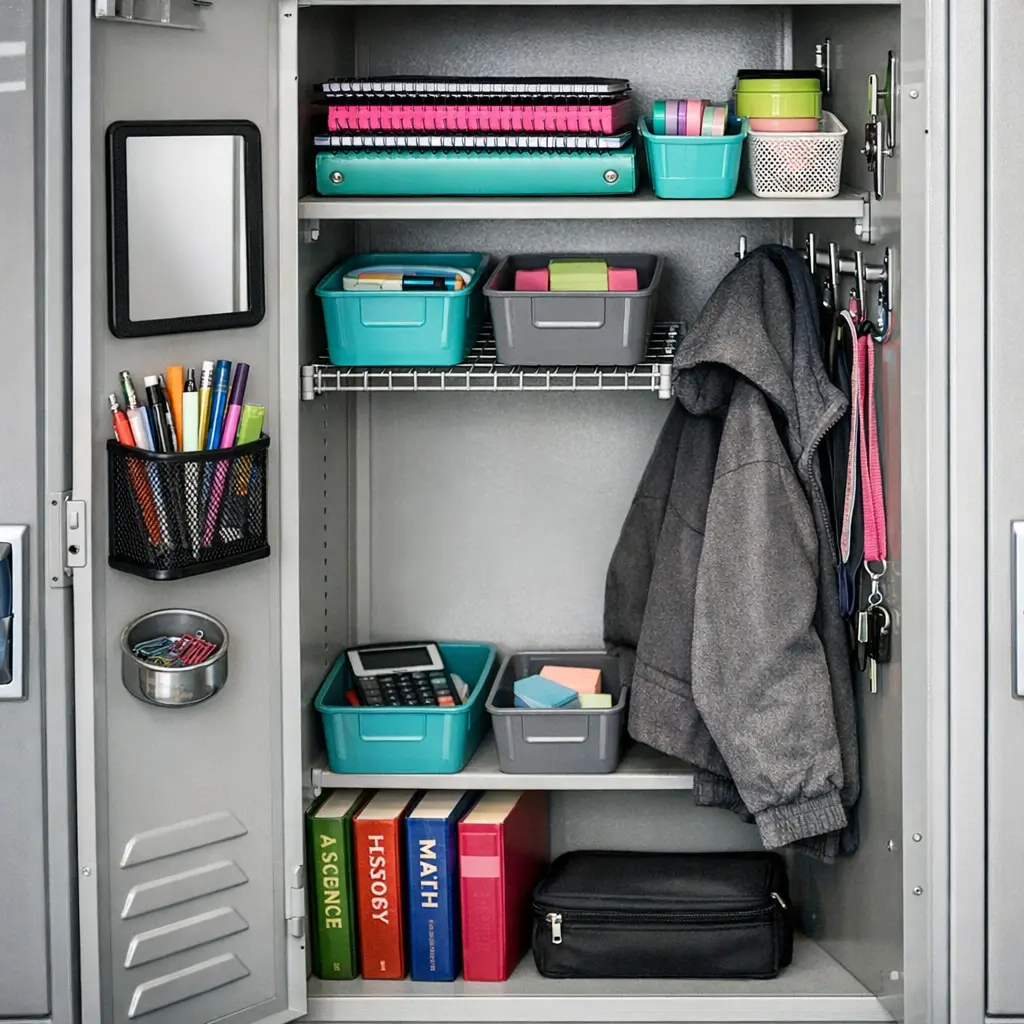
Lockers measure approximately 12 inches wide, 12 inches deep, and 24-36 inches tall. Maximize this small space with organizational supplies.
Locker Shelf
Doubles usable space by creating two levels. Metal mesh shelves hold textbooks on the bottom level and notebooks on the top level.
Adjustable shelves accommodate different locker heights and configurations.
Magnetic Accessories
Magnetic pencil holder: Attaches to locker door for quick access to writing instruments without digging through backpack.
Magnetic mirror: Helps students check appearance between classes. Reduces bathroom crowding.
Magnetic hooks: Hold jackets, PE clothes, or instrument cases.
Magnetic dry-erase board: Small board for reminders, schedule changes, or motivational notes.
Locker Organization Bins
Small plastic bins or caddies separate supplies by category. One bin for extra school supplies, another for personal items (lotion, tissues, hand sanitizer).
Choose bins that fit locker width without wasting space.
Emergency Supply Kit
Keep backup supplies in a small pouch in the locker:
- Extra pencils and pens
- Band-aids
- Tissues
- Hair ties
- Small snack (if allowed)
- Feminine hygiene products (for older students)
- Phone charging cable
This emergency kit prevents borrowing from classmates or missing class to visit the nurse for minor needs.
Technology and Digital Supplies
Modern middle schools blend traditional and digital learning. Supply lists now include technology components.
Required Digital Items
School-issued devices: Many districts provide Chromebooks, tablets, or laptops. Students need protective cases not provided by schools.
Headphones or earbuds: Required for computer-based learning, videos, and testing. Choose durable over-ear headphones rather than cheap earbuds that break within weeks. Many schools require wired (not wireless) headphones to prevent connectivity issues.
Device chargers: Keep one charger at home and consider a backup. Lost chargers create homework barriers.
Optional Digital Tools
USB drive: 16-32GB flash drive for backing up projects and transferring work between school and home computers. Less critical in schools using cloud platforms.
Portable charger: For schools that allow students to carry personal phones. Choose 5,000-10,000 mAh capacity.
Digital Organization
Cloud storage organization: Create folders for each subject within Google Drive, OneDrive, or school platforms. Mirror physical organization systems digitally.
Password management: Middle schoolers access multiple platforms (school portal, email, Google Classroom, library database). Keep a written list of usernames and passwords at home for parent reference.
File naming systems: Teach consistent file naming: “LastName_Subject_AssignmentName_Date.” Finding digital assignments quickly matters as much as physical organization.
Subject-Specific Supply Breakdown
Different subjects create different supply needs. Prepare for these common subject-specific requirements.
Mathematics
- Graphing or scientific calculator (grade-dependent)
- Graph paper (1/4 inch or 5mm)
- Protractor (6-inch)
- Compass for drawing circles
- Ruler (12-inch with metric and standard)
- Pencils (many math teachers prohibit pens)
Science
- Composition notebook for lab reports
- Safety goggles (some schools provide, others require student purchase)
- Lab apron (if required)
- Colored pencils for diagrams
- Index cards for vocabulary
English/Language Arts
- Pocket folder for handouts and reading materials
- Highlighters for text annotation
- Composition notebook for writing assignments
- Small stapler (some teachers require students to staple their own work)
Social Studies
- Map pencils or colored pencils
- Highlighters for textbook reading
- Index cards for study guides
- Pocket folder for handouts and maps
Electives
Art: Classes typically provide supplies, but students may need:
- Sketchbook
- Drawing pencils (2H, HB, 2B, 4B)
- Eraser
Music: Specific to instrument and program
Technology/Computer Science: Usually no supplies required beyond school-issued device
Physical Education:
- Athletic shoes
- Gym clothes
- Lock for PE locker
- Deodorant
- Small towel
Foreign Language:
- Composition notebook or folder
- Index cards for vocabulary
- Highlighters
Budget-Friendly Shopping Strategies
Middle school supply costs range from $80-200 per student depending on calculator requirements and quality choices.
Strategic Shopping Timeline
July: Purchase basic supplies during back-to-school sales. Retailers heavily discount notebooks, folders, pencils, and paper. Stock up on consumables at rock-bottom prices.
Late August: Wait for calculator purchases. Teachers often provide specific model requirements during the first week of school. Premature calculator purchases may not meet course needs.
September-October: Buy specialty subject supplies after teachers clarify requirements. Avoid purchasing graph paper, protractors, or composition notebooks until you know they’re needed.
January: Restock during after-Christmas sales. Replace worn items and replenish consumables at clearance prices.
Money-Saving Strategies
Buy in bulk: Purchase notebooks, folders, and paper in multipacks. The per-unit cost drops significantly.
Share with siblings or friends: Buy large packs of pencils, erasers, or glue sticks and split them with other families.
Previous year supplies: Gently used binders, barely-touched notebooks, and functional supplies from last year work perfectly. Don’t replace what still functions.
Generic vs. name brand: Generic works fine for consumables (pencils, paper, glue sticks, folders). Invest in quality for items used daily (backpack, calculator, binders).
Retailer price matching: Major retailers price-match competitors during back-to-school season. Comparison shop without driving to multiple stores.
Supply swaps: Organize neighborhood or school supply swaps. Exchange unused items from previous years.
Tax-free weekends: Many states offer sales tax holidays during back-to-school season, saving 6-8% on purchases.
Quality vs. Generic: Where to Splurge and Save
Strategic spending maximizes value without overspending on unnecessary premium products.
Worth the Investment (Splurge)
Backpack: Quality backpacks from established brands last multiple years and protect your student’s back health. Expect to spend $40-70. Cheap backpacks break within months, requiring replacement.
Calculator: For graphing calculators, buy the recommended model new. These $90-120 investments last through high school and college. Used calculators may have button failures or dead batteries that cost nearly as much to replace.
Binders: Heavy-duty binders with metal rings survive the school year. Cheap plastic binders with vinyl rings break within weeks. Spend $5-8 per quality binder instead of $2 for poor quality.
Mechanical pencils: Quality mechanical pencils with comfortable grips and reliable mechanisms prevent frustration. Cheap mechanical pencils jam and break.
Smart Savings (Choose Generic)
Notebooks: Store-brand spiral notebooks perform identically to name brands at half the cost. Paper quality matters little for daily student work.
Folders: Generic plastic pocket folders function the same as name brands. Save 50-70% without performance difference.
Loose-leaf paper: Store-brand filler paper works perfectly. No student or teacher notices the difference.
Pencils: Generic #2 pencils write exactly like name-brand pencils. Buy 48-packs for $3-5.
Glue sticks and basic supplies: Generic glue sticks, erasers, and scissors perform identically at lower prices.
Pens: Store-brand pens write as well as premium pens. Middle schoolers lose pens regularly—buy affordable options.
Supply Organization and Maintenance Tips
Organization systems fail without consistent maintenance. Build these habits for year-long success.
Weekly Maintenance
Sunday backpack cleanout: Empty the entire backpack. Remove trash, old papers, and food wrappers. Reorganize materials and restock supplies.
Locker reorganization: Every Friday afternoon, clean the locker. Remove unnecessary items, reorganize shelves, and prepare for the next week.
Supply inventory: Check pencil, pen, and paper levels weekly. Restock before you run out completely.
Monthly Deep Clean
Binder purge: Remove graded papers that don’t need to stay in active binders. File important tests and projects at home; recycle routine worksheets.
Backpack wash: Many backpacks are machine washable. Clean monthly to remove dirt, smells, and bacteria.
Supply replacement: Replace broken folders, worn notebooks, and dried-out markers.
Semester Organization
December and May cleanouts: At semester end, remove all previous semester materials from lockers and backpacks. Start fresh with new organizational systems.
Archive important work: Transfer semester exams, major projects, and important graded work to storage at home.
Assess systems: What organizational methods worked? What failed? Adjust systems for the next semester.
Common Middle School Supply Mistakes
Avoid these frequent errors that waste money and create organizational problems.
Mistake 1: Buying Everything on the List Immediately
School supply lists often include items needed later in the year or for specific projects. Teachers clarify actual needs during the first week.
Solution: Buy core supplies before school starts. Wait on specialty items until teachers request them.
Mistake 2: Choosing Style Over Function
Trendy backpacks with insufficient support or flimsy construction break quickly. Character-themed supplies may embarrass students mid-year as preferences change.
Solution: Prioritize durability and function. Choose neutral colors and classic styles that won’t feel babyish or outdated.
Mistake 3: Overbuying Consumables
Buying 20 glue sticks when students need 3 for the year wastes money. Unused supplies from September still sit in lockers in May.
Solution: Start with reasonable quantities. Restock as needed. Most supplies can be purchased throughout the year.
Mistake 4: Underestimating Durability Needs
Elementary-quality supplies break under middle school demands. Thin folders tear, cheap binders collapse, and lightweight backpacks rip.
Solution: Invest in middle-school-grade durability for frequently used items. These supplies withstand rougher handling.
Mistake 5: Ignoring Student Input
Parents who select supplies without student input create systems students won’t use. Color-coding that makes sense to parents confuses students.
Solution: Involve your student in supply selection and organization decisions. Ownership improves compliance.
Mistake 6: No Backup Supplies
Students who run out of pencils during class disrupt learning by borrowing. Empty notebooks mean assignments on loose paper that gets lost.
Solution: Maintain backup supplies in lockers and at home. Monitor levels and restock proactively.
When to Replace and Restock
Strategic replacement prevents last-minute scrambles and maintains organization.
Replace Immediately
Broken backpack zippers or straps: A non-functional backpack creates daily chaos. Replace broken backpacks within days, not weeks.
Calculator malfunctions: Mathematics progress depends on working calculators. Replace or repair immediately.
Worn binders with broken rings: Papers fall out of damaged binders, causing lost work and grade penalties.
Replace Within a Week
Leaking pens: Ink stains damage other papers and clothing.
Dull scissors: Struggling with dull scissors causes frustration and poor project results.
Torn folders: Papers fall out of damaged folders and get lost.
Restock Regularly
Pencils and pens: Refill when supply drops below five usable writing instruments.
Notebook paper: Restock when fewer than 50 sheets remain.
Highlighters: Replace dried-out highlighters as they fail.
Glue sticks: Keep 2-3 on hand throughout the year.
End-of-Year Assessment
May evaluation: Assess which supplies survived the year and which broke down. Use this information to inform next year’s quality decisions.
Save functional items: Barely-used notebooks, working folders, and functional supplies carry to next year.
Donate extras: Unopened or gently used supplies can be donated to schools or community organizations.
COMPARISON TABLES
Calculator Comparison by Grade Level
| Grade Level | Calculator Type | Key Features | Approximate Cost | When to Buy |
|---|---|---|---|---|
| 6th Grade | Scientific | Fraction display, basic functions | $12-18 | Before school starts |
| 7th Grade | Scientific | Multi-line display, statistics | $15-25 | Confirm with teacher first week |
| 8th Grade (Standard Math) | Scientific | Advanced functions, graphing prep | $15-25 | After teacher confirmation |
| 8th Grade (Algebra/Geometry) | Graphing | Full graphing capability, pre-loaded apps | $90-120 | Wait for teacher specification |
Backpack Features Comparison
| Feature | Elementary Style | Middle School Needs | Why It Matters |
|---|---|---|---|
| Size | 1,000-1,500 cu. in. | 1,500-2,000 cu. in. | More subjects = more materials |
| Straps | Basic padding | Ergonomic, padded, adjustable | Prevents back/shoulder strain from heavier loads |
| Compartments | 1-2 sections | 3-4 sections + organizer pockets | Multiple subjects need separation |
| Bottom | Standard fabric | Reinforced, padded | Daily locker storage creates wear |
| Water resistance | Not critical | Important | Protects electronics and papers |
| Durability | 1 year expected | 2-3 years expected | Middle school use is rougher |
Organization System Comparison
| System | Best For | Advantages | Disadvantages | Weight |
|---|---|---|---|---|
| Single 3″ Binder | Extremely organized students | All materials together, nothing forgotten | Very heavy, bulky, intimidating | Heavy |
| Subject Binders (1″ each) | Students with strong routines | Subject separation, moderate weight | Risk of forgetting needed binder | Medium |
| Notebook + Folder Combo | Minimalists | Lightweight, simple, affordable | Requires discipline to file completed work | Light |
| Accordion Folder System | Students who lose things | Everything in one place, hard to lose | Can become disorganized inside | Light |
Supply Quality Investment Guide
| Supply Category | Generic Acceptable? | When to Splurge | Expected Lifespan |
|---|---|---|---|
| Backpack | No | Always buy quality | 2-3 years |
| Binders | Depends | Heavy-use binders (math, English) | 1 year (quality) vs. 2-3 months (generic) |
| Notebooks | Yes | Never necessary | Used until full |
| Folders | Yes | Consider for core subjects | 3-6 months (generic) vs. full year (quality) |
| Pencils/Pens | Yes | Not necessary | Until lost or empty |
| Calculator | No | Always buy specified model | Through high school |
| Planner | Depends | If student engages with premium features | 1 school year |
| Locker Shelf | Depends | If locker is very small or oddly shaped | Multiple years |
CHECKLISTS
Essential Middle School Supply Checklist
Backpack & Carriers
- Quality backpack (1,500-2,000 cu. in.)
- Lunch bag (if not using backpack compartment)
Writing & Paper
- Mechanical pencils (3-4)
- Extra lead refills
- Wooden #2 pencils (24 count)
- Blue or black pens (12 count)
- Red pens (4 count)
- Highlighters (4 colors)
- Loose-leaf paper (500 sheets, college-ruled)
Organization
- 5-subject notebook OR individual subject notebooks (6)
- 3-ring binders (4-6, 1.5-2 inch)
- Pocket folders (6-8, various colors)
- Tab dividers (1-2 packs)
- Pencil pouch
- Student planner
Calculation & Measurement
- Calculator (scientific or graphing, grade-appropriate)
- Ruler (12 inch)
- Protractor
- Compass
Basic Supplies
- Erasers
- Glue sticks (4-6)
- Scissors (5 inch)
- Index cards 3×5 (100 count)
- Index cards 4×6 (100 count)
- Book covers (3-4 stretchy fabric)
Locker Organization
- Locker shelf
- Magnetic mirror
- Magnetic pencil holder
- Magnetic hooks (2-3)
- Small storage bins (2-3)
Technology
- Headphones (wired)
- Device case/protection
- USB drive (16-32GB) – optional
- Charging cables
Subject-Specific (buy after teacher confirmation)
- Composition notebooks
- Graph paper
- Colored pencils
- Art supplies
- PE clothes and shoes
- Specialty items per teacher request
First Week of School Checklist
- Confirm calculator requirements with math teacher
- Verify notebook/binder preferences for each subject
- Establish color-coding system
- Set up locker organization
- Program locker combination into phone
- Create emergency supply kit for locker
- Test organization system with student
- Establish daily backpack routine
- Set up homework space at home
- Create digital folders matching physical organization
- Purchase any specialty supplies teachers requested
- Adjust system based on first-week experience
Monthly Supply Maintenance Checklist
- Check pencil/pen inventory (restock if below 5)
- Verify paper supply (restock if below 50 sheets)
- Inspect backpack for damage or needed cleaning
- Clean out locker (remove trash, old papers)
- Purge binders of unnecessary papers
- Test calculator batteries
- Replace broken or worn supplies
- Check planner usage consistency
- Reorganize digital files
- Restock emergency locker supplies
End-of-Year Supply Assessment Checklist
- Evaluate backpack condition (keep or replace next year?)
- Test calculator functionality (working for next year?)
- Sort binders (which survived? Which broke?)
- Identify unused supplies for next year
- Review organizational systems (what worked? What didn’t?)
- Note supply brands that performed well
- List items that needed frequent replacement
- Save functional supplies for next year
- Donate unused, unopened supplies
- Create shopping list based on this year’s lessons
DECISION FRAMEWORKS
Choosing the Right Organization System
Answer these questions to determine the best system for your student:
1. How organized is your student naturally?
- Very organized → Individual subject binders
- Moderately organized → Notebook + folder combo
- Struggles with organization → Single large binder or accordion folder
2. How much does your student carry between classes?
- Only 1-2 classes worth → Individual binders work well
- Changes completely at lunch → Two-binder system (AM/PM)
- Prefers everything always → Single large binder or accordion
3. Does your student have a good memory for materials?
- Excellent memory → Individual subject system
- Sometimes forgets → Color-coded system
- Frequently forgets → Keep-it-together system (accordion or large binder)
4. How much does your student care about weight?
- Doesn’t mind heavier backpack → Binders
- Prefers lighter → Notebooks and folders
- Concerned about back strain → Accordion folder or thin notebooks
5. What does your student prefer?
- Student choice dramatically impacts system success. Let them guide the decision.
Calculator Purchase Decision Tree
Start: What grade is your student entering?
6th Grade:
→ Purchase scientific calculator ($12-18)
→ TI-30X IIS or Casio FX-260
→ Buy before school starts
7th Grade:
→ Check if regular or advanced math
→ Regular: Scientific calculator ($15-25)
→ Advanced: Wait for teacher specification (may need graphing)
8th Grade:
→ Is your student in Algebra or Geometry?
Yes, Algebra/Geometry:
→ Wait for teacher specification (likely graphing calculator needed)
→ TI-84 Plus most common ($90-120)
→ Purchase after teacher confirms specific model
→ Consider used/refurbished from reputable seller
No, standard 8th grade math:
→ Advanced scientific calculator ($15-25)
→ TI-30X IIS or equivalent
Budget concerns with graphing calculator:
→ Check if school has loaner program
→ Look for previous year students selling
→ Consider refurbished from retailer with warranty
→ Split purchase with other parent (student keeps at school, sibling uses for homework)
Binder vs. Notebook Decision Framework
Factors favoring BINDERS:
- Student likes keeping all materials for a subject together
- Handouts and worksheets are frequent
- Student needs to reference previous work regularly
- Teacher preference in multiple classes
- Student reorganizes materials regularly
Factors favoring NOTEBOOKS:
- Student prefers lightweight backpack
- Primarily note-taking with few handouts
- Quick access to current work is priority
- Student struggles with binder organization
- Budget is very limited
Hybrid approach:
- Use binders for heavy-handout subjects (English, Social Studies)
- Use notebooks for note-heavy subjects (Math, Science)
- Match method to subject needs rather than forcing single system
When to Buy Quality vs. Generic
Buy QUALITY when:
- Item is used multiple times every day (backpack, pencil pouch)
- Replacement would be disruptive (calculator, binders)
- Durability directly impacts function (backpack straps, binder rings)
- Item must last multiple years (calculator, protractor)
- Comfort and ergonomics matter (backpack, mechanical pencils)
Buy GENERIC when:
- Item is consumable (paper, pencils, glue)
- Item is frequently lost (pens, erasers)
- Brand doesn’t affect performance (folders, rulers)
- Item will be outgrown or replaced by year-end (trendy items)
- Quantity matters more than quality (index cards, basic folders)
Middle ground:
- Binders (quality for core subjects, generic for electives)
- Notebooks (quality if student is particular about paper feel, generic otherwise)
- Folders (quality for subjects with heavy use, generic for light-use subjects)
1. What’s the difference between elementary and middle school supply needs?
Middle school supplies must be more durable to withstand daily locker-to-classroom transitions, support organization across 6-8 different subjects, and encourage student independence without teacher oversight. The key differences include replacing desk storage with locker organization, using college-ruled paper instead of wide-ruled, needing scientific or graphing calculators, requiring student planners for assignment tracking, and transitioning from teacher-provided supplies to student-managed materials. Middle schoolers also need supplies that survive rougher handling and more frequent use compared to elementary school.
2. Do I need to buy everything on the school supply list immediately?
No. Purchase core supplies before school starts (backpack, basic writing instruments, notebooks, folders, binder, paper), but wait on specialty items until teachers provide specific requirements during the first week. Many supply lists include items needed for specific projects later in the year or optional supplies that not all teachers actually require. Calculators especially should wait for teacher specification to ensure you buy the correct model. This approach prevents wasting money on unnecessary items while ensuring students have essentials for day one.
3. What type of calculator does my middle schooler need?
Calculator needs depend on grade level and math course. Sixth graders typically need scientific calculators with fraction capabilities ($12-18). Seventh graders usually continue with scientific calculators unless enrolled in advanced math. Eighth graders in Algebra I or Geometry typically require graphing calculators ($90-120), most commonly the TI-84 Plus. Always confirm the specific calculator model with the math teacher during the first week of school before purchasing, as requirements vary by curriculum and teacher preference. Graphing calculators represent a significant investment but last through high school.
4. How can I help my middle schooler stay organized?
Implement a color-coding system assigning each subject a specific color for notebooks, folders, and binders. Establish daily routines including morning locker organization, lunchtime material switching, and end-of-day backpack preparation. Provide adequate organizational tools like locker shelves, pencil pouches, and planners. Conduct weekly backpack cleanouts every Sunday to remove trash and reorganize materials. Most importantly, involve your student in selecting organizational systems—student buy-in dramatically improves compliance. Start with simple systems and adjust based on what actually works for your child’s habits and preferences.
5. Should I buy one big binder or separate binders for each subject?
This depends on your student’s organizational style and preferences. A single large binder (3 inches) with dividers keeps all materials together, reducing forgotten items, but becomes heavy and bulky. Individual subject binders (1-1.5 inches each) provide better organization and lighter carrying but increase the risk of forgetting needed materials. Many students succeed with a hybrid approach using binders for handout-heavy subjects and notebooks with folders for others. Test the system during the first month and adjust based on what your student actually uses consistently.
6. How many notebooks and folders does a middle schooler need?
Most middle schoolers need 6-8 subjects worth of organization. You can accomplish this with either one 5-subject notebook (200+ pages) plus a few single-subject notebooks, or individual single-subject notebooks for each class. Purchase 6-8 pocket folders in different colors corresponding to subjects. Have at least one extra notebook and two extra folders on hand for teachers who have specific preferences or for replacement when items wear out. The exact quantity depends on whether your student uses binders (fewer notebooks needed) or primarily notebooks (one per subject).
7. What supplies should I keep in my middle schooler’s locker?
Essential locker supplies include a locker shelf to double usable space, magnetic accessories (mirror, pencil holder, hooks), and an emergency supply kit containing backup pencils, pens, tissues, band-aids, feminine hygiene products for older students, and a small non-perishable snack if allowed. Add small organizational bins to separate supplies from personal items. Keep extra supplies that aren’t needed daily but might be forgotten (glue stick, scissors, ruler). Many students also appreciate magnetic dry-erase boards for reminders. The goal is creating a functional space that supports quick material access during short passing periods.
8. How much should I budget for middle school supplies?
Budget $80-200 per student depending on grade level and calculator requirements. Sixth grade typically costs $80-120 with a scientific calculator. Seventh grade runs $90-130. Eighth grade ranges from $100-200, with graphing calculator requirements pushing costs higher. This estimate includes backpack, organizational supplies, writing instruments, paper, calculator, and basic subject supplies. Reduce costs by shopping sales, using previous year’s functional supplies, choosing generic for consumables, and waiting to purchase specialty items until confirmed necessary. Spread purchases across July sales, late August confirmations, and mid-year restocking.
9. What makes a good middle school backpack?
Quality middle school backpacks have padded, adjustable shoulder straps to distribute 15-25 pounds of materials comfortably, reinforced bottoms to survive daily locker storage, water-resistant material to protect electronics and papers, heavy-duty zippers that withstand constant use, and multiple compartments for organization. Size should be 1,500-2,000 cubic inches for most students. Look for ergonomic designs with chest and waist straps if your student carries particularly heavy loads. Expect to spend $40-70 for a backpack that lasts 2-3 years. This is worth the investment as cheap backpacks break within months and provide inadequate support.
10. When should I replace worn-out supplies during the school year?
Replace broken backpacks, calculator malfunctions, and binders with broken rings immediately, as these disruptions significantly impact daily learning. Replace leaking pens, dull scissors, and torn folders within a week. Restock consumables like pencils when supply drops below five usable instruments, paper when fewer than 50 sheets remain, and glue sticks to maintain 2-3 on hand. Conduct monthly supply inventories to identify needs before they become urgent. Plan for mid-year restocking around January when retailers run post-holiday sales on school supplies. Most students need at least one significant supply refresh between September and May.



Leave a Reply