

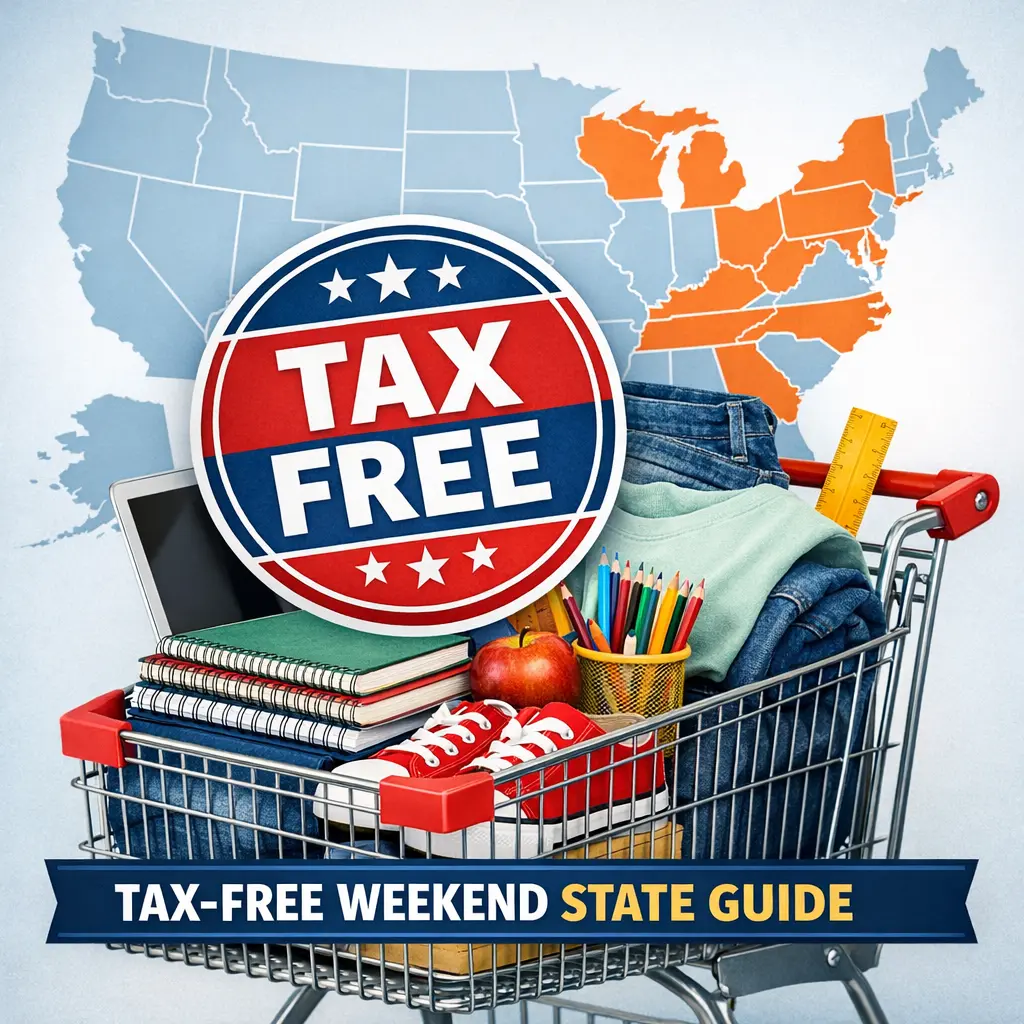
Planning your back-to-school shopping budget just got easier. Tax free weekend allows families to purchase clothing, school supplies, computers, and other essential items without paying state sales tax. For a family spending $800 on back-to-school items in a state with 7% sales tax, that’s $56 in immediate savings.
However, tax free weekend rules differ dramatically by state. Some states offer three-day shopping periods with generous price limits. Others provide single-day events with strict category restrictions. Understanding your state’s specific rules helps you maximize savings and avoid checkout surprises.
This guide breaks down which states participate, when tax holidays occur, what items qualify, and how to strategically plan purchases for maximum benefit. You’ll learn the exact dates, price thresholds, and category definitions for every participating state, plus shopping strategies that compound your savings beyond just tax exemption.
What Is Tax Free Weekend?
Tax free weekend is a designated period when state governments suspend sales tax collection on specific categories of merchandise. These temporary sales tax holidays give consumers relief from state sales tax on essential purchases.
State legislatures create tax free weekends to:
- Reduce financial burden on families during expensive shopping seasons
- Stimulate retail economic activity
- Provide targeted relief for education-related expenses
- Encourage disaster preparedness
- Promote energy-efficient appliance purchases
The first sales tax holiday appeared in New York in 1997. The concept spread rapidly, with peak participation reaching 19 states by 2010. Current participation fluctuates as states weigh revenue impact against consumer benefit.
Key distinction: Tax free weekends differ from everyday tax exemptions (like groceries in some states) by being temporary, event-based, and applying to normally taxable categories.
How Tax Free Weekend Works
The tax exemption applies automatically at point of sale. When you purchase qualifying items during the designated period, retailers remove state sales tax from your transaction. No coupons, applications, or special requests are necessary.
The basic process:
- State legislature passes tax holiday legislation specifying dates, categories, and price limits
- State revenue department issues detailed guidance to retailers
- Retailers program point-of-sale systems to exempt qualifying items during the window
- Consumers shop normally; tax removal happens automatically
- Retailers report exempt sales through standard tax filing procedures
Timing specifics matter: The tax exemption typically applies based on when the transaction is completed, not when you browse or add items to a cart. For online purchases, most states use the order timestamp. For in-store purchases, the register time stamp determines eligibility.
Layaway considerations: Some states allow items placed on layaway during the tax holiday to receive exemption even if final payment occurs later. Rules vary by state.
Returns and exchanges: If you return a tax free item after the holiday ends, you typically don’t owe back taxes. If you exchange a tax free item for a different item after the holiday, the new item may be taxable.
States Offering Tax Free Weekend
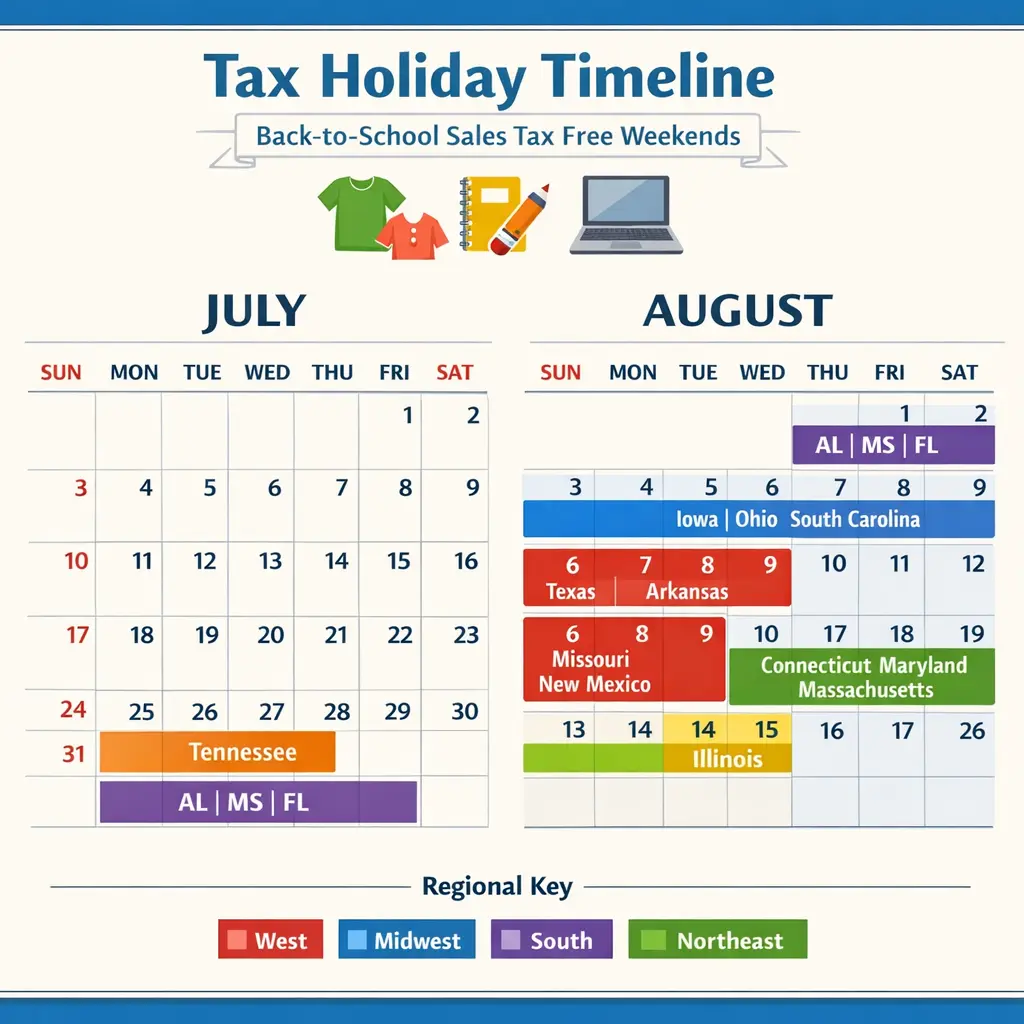
Seventeen states currently offer sales tax holidays. Participation changes based on state budget situations and legislative priorities.
States with active tax free weekends:
- Alabama
- Arkansas
- Connecticut
- Florida
- Iowa
- Maryland
- Massachusetts
- Mississippi
- Missouri
- New Mexico
- Ohio
- Oklahoma
- South Carolina
- Tennessee
- Texas
- Virginia
- West Virginia
States that previously offered but discontinued:
- Georgia (suspended indefinitely)
- Louisiana (periodic participation)
- North Carolina (discontinued)
States without sales tax (no tax holiday needed):
- Alaska
- Delaware
- Montana
- New Hampshire
- Oregon
Important note: Even within participating states, local jurisdictions may opt out or continue collecting local sales taxes. Always verify local participation.
Complete State-by-State Breakdown
Alabama
Typical Dates: Third weekend in July (Friday-Sunday)
Qualifying Items:
- Clothing: $100 or less per item
- School supplies: $50 or less per item
- Books: $30 or less per book
- Computers and software: $750 or less
Exclusions: Jewelry, cosmetics, eyewear, wallets, watches, furniture
Local Tax: Participating localities may also waive local sales tax
Arkansas
Typical Dates: First weekend in August (Saturday-Sunday)
Qualifying Items:
- Clothing and footwear under $100 per item
- Clothing accessories under $50 per item
- School supplies (no price limit)
- School art supplies (no price limit)
- School instructional materials (no price limit)
Exclusions: Jewelry, handbags, umbrellas, eyewear, watches
Connecticut
Typical Dates: One week in August
Qualifying Items:
- Clothing and footwear under $100 per item
Exclusions: Athletic/protective clothing, jewelry, handbags, luggage, umbrellas, wallets, watches
Special note: Connecticut’s holiday is typically longer than other states (full week vs. weekend)
Florida
Typical Dates: Two periods – back-to-school (late July/early August) and disaster preparedness (late May/early June)
Back-to-School Qualifying Items:
- Clothing, footwear, and accessories: $100 or less per item
- School supplies: $50 or less per item
- Learning aids and puzzles: $30 or less
- Personal computers and accessories: $1,500 or less
Disaster Preparedness Qualifying Items:
- Battery-powered radios: $50 or less
- Tarps and ground covers: $100 or less
- Batteries and flashlights: specific price limits apply
- Portable generators: $3,000 or less
Iowa
Typical Dates: First Friday and Saturday in August
Qualifying Items:
- Clothing and footwear under $100 per item
Exclusions: Accessories, athletic/protective equipment, rentals
Maryland
Typical Dates: Second weekend in August (one week, Sunday-Saturday)
Qualifying Items:
- Clothing and footwear: $100 or less per item
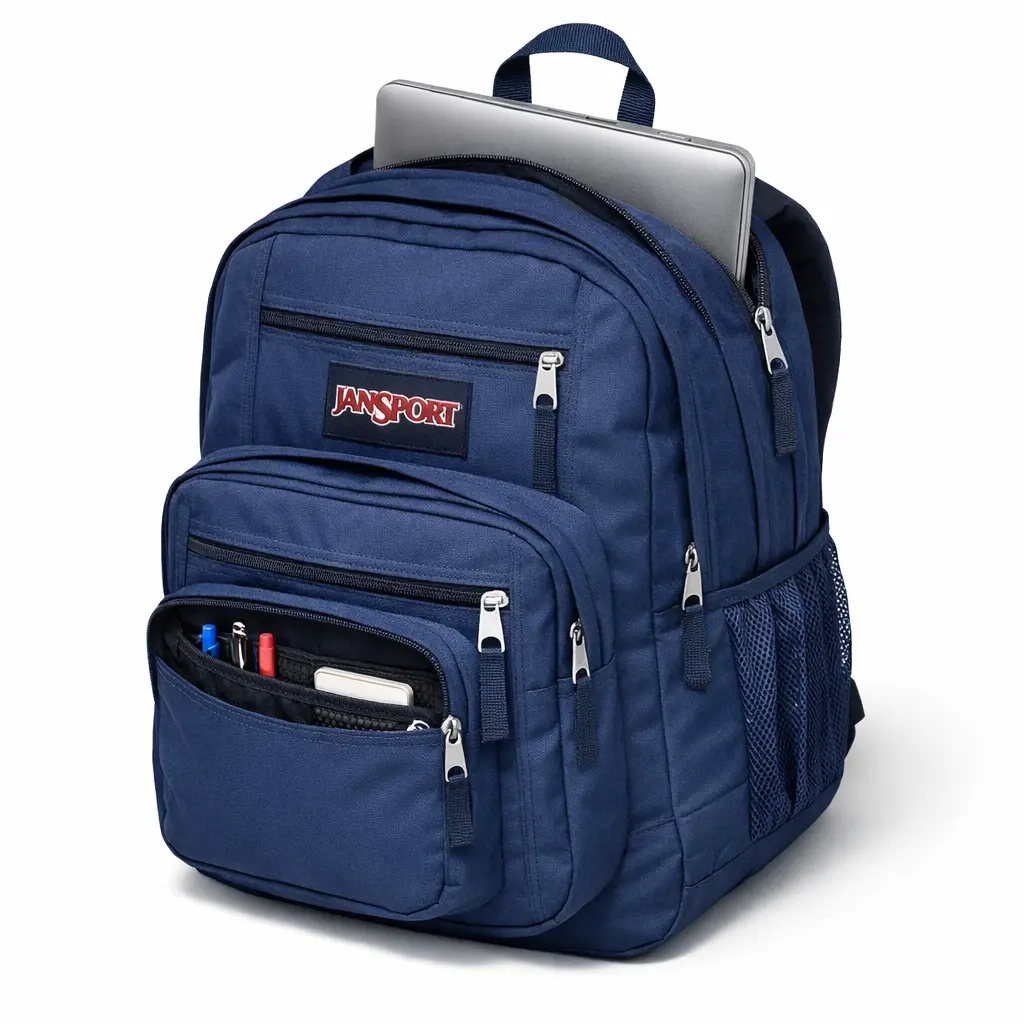
- Backpacks and bookbags: first $40 tax free
Exclusions: Accessories, athletic/protective clothing, sewing materials
Massachusetts
Typical Dates: One weekend in August (Saturday-Sunday)
Qualifying Items:
- Most tangible personal property: $2,500 or less per item
Exclusions: Motor vehicles, motorboats, meals, telecommunications, gas, electricity, tobacco, marijuana
Special note: Massachusetts offers the broadest exemption, not limited to clothing and school supplies
Mississippi
Typical Dates: Last Friday and Saturday in July
Qualifying Items:
- Clothing and footwear: $100 or less per item
Exclusions: Accessories, athletic/protective equipment, rentals, skis, swim fins
Missouri
Typical Dates: First Friday through Sunday in August
Qualifying Items:
- Clothing: $100 or less per item
- School supplies: $50 or less per purchase
- Computer software: $350 or less
- Personal computers and peripherals: $1,500 or less
- Computer hardware: $3,500 or less
New Mexico
Typical Dates: First weekend in August (Friday-Sunday)
Qualifying Items:
- Clothing and footwear: $100 or less per item
- Computers: $1,000 or less
- Computer peripherals: $500 or less
- School supplies: $30 or less per item
Ohio
Typical Dates: First weekend in August (Friday-Sunday)
Qualifying Items:
- Clothing: $75 or less per item
- School supplies: $20 or less per item
- School instructional materials: $20 or less per item
Oklahoma
Typical Dates: First weekend in August (Friday-Sunday)
Qualifying Items:
- Clothing and footwear: $100 or less per item
South Carolina
Typical Dates: First weekend in August (Friday-Sunday)
Qualifying Items:
- Clothing and accessories
- Footwear
- School supplies
- Computers, printers, and software
- Bed and bath items for dorm rooms
Special note: South Carolina has no price limits on qualifying items
Tennessee
Typical Dates: Last Friday in July through Sunday
Qualifying Items:
- Clothing: $100 or less per item
- School supplies: $100 or less per item
- Computers: $1,500 or less
Texas
Typical Dates: One weekend in August (Friday-Sunday)
Qualifying Items:
- Clothing and footwear: Under $100 per item
- School supplies: Under $100 per item
- Backpacks: Under $100 for first day of school use
Exclusions: Accessories, athletic/protective clothing and equipment, rentals
Virginia
Typical Dates: First Friday through Sunday in August
Qualifying Items:
- Clothing and footwear: $100 or less per item
- School supplies: $20 or less per item
- Energy Star and WaterSense products: $2,500 or less (different date period)
Special note: Virginia offers a separate Energy Efficiency sales tax holiday
West Virginia
Typical Dates: First weekend in August (Friday-Sunday)
Qualifying Items:
- Clothing: $125 or less per item
- Laptops and tablets: $500 or less
- School supplies: $20 or less per item
- School instructional materials: $20 or less per item
- Sports equipment: $150 or less per item
What Items Qualify for Tax Exemption
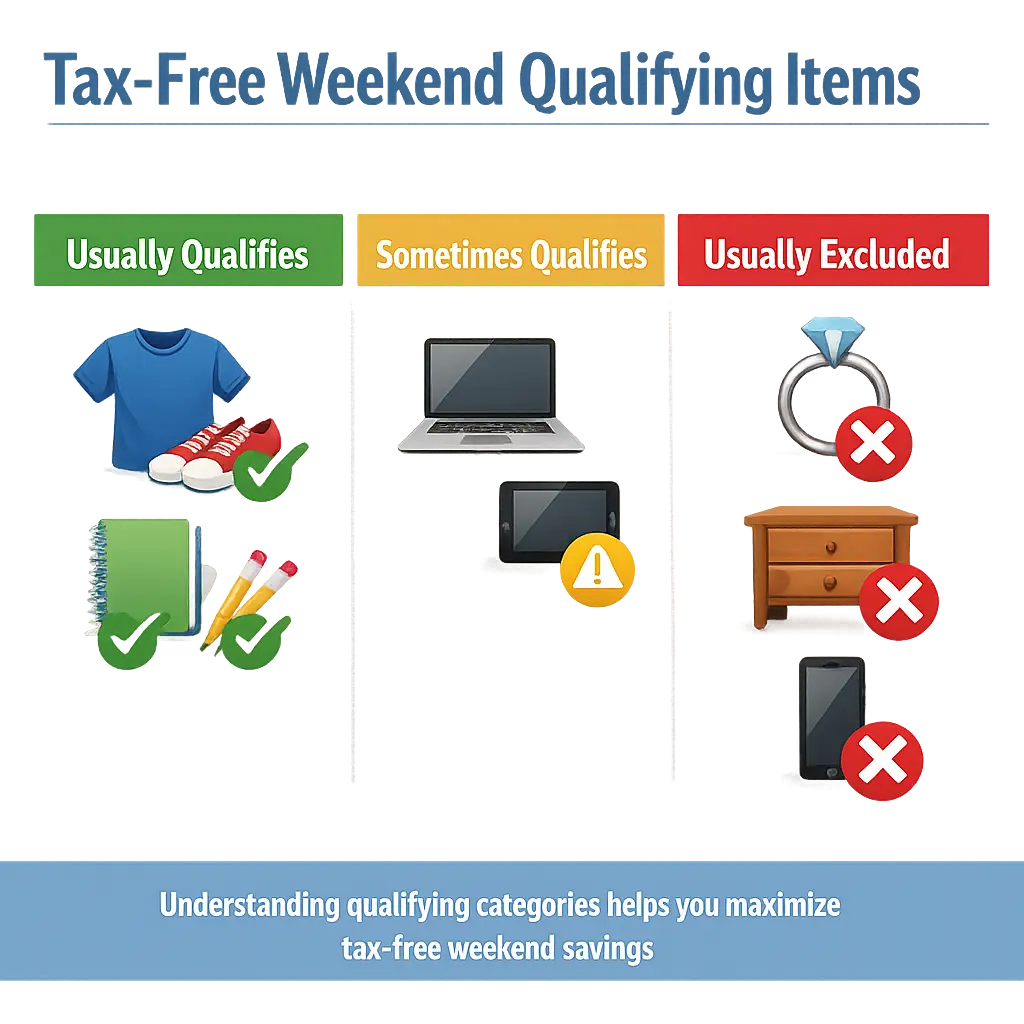
Understanding category definitions prevents checkout confusion. States provide specific guidance documents defining qualifying items.
Clothing and Footwear
Generally qualifies:
- Shirts, blouses, t-shirts
- Pants, jeans, shorts
- Dresses, skirts
- Underwear, socks
- Shoes, sneakers, boots, sandals
- Jackets, coats
- Sleepwear
Generally excluded:
- Jewelry
- Watches
- Handbags and purses
- Wallets
- Belt buckles sold separately
- Cosmetics
- Hair accessories
- Athletic/protective equipment (helmets, pads)
- Rental clothing
Gray areas requiring state verification:
- Costumes
- Uniforms
- Athletic clothing (yoga pants, running shorts)
- Work boots/safety shoes
- Accessories (belts, ties, scarves)
School Supplies
Generally qualifies:
- Pens, pencils, erasers
- Crayons, markers, colored pencils
- Notebooks, composition books
- Loose-leaf paper, folders
- Binders, dividers
- Rulers, protractors, compasses
- Calculators (non-graphing typically)
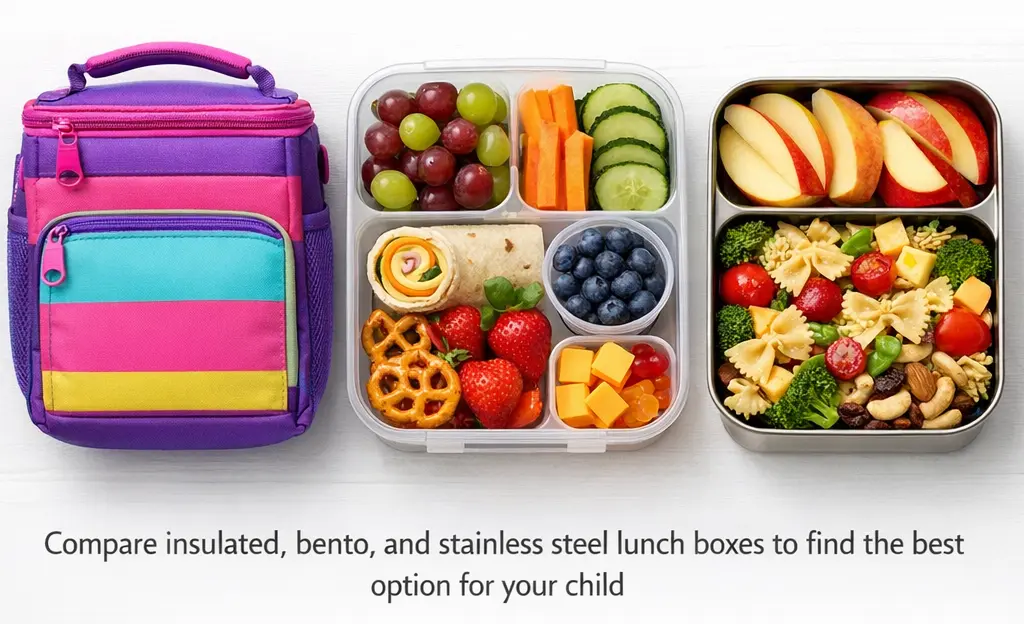
- Lunchboxes
- Scissors, glue, tape
Generally excluded:
- Furniture (desks, chairs)
- Electronic devices (phones, tablets—unless specifically included)
- Software (unless specifically included)
- Printers and printer supplies
- Books (unless specifically included)
- Musical instruments
Computers and Electronics
States that include computers typically define:
Qualifying items:
- Laptop computers
- Desktop computers
- Tablets (in some states)
- Computer monitors
- Keyboards and mice
- Routers and modems (in some states)
- Computer software (in some states)
Price limits vary widely:
- Low end: $750 (Alabama)
- Mid range: $1,000-$1,500 (most states)
- Specific components: Separate limits for peripherals
Common exclusions:
- Smartphones
- Smartwatches
- Gaming consoles
- Digital cameras
- Furniture/desks
- Computer repair services
Special Categories
Energy Star/Energy Efficient Appliances:
Some states offer separate tax holidays for Energy Star certified appliances with price limits ranging from $2,500-$6,000.
Disaster Preparedness:
Florida offers a separate disaster preparedness tax holiday covering generators, batteries, flashlights, tarps, and emergency supplies.
Price Limits and Restrictions
Price limits determine whether items receive full exemption, partial exemption, or no exemption.
How Price Limits Work
Per-item pricing: Most states apply limits per individual item, not per transaction.
Example: In a state with a $100 clothing limit:
- One jacket priced at $95 = tax free
- One jacket priced at $105 = fully taxable (not tax free on first $100)
- Five shirts at $20 each = all five are tax free
Bundle pricing: When similar items are sold as a set:
- Some states tax the entire bundle if the combined price exceeds the limit
- Other states allow separation if items are normally sold individually
- State guidance documents clarify specific scenarios
Buy-one-get-one offers:
Tax treatment depends on how the retailer structures the discount:
- If both items are free-standing purchases, each is evaluated separately
- If structured as a single transaction, some states evaluate the total
Common Price Thresholds
Clothing:
- $75 per item: Ohio
- $100 per item: Most states (Alabama, Arkansas, Florida, Iowa, Maryland, Mississippi, Missouri, Oklahoma, Tennessee, Texas, Virginia)
- $125 per item: West Virginia
- No limit: South Carolina
School Supplies:
- $20 per item: Ohio, Virginia, West Virginia
- $30 per item: New Mexico
- $50 per item: Alabama, Arkansas, Florida, Missouri
- $100 per item: Tennessee
- No limit: Arkansas (certain categories), South Carolina
Computers:
- $750: Alabama
- $1,000: New Mexico
- $1,500: Florida, Missouri, Tennessee
- Component limits: Some states set separate thresholds for peripherals
Tax Free Weekend for Online Shopping
Online purchases qualify in most states if ordered and paid during the tax holiday period.
Online Purchase Rules
Timing requirements:
Most states consider an online purchase exempt if:
- Order is placed during the tax holiday window
- Payment is processed during the tax holiday window
- Item qualifies under state category and price rules
Shipping considerations:
- Shipping charges generally don’t affect item price for qualification purposes
- Some states clarify that items shipping after the holiday still qualify if ordered during the window
Mixed shopping carts:
When your online cart contains both qualifying and non-qualifying items:
- Qualifying items receive exemption
- Non-qualifying items remain taxable
- Retailers should separate tax application item-by-item
Retailer Participation
National retailers: Major online retailers typically program systems to recognize tax holidays in states where they have nexus (tax collection obligation).
Small retailers: Some smaller online sellers may not have systems configured for temporary tax holidays. Contact customer service to verify.
Marketplace facilitators: Platforms like Amazon, eBay, and Etsy typically handle tax holiday exemptions for sellers using their platforms in participating states.
Pick-up orders: Buy-online-pickup-in-store orders typically qualify if both order placement and pickup occur during the holiday period. State rules vary on timing requirements.
Strategic Shopping Planning
Maximizing tax holiday benefits requires advance planning and strategic purchase timing.
High-Value Purchase Strategy
Focus tax free shopping on items with:
- High price points (computers, multiple clothing items)
- Necessary purchases you planned anyway
- Bulk quantity needs (multiple children’s wardrobes)
Calculation example:
Family with three school-age children in a state with 7% sales tax:
- Child 1 clothing: $300
- Child 2 clothing: $300
- Child 3 clothing: $300
- School supplies (all children): $200
- Two laptops for high schoolers: $2,000
Total qualifying purchases: $3,100
Tax savings at 7%: $217
Pre-Holiday Preparation
Four weeks before:
- Inventory current clothing, supplies, and technology
- Create needs list with estimated prices
- Research which items qualify in your state
- Sign up for retailer email lists for holiday promotions
Two weeks before:
- Compare prices across retailers
- Check return policies
- Verify price limits for big-ticket items
- Create prioritized shopping list
During tax holiday:
- Shop early in the weekend for best selection
- Bring measurements for clothing
- Keep receipts organized
- Verify tax removal on receipts before leaving store
Combining Savings Strategies
Stackable savings opportunities:
- Tax exemption (4-9% depending on state)
- Back-to-school sales (often coincide with tax holidays)
- Store coupons and promotions
- Credit card rewards (1-5% back)
- Cash-back shopping portals (2-10% back)
Example scenario:
$100 jeans in a state with 7% sales tax
- Regular price with tax: $107
- Tax holiday price: $100 (save $7)
- Additional 20% store sale: $80 (save $20)
- 5% credit card rewards: $4 back
- Total effective price: $76
- Total savings: $31 (29% off)
Items to Prioritize
Best tax holiday purchases:
- Computers and technology (high price, high tax)
- Winter coats and outerwear (expensive, necessary)
- Multiple pairs of shoes (add up quickly)
- Full wardrobe restocking (quantity savings)
- Graphing calculators (if qualifying)
Skip or buy outside tax holiday:
- Items on clearance that won’t last until tax holiday
- Items you need immediately (before tax holiday dates)
- Items already deeply discounted (bigger than tax savings)
- Non-qualifying categories with better sales at other times
Common Mistakes to Avoid
Understanding frequent errors helps you maximize benefits and avoid frustration.
Mistake 1: Assuming All Items Are Tax Free
The problem: Shoppers assume entire purchases qualify without checking category and price rules.
The consequence: Surprise tax charges at checkout, budget overruns.
The solution: Before shopping, review your state’s specific qualifying items and price limits. When in doubt, ask the retailer before checkout.
Mistake 2: Exceeding Price Thresholds
The problem: Purchasing a $110 item in a state with a $100 limit, expecting tax exemption on the first $100.
The consequence: Full tax applies to the entire purchase price.
The solution: Know your state’s exact price limits. Choose items just under the threshold, or split purchases into multiple qualifying items.
Mistake 3: Forgetting Local Taxes
The problem: Expecting complete tax elimination without verifying local tax participation.
The consequence: Still paying 1-3% in local taxes while expecting zero tax.
The solution: Contact local revenue authorities to verify whether your city or county participates in the state tax holiday.
Mistake 4: Missing Online Order Deadlines
The problem: Adding items to an online cart during the tax holiday but completing purchase after the window closes.
The consequence: Full tax applies despite shopping during the holiday period.
The solution: Complete the entire transaction (order and payment) before the tax holiday end time. Don’t assume midnight; verify exact cutoff times.
Mistake 5: Misunderstanding Business Purchases
The problem: Business owners attempting to purchase inventory or resale items during tax holidays.
The consequence: Purchases are taxable because tax holidays apply to personal use, not business purposes.
The solution: Tax holidays generally exempt personal use purchases only. Business purchases require proper resale certificates through normal channels.
Mistake 6: Ignoring Better Non-Holiday Deals
The problem: Purchasing items during tax holidays that are more discounted at other times.
The consequence: Missing better overall savings.
The solution: Compare tax holiday pricing with Black Friday, end-of-season clearance, and other promotional periods. Sometimes a 40% off sale beats a 7% tax savings.
Mistake 7: Purchasing Unnecessary Items
The problem: Buying items you don’t need simply because they’re tax free.
The consequence: Spending money wastefully despite the tax savings.
The solution: Stick to your planned needs list. A tax free purchase you don’t need is still wasted money.
Maximizing Your Savings
Advanced strategies compound your tax holiday benefits.
Multi-State Shopping
If you live near state borders:
- Compare participating states’ dates and rules
- Identify which state offers better exemptions for your needs
- Verify that purchasing in another state is practical (gas, time, selection)
- Understand use tax obligations (you may owe use tax in your home state on items purchased in another state)
Price Matching Opportunities
Some retailers offer price matching during tax holidays:
- Research competitor prices before shopping
- Bring proof of lower prices (smartphone screenshots work)
- Understand each retailer’s price match policy
- Combine price matching with tax exemption for double savings
Retailer-Specific Strategies
Department stores: Often run concurrent back-to-school sales with additional coupon offers.
Office supply stores: May offer loss-leader pricing on popular items plus rewards program benefits.
Online retailers: Free shipping thresholds may align with tax holiday purchases.
Outlet stores: Already-reduced prices plus tax exemption create substantial savings.
Gift Card Timing
Before tax holiday:
Purchase discounted gift cards (from grocery rewards, gift card exchanges) to use during tax holiday.
During tax holiday:
Some states exempt gift card purchases from sales tax. Verify state rules, as most states consider gift cards non-taxable regardless.
Warranty and Service Plans
Important distinction:
- Product purchase may be tax-exempt
- Extended warranty or service plan may be taxable
- Some states exempt warranties during tax holidays if sold with qualifying products
- Verify whether warranties/service plans qualify in your state
Special Category Tax Holidays
Some states offer additional tax holidays beyond back-to-school events.
Energy Efficiency Tax Holidays
Participating states: Florida, Georgia (when active), Virginia
Typical qualifying items:
- Energy Star certified appliances
- WaterSense labeled products
- Programmable thermostats
- Energy-efficient light bulbs
- Energy Star HVAC systems
Price limits: Usually $2,500-$6,000 depending on product category
Environmental benefit: Encourages consumer purchases that reduce energy consumption and environmental impact.
Disaster Preparedness Tax Holidays
Primary state: Florida (annually before hurricane season)
Typical qualifying items:
- Portable generators ($3,000 or less)
- Tarps and tie-down kits ($100 or less)
- Battery-powered radios ($50 or less)
- Fire extinguishers ($70 or less)
- Smoke detectors and alarms ($70 or less)
- Batteries and flashlights (various limits)
- Coolers and ice ($60 or less)
Timing: Usually late May or early June, before peak hurricane season
Second Amendment Tax Holidays
States: Louisiana, Mississippi, South Carolina (periodically)
Typical qualifying items:
- Firearms
- Ammunition
- Hunting supplies
- Safety equipment
Purpose: Promote constitutional rights and outdoor recreation
Gun Safe/Safety Equipment Tax Holidays
Separate from general firearms holidays:
Some states offer specific exemptions for gun safes, trigger locks, and safety equipment to promote responsible ownership.
Business vs. Personal Purchases
Tax holidays apply to personal consumer purchases, not business transactions.
Personal Use Qualification
Qualifies for tax exemption:
- Clothing for personal/family use
- School supplies for your children
- Computer for personal home use
- Items for personal consumption
Does not qualify:
- Inventory for resale
- Supplies for business operations
- Equipment for professional use
- Items purchased with intent to resell
Teacher Purchases
Special consideration:
Teachers purchasing classroom supplies face a gray area:
- Some states explicitly allow teacher purchases for classroom use
- Other states limit exemption to personal use only
- Teachers should verify state-specific guidance
- Keep receipts and documentation for tax deduction purposes (separate from sales tax holiday)
Federal teacher tax deduction:
Remember that teachers can deduct up to $300 in unreimbursed classroom expenses on federal taxes (separate benefit from state sales tax holidays).
Business Owner Guidance
Business owners cannot use tax holidays to avoid sales tax on:
- Office equipment
- Computers for business use
- Inventory
- Supplies for business operations
Proper approach:
Business purchases require standard resale certificates or exemption certificates through normal tax processes, not temporary tax holidays.
Future of Tax Free Weekends
Tax holiday participation fluctuates based on state budget priorities and economic conditions.
Current Trends
Expansion indicators:
- Some states extending duration (weekend to full week)
- Additional category holidays (energy efficiency, disaster prep)
- Increased price thresholds over time
Contraction indicators:
- States suspending programs during budget shortfalls
- Debate over economic effectiveness
- Revenue department administrative costs
Legislative Considerations
State legislatures weigh multiple factors:
Arguments for tax holidays:
- Direct consumer relief
- Economic stimulus for retail sector
- Political popularity
- Targeted assistance for families with children
Arguments against tax holidays:
- Revenue loss to state budgets
- Administrative complexity for retailers
- Regressive benefit (helps those already able to purchase)
- Questionable economic impact (may shift timing rather than increase spending)
Economic Research
Studies on tax holiday effectiveness show mixed results:
- Consumer behavior: Purchases concentrate during holiday but may represent shifted timing rather than new spending
- Retail impact: Retailers report increased traffic but unclear long-term benefit
- Revenue impact: States forgo revenue with uncertain economic return
- Consumer savings: Clear direct benefit to participating families
Most likely future scenario: Fluctuating participation with some states maintaining permanent annual holidays while others adopt, suspend, or discontinue based on budget conditions.
COMPARISON TABLES
State Tax Holiday Comparison
| State | Typical Dates | Clothing Limit | School Supplies Limit | Computer Limit | Duration |
|---|---|---|---|---|---|
| Alabama | 3rd weekend July | $100 | $50 | $750 | 3 days |
| Arkansas | 1st weekend August | $100 | No limit | N/A | 2 days |
| Connecticut | One week August | $100 | N/A | N/A | 7 days |
| Florida | Late July/Early Aug | $100 | $50 | $1,500 | 3 days |
| Iowa | 1st Fri-Sat August | $100 | N/A | N/A | 2 days |
| Maryland | 2nd weekend August | $100 | N/A | N/A | 7 days |
| Massachusetts | Weekend August | N/A | N/A | N/A* | 2 days |
| Mississippi | Last Fri-Sat July | $100 | N/A | N/A | 2 days |
| Missouri | 1st weekend August | $100 | $50 | $1,500 | 3 days |
| New Mexico | 1st weekend August | $100 | $30 | $1,000 | 3 days |
| Ohio | 1st weekend August | $75 | $20 | N/A | 3 days |
| Oklahoma | 1st weekend August | $100 | N/A | N/A | 3 days |
| South Carolina | 1st weekend August | No limit | No limit | No limit | 3 days |
| Tennessee | Last weekend July | $100 | $100 | $1,500 | 3 days |
| Texas | Weekend August | $100 | $100 | N/A | 3 days |
| Virginia | 1st weekend August | $100 | $20 | N/A | 3 days |
| West Virginia | 1st weekend August | $125 | $20 | $500** | 3 days |
*Massachusetts: $2,500 limit on most items (not category-specific)
**West Virginia: Applies to laptops/tablets
Savings Potential by State Tax Rate
| State | Sales Tax Rate | Tax Savings on $100 | Tax Savings on $1,000 | Tax Savings on $2,000 |
|---|---|---|---|---|
| Alabama | 4% | $4 | $40 | $80 |
| Arkansas | 6.5% | $6.50 | $65 | $130 |
| Connecticut | 6.35% | $6.35 | $63.50 | $127 |
| Florida | 6% | $6 | $60 | $120 |
| Iowa | 6% | $6 | $60 | $120 |
| Maryland | 6% | $6 | $60 | $120 |
| Massachusetts | 6.25% | $6.25 | $62.50 | $125 |
| Mississippi | 7% | $7 | $70 | $140 |
| Missouri | 4.225% | $4.23 | $42.25 | $84.50 |
| New Mexico | 5.125% | $5.13 | $51.25 | $102.50 |
| Ohio | 5.75% | $5.75 | $57.50 | $115 |
| Oklahoma | 4.5% | $4.50 | $45 | $90 |
| South Carolina | 6% | $6 | $60 | $120 |
| Tennessee | 7% | $7 | $70 | $140 |
| Texas | 6.25% | $6.25 | $62.50 | $125 |
| Virginia | 5.3% | $5.30 | $53 | $106 |
| West Virginia | 6% | $6 | $60 | $120 |
Note: Local taxes may apply in addition to state rates
CHECKLISTS
Pre-Tax Holiday Planning Checklist
4 Weeks Before:
- Verify your state participates in tax free weekend
- Note exact dates and times for tax holiday
- Review qualifying item categories for your state
- Check price limits for clothing, supplies, and computers
- Inventory current clothing, shoes, and supplies
- Measure children for accurate clothing sizes
- Create needs list by category
- Set shopping budget
- Research retailer return policies
2 Weeks Before:
- Compare prices across multiple retailers
- Sign up for retailer email lists for additional coupons
- Check if local taxes still apply in your area
- Purchase discounted gift cards if available
- Create prioritized shopping list
- Plan shopping route/schedule
- Verify which online retailers participate
- Check credit card rewards programs
During Tax Holiday:
- Shop early for best selection
- Bring measurements and size information
- Verify tax removal on each receipt
- Keep all receipts organized
- Check online order confirmation shows tax exemption
- Take advantage of additional sales/coupons
- Review purchases before leaving store
- Complete online orders before deadline
After Tax Holiday:
- Calculate total tax savings
- Organize receipts for potential returns
- Note lessons learned for next year
- Mark calendar for next year’s tax holiday
Back-to-School Shopping List
Clothing (Per Child):
- Pants/jeans (quantity: ___)
- Shorts (quantity: ___)
- Shirts/tops (quantity: ___)
- Dresses/skirts (quantity: ___)
- Shoes – everyday (quantity: ___)
- Shoes – athletic (quantity: ___)
- Underwear (quantity: ___)
- Socks (quantity: ___)
- Jacket/coat (quantity: ___)
- Sleepwear (quantity: ___)
School Supplies:
- Backpack
- Lunch box
- Pencils
- Pens
- Erasers
- Notebooks
- Folders
- Binders
- Loose-leaf paper
- Crayons/markers/colored pencils
- Scissors
- Glue/glue sticks
- Ruler
- Calculator
- Highlighters
- Index cards
Technology:
- Laptop/computer
- Tablet (if qualifying)
- Computer mouse
- Laptop case/bag
- Software (if qualifying)
- Headphones
- USB drive
Price Check Each Item:
- Verify each item under price limit
- Check if item qualifies in your state
- Compare prices across retailers
- Look for additional coupons/sales
DECISION FRAMEWORKS
Should You Wait for Tax Free Weekend? Decision Tree
Start Here: Do you need the item before the tax holiday?
- YES → Purchase now (need trumps savings)
- NO → Continue to next question
Is your state currently participating in tax free weekend?
- NO → Don’t wait; purchase when convenient
- YES → Continue to next question
Does the item category qualify in your state?
- NO → Don’t wait; purchase when convenient
- YES → Continue to next question
Is the item price under your state’s limit?
- NO → Don’t wait; purchase when convenient
- YES → Continue to next question
Is there a current sale/discount larger than the tax savings?
- YES, and sale won’t last until tax holiday → Purchase now
- NO, or sale continues through tax holiday → Continue to next question
Can you wait 2-6 weeks for the item?
- NO → Purchase now
- YES → Wait for tax free weekend
Final calculation:
Compare tax savings vs. current available discounts
- Tax savings > current discount → Wait
- Current discount > tax savings → Purchase now
- Roughly equal → Consider convenience and need urgency
Maximize Savings Decision Framework
For each purchase, ask:
Question 1: Does tax exemption provide the best available discount?
- Calculate tax savings (item price × state tax rate)
- Compare to available sales, coupons, clearance prices
- Choose option with greatest savings
Question 2: Can I combine savings strategies?
- Tax exemption + store sale = YES (stackable)
- Tax exemption + manufacturer coupon = YES (stackable)
- Tax exemption + credit card rewards = YES (stackable)
- Tax exemption + cash-back portal = YES (stackable)
- Tax exemption instead of better single discount = NO (choose best option)
Question 3: Is this a high-value purchase?
- Computer/technology over $1,000 = High priority for tax holiday
- Multiple clothing items totaling $300+ = High priority
- Single low-cost items = Low priority (minimal savings)
Question 4: Is this a planned necessity or impulse?
- Planned necessity = Good tax holiday purchase
- Impulse buy = Skip (saving on unneeded items wastes money)
Question 5: What’s my opportunity cost?
- Time spent shopping during crowded tax holiday
- Potential better deals at other times of year
- Immediate need for the item
- Selection availability during high-traffic period
Optimal purchase profile:
- Planned purchase of qualifying item
- Price under state limit
- High total value ($200+)
- No better discount currently available
- Can stack with additional sales/rewards
- Item available in stock during tax holiday
FAQs
1. What is tax free weekend and how does it work?
Tax free weekend is a designated period when participating states suspend sales tax collection on specific categories of items, typically clothing, school supplies, and computers. The tax exemption applies automatically at checkout when you purchase qualifying items during the specified dates. No coupons, applications, or special requests are required. Retailers remove state sales tax from qualifying purchases, and shoppers save an amount equal to their state’s sales tax rate (typically 4-9%) on eligible items. Each state sets its own dates, qualifying categories, and price limits. The exemption applies to both in-store and online purchases completed during the tax holiday window.
2. Which states have tax free weekends?
Seventeen states currently offer sales tax holidays: Alabama, Arkansas, Connecticut, Florida, Iowa, Maryland, Massachusetts, Mississippi, Missouri, New Mexico, Ohio, Oklahoma, South Carolina, Tennessee, Texas, Virginia, and West Virginia. Participation can change based on state legislative decisions and budget priorities. Some states have suspended programs temporarily while others maintain annual tax holidays. Five states (Alaska, Delaware, Montana, New Hampshire, Oregon) have no sales tax at all, so they don’t need tax free weekends. If you’re unsure about your state’s participation, check your state’s revenue department website for current information.
3. When is tax free weekend?
Tax free weekend dates vary by state but typically occur in late July through early August to coincide with back-to-school shopping. Most states designate a three-day weekend (Friday through Sunday), though some offer two-day periods and others extend to a full week. Connecticut and Maryland typically offer week-long tax holidays. Florida offers multiple tax holidays throughout the year, including back-to-school and disaster preparedness events. Exact dates change annually, so verify your state’s specific dates each year. State revenue department websites publish official tax holiday schedules, usually several months in advance.
4. What items qualify for tax free weekend?
Qualifying items vary by state but commonly include clothing, footwear, school supplies, and sometimes computers or electronics. Most states set price limits—typically $100 per clothing item, $50 per school supply item, and $750-$1,500 for computers. Items that generally qualify include shirts, pants, shoes, notebooks, pens, pencils, backpacks, and in some states, laptops and tablets. Items typically excluded include jewelry, accessories, handbags, cosmetics, furniture, and rental items. South Carolina has no price limits on qualifying categories. Each state publishes detailed lists defining qualifying items and exclusions, which you should review before shopping.
5. Does tax free weekend apply to online shopping?
Yes, tax free weekend applies to online purchases in most participating states, provided the order is placed and payment is processed during the tax holiday window. The item must qualify under your state’s category and price limit rules, and the online retailer must have nexus (tax collection obligation) in your state. Major national retailers typically program their systems to recognize tax holidays automatically. Shipping charges don’t affect whether an item qualifies, and items shipping after the holiday still receive exemption if ordered during the window. Verify tax removal on your order confirmation before finalizing the purchase. Buy-online-pickup-in-store orders usually qualify if both ordering and pickup occur during the holiday period.
6. Are there price limits on tax free items?
Yes, most states impose price limits on qualifying items. Common limits include $100 per clothing or footwear item, $50 per school supply item, and $1,500 per computer. If an item exceeds the price limit, the entire purchase becomes taxable, not just the amount over the threshold. For example, in a state with a $100 clothing limit, a $105 jacket is fully taxable. Price limits apply per item, not per transaction, so you can purchase multiple qualifying items in one transaction. South Carolina stands out by having no price limits on qualifying categories. Ohio has a lower clothing limit at $75 per item, while West Virginia has a higher limit at $125 per item.
7. Can I use coupons during tax free weekend?
Yes, you can typically combine tax exemption with manufacturer coupons, store coupons, and sales promotions. Tax free weekend doesn’t restrict other discounts. Many retailers strategically run back-to-school sales concurrent with tax holidays, allowing you to stack discounts. For example, you might use a 20% off coupon on an item that’s also tax-exempt, compounding your savings. Credit card rewards, cash-back shopping portals, and loyalty program benefits also stack with tax exemption. The item’s price after coupons determines whether it falls under the state’s price limit. Always check individual retailer policies, as coupon terms vary, but tax holiday participation doesn’t typically restrict coupon usage.
8. Do local taxes apply during tax free weekend?
It depends on your specific locality. While the state sales tax is waived during tax free weekends, local jurisdictions (cities and counties) may choose whether to participate. Some localities waive local taxes during the state tax holiday, while others continue collecting local sales tax. This means you might still pay 1-3% in local taxes even during a state tax holiday. Check with your city or county revenue department to verify local participation. State revenue departments often publish lists of participating and non-participating localities. Even partial tax savings (state only) provides meaningful benefit, typically representing the majority of total sales tax.
9. How much money can I save during tax free weekend?
Savings equal your state’s sales tax rate multiplied by your total qualifying purchases. In a state with 7% sales tax, spending $1,000 on qualifying items saves $70. For families with multiple school-age children, typical savings range from $50-$300 depending on purchase volume and state tax rate. Higher tax states (Tennessee and Mississippi at 7%) offer greater savings than lower tax states (Missouri at 4.225%). The savings increase when you stack tax exemption with sales, coupons, and credit card rewards. For maximum benefit, concentrate high-value purchases (computers, complete wardrobes for multiple children) during the tax holiday rather than spreading purchases throughout the year.
10. Can teachers buy classroom supplies tax free?
Rules vary by state. Some states explicitly allow teachers to purchase classroom supplies tax free during sales tax holidays, while others limit exemption to personal use only. Teachers should verify their specific state’s guidance. Even when allowed, teachers must still meet item category and price limit requirements. Remember that teachers can separately claim up to $300 in unreimbursed classroom expenses on federal tax returns (educator expense deduction), which is a different benefit from state sales tax holidays. Keep detailed receipts for both purposes. Some states recognize the distinction between personal purchases and professional educator purchases in their tax holiday guidance documents.





Leave a Reply